True/False Film Festival: Secret Mall Apartment director turns to South Korea with the heartbreaking/heartwarming School for Defectors

True/False is an annual festival in Columbia, Missouri, MO, that celebrates the best of nonfiction (and nonfiction-adjacent) filmmaking. Our film editor, Abby Olcese, is covering the event’s 23rd year, and all her dispatches can be found here.
Secret Mall Apartment director Jeremy Workman is no stranger to outsiders, but School for Defectors takes that interest in a different direction. This time, Workman isn’t filming ambitious squatters, urban adventurers or even domino race champions, like he did with The World Before Your Feet or Lily Topples the World. Workman’s latest film explores the experiences of high schoolers in South Korea whose parents are North Korean defectors.
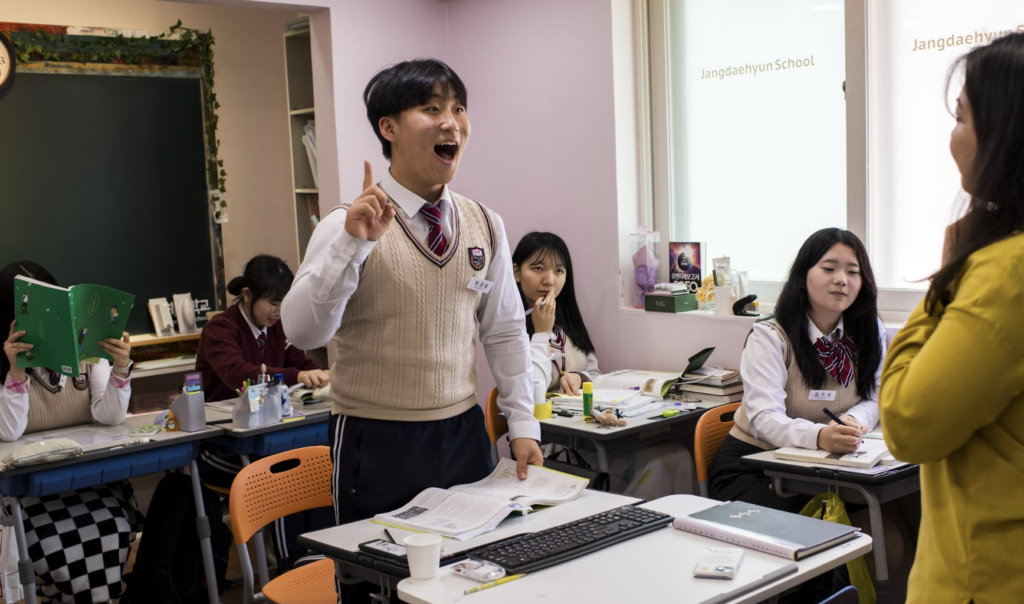
There’s a stigma of weakness and dependency attached to North Korean defectors in South Korea that makes it difficult for their children to go to school without that aspect becoming their entire identity. At the country’s speciality schools for defectors, these kids are freer to be themselves and to focus on healthy integration into a new culture. Busan’s Jangdaehyun School, the film’s subject, is the only boarding school in this educational subset.
School for Defectors is clever (though not cynically so) in how it gets you to care so deeply about these kids. For the first third of the film, it just follows them around. There’s Philip, the class clown and student body president, Yoojung, who’s intent on getting into a good college, and Jinhee, who wants to understand her mother’s experience in North Korea—where citizens are essentially forced into government slave labor—more fully. These kids aren’t terribly different from teenagers you’d meet in a high school in the U.S. They goof around, work on school projects, and giggle in the dormitories.
That’s when the film’s final two-thirds kick in, and the waterworks start.
When the kids go home for break, Workman introduces us to their parents (some of whom still have to be blurred out for their safety), and we learn about the insane measures it took to get them into South Korea. Jinhee’s mother, Mae, went to China in search of work and was trafficked. Philip’s parents, who brought Philip over at age 5, had to leave his older brother and grandmother behind. Yoojung’s father tells the harrowing story of how Yoojung’s birth convinced him to defect, and details the intense choices he had to be willing to make in case the family was caught.
In some documentaries, this could be construed as manipulative. Not here.
Workman details these circumstances to give you a fuller picture of what these kids have had to overcome to become the relatively happy, well-adjusted teenagers we see. Much of that lies at the feet of the faculty and administration of Jangdaehyun School, who prioritize social well-being over academics, and seem deeply invested in their students. Watching a teen girl get into college is one thing. Watching them get into their dream school after we just heard her father recount agonizing over what he’d have to do if they didn’t make it to South Korea in the first place is something totally different.
Workman’s playful sensibility as a director helps School for Defectors focus primarily on hope and joy, which welcomes the audience in and buoys them right along, even as we learn about the dire circumstances the film’s subjects had to escape. We aren’t left worrying what’s going to happen to these kids after they graduate; it’s clear they’re going to be fine.
It’s all the work that goes into ensuring they’ll be fine that makes it such a moving experience.
School for Defectors is the kind of movie that makes you appreciate teachers, counselors, and everyone who puts their energy into shaping the future of the world. It gives you a glimmer of hope for humanity as a whole.
You’ll probably cry a lot, but think of it like a cleanse. You’re going to feel pretty good afterward.