True/False Film Festival: Broken English gives Marianne Faithfull her flowers

Courtesy True/False Film Festival
True/False is an annual festival in Columbia, Missouri, MO, that celebrates the best of nonfiction (and nonfiction-adjacent) filmmaking. Our film editor, Abby Olcese, is covering the event’s 23rd year, and all her dispatches can be found here.
Artist documentaries can be hard to make compelling. There are only so many paths you can take—do you let the work speak for itself? Go the talking head route, where everyone talks about how great the artist is? Usually, the end result feels like many artist biopics do: feigning complexity and fawning over surface-level observations.
There is, it turns out, another way to do it, the way Broken English, Ian Forsyth and Jane Pollard’s clever documentary on 60s counterculture icon Marianne Faithfull, does: Blow everything up, combine tribute, analysis and interviews, and add a fictional framework that weaves everything together. It works like a slice of bacon wrapped around a filet mignon: not strictly necessary, probably overkill, but undeniably tasty.
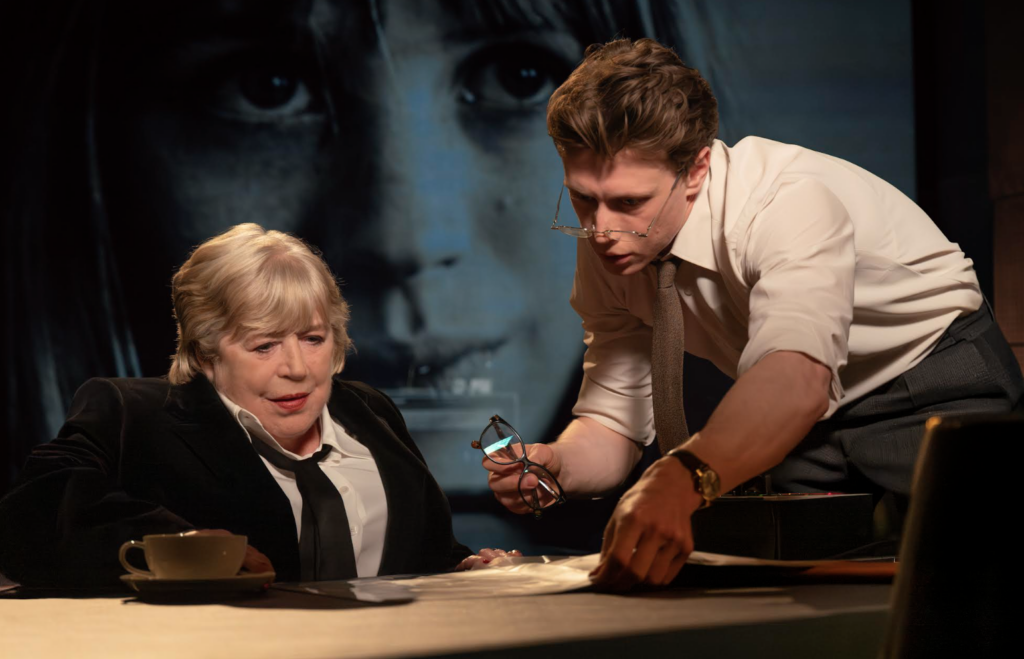
Forsyth and Pollard (who brought a similar hybrid approach to their Nick Cave documentary 20,000 Days on Earth) couch their portrait of Faithfull in the context of the fictional Institute for Not Forgetting, an office dedicated to creating the fullest record possible of its subjects, as people and as ideas. The Overseer (Tilda Swinton) introduces us to this concept, and to a Record Keeper (George McKay), who interviews Faithfull about her life.
Two researchers (Zawe Ashton and Sophia Di Martino) analyze some of the more infamous stories about the singer-songwriter, including her relationship with Mick Jagger and 1969 drug overdose and subsequent coma. Portishead’s Adrian Utley oversees a kind of recording booth of dreams where artists including Beth Orton, Courtney Love and Thurston Moore cover Faithfull tunes like “As Tears Go By” and “Sister Morphine.”
The result is a deeply compassionate portrait that lets Faithfull herself take center stage, with the surrounding performances and conversations creating context. In addition to being a formidable songwriter and performer, Faithfull was a Zelig-like figure of the swinging 60s. She relates stories of hanging out with Allen Ginsberg, Bob Dylan and the Rolling Stones with wit and candor. McKay may be interviewing Faithfull in character, but he looks genuinely enraptured. It’s hard to fault him—Faithfull is at the end of her life here (she died in 2025, while Broken English was still in production), but her charm is still operating at full capacity.
If you, like me, come to Broken English only knowing about Faithfull via her relationship to the Stones (or know nothing about her at all) Forsyth and Pollard have that covered, too. A roundtable of female artists, including filmmaker Sophie Fiennes and musician Natasha Khan (Bat for Lashes), discuss the cultural double standards and misogyny that dogged Faithfull—and women artists like her—throughout her career. Their conversation helps present a clearer picture of a woman whose formidable accomplishments and outspoken feminism were overshadowed by harsh judgment rarely heaped on her male contemporaries.
It’s true the establishing framework of Broken English can feel a little precious, but it’s ultimately a spoonful of sugar to engage wider audiences, which it does with aplomb. With their film, Forsyth and Pollard have created a “Marianne Faithfull 101” course that gives fans a little more context, and newcomers a deeper appreciation for an artist who more than deserves it. It is a true celebration of a life that considers its subject as a full person, as well as representative of a time and place. Forsyth and Pollard are enamored with their subject. By the end of the film, you probably will be, too.

Courtesy True/False Film Festival