MTH’s Moby Dick distills a dense literary tome into breezy sea shanties

Photo by Cory Weaver
There are a few inherent threats that spring to mind when you buy a ticket for a musical based on Herman Melville’s Moby-Dick. The first is, of course, that an adaptation of one of the longest books you were assigned in high school will not make for a quick evening. The second, which piles atop the first, is that musical adaptations rarely make a story go quicker. This all goes to say that, at a mere two hours, the latest show at Music Theater Heritage sailed breezily under the six-hour runtime I’d conjured in my head. Thankfully, the show is stellar enough to make me believe I would’ve been fine with triple the clock.
Moby Dick: A Sea Shanty, written and directed by MTH’s Artistic Director Tim Scott, is a precarious beast of an undertaking. A live band takes the stage, then ushers the cast into the world of their fictional bar at closing time. A sailor who refuses to leave has brought the ghosts of his dead crewmates into the pub, and the chosen method of exorcism is through the language of sea shanties.
Unlike the title’s wording, you needn’t fear that this is one long sea shanty, delivered a la epic poem, but rather a full evening’s rotation of sub-genres and tones—none ever veering too far in the repetitive, none overstaying their welcome, and none taking an obvious course.

Photo by Cory Weaver
Scott’s world premiere adaptation takes a number of artistic gambits, and almost all the choices landed direct hits for me. The wrap-around bar sequence from this introduction is one of the few misses. It is a perfectly acceptable system for introducing the ways and means of why the whale’s tale must be wailed, but it also sets us to sea in a clunky start. When the unnamed sailor turns to the audience to deliver the line “Call me Ishamael!” with a wink and a smile, my stomach did tighten at the fear we’d be taking a more capital-M ‘Musical’ approach to the material. (It doesn’t; I mark myself safe.) But it does give away the game that Scott’s show has an odd set of tonal choices, and a rhythm that keeps you on uncertain footing. At first, I found it distracting, but with some time and distance since watching our evening’s performance, I’ve come to appreciate what the show is stretching toward.
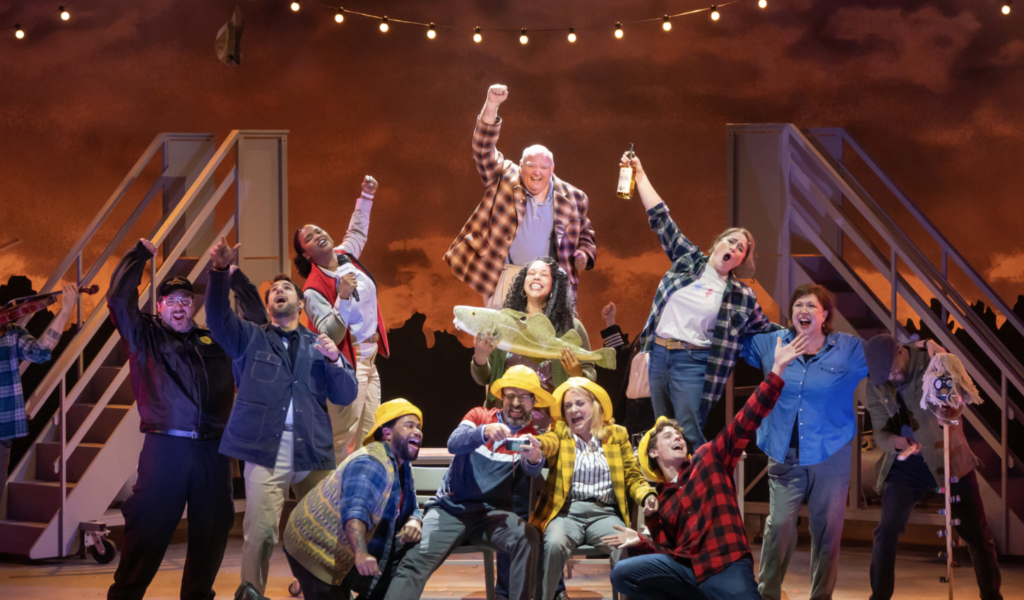
From the jump, the adaptation moves to establish the setting, the whaling industry, the ship, and quickly sprawls into handing the narrative off to the full crew. While our good captain is kept mostly in whispers until much later, the decision to let our “narrator” become less of a focus does a great service to keeping the rest of the journey bounce between perspectives—and by extension, musical interpretations.

Photo by Cory Weaver
T. Eric Morris’ Ishmael and Manon Halliburton’s Ahab are formidable performances, that also know when to let themselves blend into the company when the show calls for it. A series of wildly impressive set rotations and some of the best lighting work I’ve seen in KC guarantees that everyone finds their proper time in the literal spotlight.
When the show is staged again, it’s certainly a must-see.
The complete ensemble is Angel Z. Duong, Manon Halliburton, Katie Karel, Bob Linebarger, Eric Morris, Cody Proctor, Bradley J. Thomas, Morgan Walker, Connor Kelly Wright; with Betse Ellis (fiddle), Fritz Hutchison (guitars, mandolin, banjo), Brian Padavic (bass), and Andrew Wilson (accordion).

Photo by Cory Weaver