True/False Film Festival: Remake redefines ‘self-centered’ as infuriating irresponsibility hijacks a tragedy

Courtesy Cinetic Media
True/False is an annual festival in Columbia, Missouri, MO, that celebrates the best of nonfiction (and nonfiction-adjacent) filmmaking. Our film editor, Abby Olcese, is covering the event’s 23rd year, and all her dispatches can be found here.
In 1985, documentarian Ross McElwee’s breakout film Sherman’s March helped redefine nonfiction filmmaking. McElwee’s film starts as his attempt to retrace Civil War Union General William Tecumseh Sherman’s famous March to the Sea, but ends up becoming about McElwee’s own love life and frustrated attempts at dating.
In addition to being an influential landmark of documentary essay, Sherman’s March is also a very funny movie, all the funnier for being a highly relatable portrait of a certain kind of man in his 30s. Like many men you probably know, McElwee is smart, a little hapless, and totally unaware that he is his own stumbling block in the search to find a meaningful romantic relationship (if he is aware, he’s intentionally obfuscating it).
McElwee has made several films since Sherman’s March, but you don’t need to have seen them to understand his latest, Remake, since it includes clips throughout of his previous work, including Sherman’s March. However, it is helpful to have watched at least that 1985 movie to understand the kind of filmmaker McElwee is: always beginning with a subject in mind, then inevitably turning the camera on the people around him as he investigates his own relationship to that subject.
Remake begins as an attempt by McElwee to document the process of an announced deal to turn Sherman’s March into a fictional comedy film (and, later, a half-hour sitcom, though neither came to fruition). It ends up being about the death of McElwee’s son, Adrian, from a Fentanyl overdose.
In showing the factors that led to Adrian’s mental illness, addiction, and eventual death, it becomes abundantly clear that, as in Sherman’s March, McElwee himself is a significant problem. As in Sherman’s March, McElwee seems unable or unwilling to acknowledge that fact.
Seeing McElwee get in his own way in his 30s is endearing and funny. Seeing how little he’s grown 40 years onward, and the serious collateral damage he’s racked up as a result, is tragic.
More than anything else, unfortunately, it radiates an infuriating level of irresponsibility.
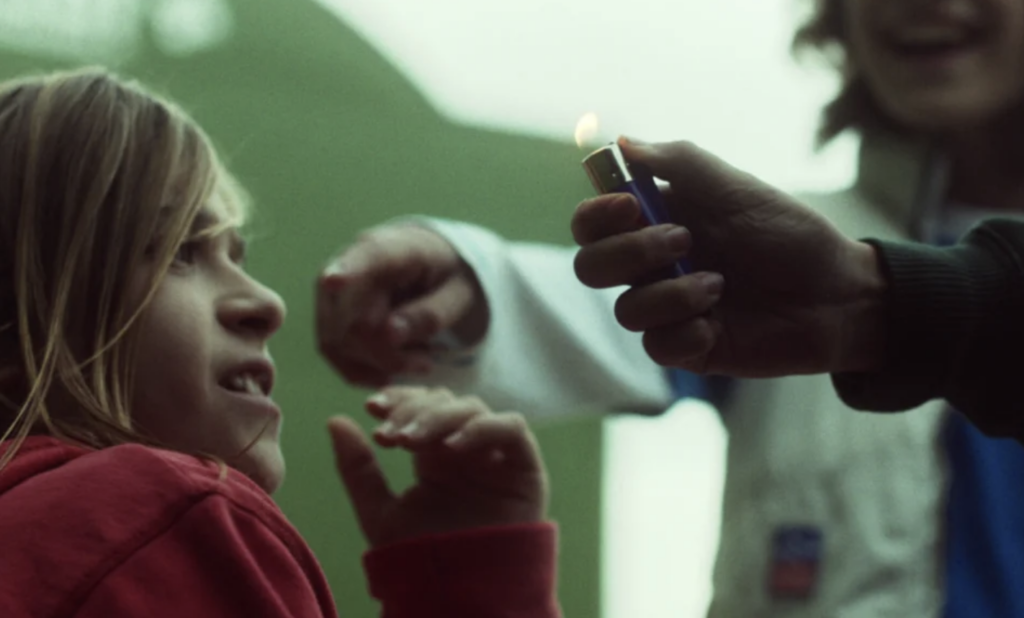
As with the rest of McElwee’s family, Adrian has played a significant part in his dad’s films, often appearing on-camera alongside McElwee’s then-wife Marilyn (they divorce during the period covered in Remake) and their adopted daughter, Mariah. Adrian is a joyful, creative kid. He loves fishing and playing with his sister. He also clearly loves his father. But from what McElwee himself tells us, his inability to put the camera down and just be with his family throws up an insurmountable barrier.
That barrier, combined with McElwee’s prominent career—which he’s built in part on the backs of his increasingly uncomfortable family—also seems to have a toxic influence on Adrian as he grows older. He’s interested in pursuing a life as a filmmaker, but totally at sea as to what he really wants to do, or what success looks like. McElwee shares a few of Adrian’s early filmmaking efforts; they’re not good, though some clearly try to emulate his dad’s style. Is he looking for validation? If McElwee had helped Adrian understand that there was literally any other way to live a life, would things have gone differently?
Remake is a father’s attempt to figure out his grief and bewilderment over the death of his child. But in retracing the experiences that led to that point, McElwee repeatedly implicates himself without ever acknowledging that’s what he’s doing.
McElwee’s feelings are completely valid, but in their expression, he ends up taking his son’s death and (surprise, surprise) makes it completely about himself, without once apologizing.
It feels exploitative. It feels manipulative. McElwee may not believe it (and contemporary culture may not either), but there are some things you don’t need to put on film.