Zoomers: a NY slice into the ascension of Gen-Z via a Smash Bros. throughline

Photo by Todd Linebaugh
Far off Broadway and many cities over, the underground off-off-Broadway production of Zoomers graced a painter’s loft in the West Bottoms September 11-13. Its’ premise: Generation Z living as adults—and all the glorious overthinking and interpersonal entanglements that come with it. Directed by Frederick Riviera, the three-night, one-weekend run brought a slice of a Bushwick living room to the Kansas City stage.

Photo by Todd Linebaugh
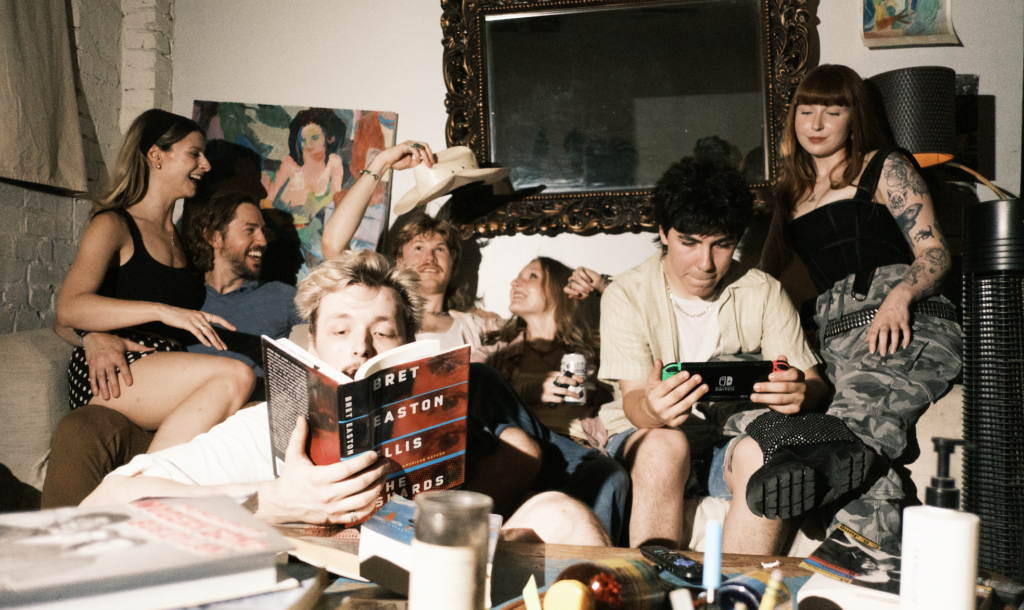
Zoomers traverses through talk of therapy, medications, and messy relationships; conversations that ricochet and never settle deeper; raw milk, hard kombucha, and a multitude of wine. Tacit weed and vape, too: this is the shared common space of a twenty-somethings apartment.
Painter Dan Vanderhoof lent his loft studio to the production. Entering the building felt like entering an antiquated mystery. I knew nothing about this play other than hearing from an actor that it was somewhat similar to Rent, with an additional promise that it was in an artist’s loft, sans air conditioning, with the presence of a cat.
The already historic charms of the West Bottoms gave rosy quality to expectations upon the entryway landing. Wide doors shuttled play-goers around a corner past a lift elevator. Black duct-tape arrows on printer paper point onwards to a narrow staircase, away from the corner where black frames of varying sizes lean against a wall. A green-and-white checkered floor blithely worn with age pads the creaking staircase’s landing, squeezing upwards until releasing into a soaring expanse of industrial wood beams. Vanderhoof’s paintings and drafts remained in the space, communicating with a makeshift stage.
To put Zoomers in this space worked well for the hyperrealistic elements of the script, something Vanderhoof and Riviera both agreed on. The setting composed of couch and cozy seats, strewn chatchkis (think Smiskis and empty cigarette boxes), stacked accumulation of books untouched in a long while (Infinite Jest), a random mirror, an ambient fan, living plants, a stool on top of a side-table, and Vanderhoof’s tacked sketches gave the space the feel of a real lived-in room.
“We’re surrounded by artwork and we’re experiencing this other piece. It’s very welcoming in a fun way. But also: do you know of any places like that, that are like left in the world? It’s a true bohemian art loft. This kind of stuff is rare,” says Riviera of his friend’s space.

Photo by Todd Linebaugh
Vanderhoof enjoyed being part of the process, agreeing that it was an apt space for Zoomers, “It’s a rough-around-the-edges kind of place: you gotta go up stairs, there’s a cat there. But all of that lends itself to the play, because the play itself is in the moment, with these conversations that people are having. The actual set location rhymed really well with the actual play.” (The cat in mention is named Einstein.)
Under the high-lofted ceiling, odds-and-ends chairs and benches peer in on the floor-level stage. Before the play begins, Jared Berlin—possibly as his character Jacob, or maybe in this moment quite simply as himself—splays on the couch playing the Nintendo character-fight game Super Smash Bros projected on the wall. Chill and unbothered as people silently watch him game, it sets an intimate tone for the rest of the production. We’re placed on the same level.
Director Frederick Riviera grew up in the suburbs outside Kansas City before moving to Brooklyn a couple years back. Both he and Jared Berlin are co-producers of Zoomers, with Berlin also acting in the production. They first met during their high school theater program at Shawnee Mission Northwest. For Zoomers, Berlin held down the production side of things Kansas-City-wise while Riviera composed cast and elements from New York City. Rehearsals took place on Zoom until two weeks before showtime.
Riviera felt compelled to produce Zoomers here in Kansas City. He came across the work of its playwright Matthew Gasda in New York City, having first viewed then acted in a handful of Gasda’s plays. “I firmly believe that the artist works very well on impulse. And—honestly, it was something that I was like, I feel like I just have to do this. I don’t know why.” Writing down his dreams and ideas, “This was one that just kept sticking,” he said.
The opening scene depicts three roommates—Jared, Michael, and Jada—playing Smash Bros on the couch, placating deep-rooted problems with their choice of character and on-screen fight tactics. During the game, Michael announces he invited a guy over for the first time last night, but tables discussion and doesn’t want to talk further about it. Jada tries to dip into deeper conversation for some far-off rumination plaguing her. And Jacob, master of Smash and lord of avoiding deep-set feelings, drags both of them back to the pitted surface of stumbling connections the first act orbits, with his insistence they keep playing.
One of the most striking elements about the performance was its reflecting quality of everyday Gen-Z meanderings. Knowing too much about some audience members in the room and afterwards learning about others, I came to find elements in the play uncannily similar to individual’s real lives, mine included. Said elements of real lives depicted on stage: a couple who broke up for good reason get back together; a girl puts the dreams of the city on pause to recollect herself and her funds and moves back to her hometown; the older partner in an open, age-gap relationship expresses concerns that his partner won’t get to have the same free, unburdened life experiences he already got to live. Spoken lines on stage were nearly verbatim with words people in the room actually lived. I felt the urge to slap my knees at the absurd nature of coincidence and regain composure on the ground, theatrically, to display how I felt: truly and properly floored. Riviera shared that the actors themselves felt seen by the characters, as did he.

Photo by Todd Linebaugh
So goes the hyperrealistic play. It’s an element that Riviera enjoys, “It treats the audience as if they’re an intelligent being who is experiencing the work rather than a didactic piece that really is talking to you saying ‘this is what you need to take from this, this is the ultimate message.’” He appreciates a mood-focused bottom line.
At the millennial cutoff, just barely before Gen-Z, Riviera’s sensibilities straddle the line of both generations. His direction gave grace to Gasda’s writing that at times could edge into millennial cringe: an ironic-not-ironic use of “cap”? The female characters carrying conversation with their questions a bit too much? Lines that seem to translate Gen-Z perspective as leaning incapable rather than enormously overwhelmed? At least there’s writer’s recognition of where he places women in the script when Lauren Smith as Ella, extroverted-Carrie-Bradshaw-lover and replacement roommate of the woman who left for her hometown, quips, “is the third roommate, like, always sexual mother?” Though even then, her quip takes the form of a question. Riviera and the actors smooth the wrinkle between the worlds of outsider-millennial-writer and Gen-Z depiction where they can with tact and Gen-Z-humored flourishes.
A scene that nails a well-written section exquisitely well is an argument between Jacob and Sarah—the couple who get back together. We as the audience are not pit against either person. We take neither side. Having already been introduced to Jacob’s character and only now meeting Sarah in the midst of the argument, subconscious favor could skew in Jacob’s direction. The tension of the scene wrought so wonderfully that neither person was villainized or pedestaled. Both sides of a dysfunctional relationship full of misplaced love and personal failings are revealed, but not judged.
Riviera spoke of giving the actors guidebooks, but also freedom to make decisions based on their natural instincts in moments like these, “I wanted to give them the coloring book and have them color in with the crayons.”
From the back of the room, Vanderhoof watches his quiet loft transform to warbled hyper-realistic generational-scape alongside Einstein, the physical art form of Zoomers unfolding into another elemental space entirely as the night went on. He speaks of observing the process, “There’s a quality to seeing something live, in the moment, with all these people watching it that’s hypnotic. As an artist—people see the finished product of a painting. I liked seeing them try to put it all together behind the scenes.”
And so, the outcome: an amalgamation of the younger generation joining together to put on a play about their own generation. Meta and self-effacing, the closing scene brings the play full-circle. Roommates Michael and Jacob play Smash Bros on the couch once again, joined in harmonious company by Ella’s boyfriend, Mark. There it starts and there it ends. Community in shared torpid natures, connecting be where connecting can. Gaining no astute moral nugget of wisdom, yet gleaning hyper-pixelated fragments of ourselves, Zoomers leaves a lingering mark when the lights go up. One that settles deeper than a fleeting video-game as days wear on.

Photo by Todd Linebaugh