WWII drama Pressure wastes worthwhile talent on a blustering narrative
Brendan Fraser and Andrew Scott front a forgettable D-Day flick, serving tired awards-bait cinema perplexingly distant from awards season.

Next week marks 82 years since the Normandy landings on D-Day, an event that led to the liberation of France and Western Europe, and was an integral part of the victory against Nazi tyranny. But the hundreds of thousands of men braving the French shores and skies also faced another, less predictable enemy: the weather.
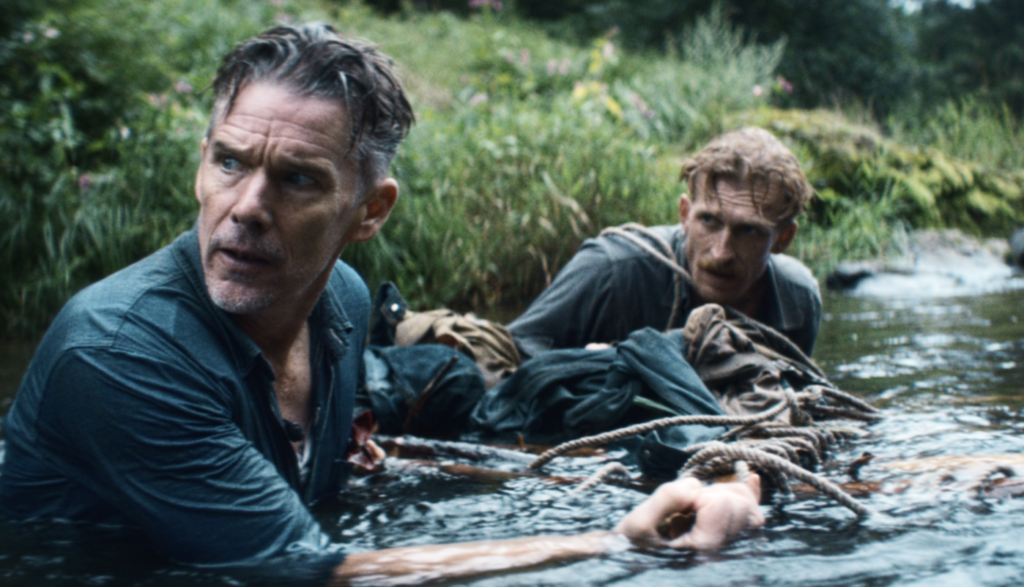
Pressure stars Brendan Fraser as Dwight D. Eisenhower and Andrew Scott as meteorologist James Stagg. The leading men meet just 72 hours before the invasion in this retelling of the true story of how the decision to launch the largest seaborne invasion in history was made. Director Anthony Maras co-wrote the screenplay with David Haig, whose 2014 play of the same name served as the basis for the film.
Invading from the sea heightens the stakes, as waves over five feet, low visibility, or a potential torrential downpour could mean increased casualties, and likely losing the war entirely.
Colonel Krick, played by Chris Messina, insists on basing the prediction on what weather patterns looked like on the same day years prior–called analog forecasting. But Stagg claims Northern Europe’s climate is too unpredictable to rely on this dated method, and says Krick is neglecting the presence of jet streams that could propel two massive storms across the Atlantic straight to Normandy.
Stagg consistently enrages Eisenhower and other military personnel with his forecasts, telling men accustomed to black and white thinking and decision-making that he can only be confident, never completely certain.
Pressure’s release, being positioned between Memorial Day and D-Day’s anniversary, could be assumed to be an appeal to patriotism. But as the film progressed, it proved itself to be something entirely different.
Rather than pulling on the heartstrings of those who came to the theater simply to honor D-Day with a plot-driven storyline, the film centers around the character dynamics more than the war itself.
For example, Eisenhower aide Kay Summersby, played by Kerry Condon, is constantly demeaned by her superiors. But her compassion and patience overcomes her adversity, and her arc is satisfying to witness.
In the days before the invasion, Fraser and Scott are seen almost entirely confined to interior shots, as if the intensity of their situation causes the walls to slowly close in. Their clashing personalities are explored to their full potential.
In a scene where Stagg is introduced to Krick and the meteorological crew, Krick brags about his relationship with Eisenhower. He claims to have gone to a screening of Gone With the Wind with good ‘ole Ike, a small but key intertextual reference.
The 1939 Civil War romance is still the highest-grossing film of all time after adjusting for inflation. Its portrayal of slaves content in their enslavement acted as a way for former Confederate states to make sense of their own history, in the same way John Wayne Westerns were a justification for America’s manifest destiny, and the genocide that the ideology led to.
It was in this scene that Pressure’s politics began to make sense.
Krick and Stagg’s butting heads represent traditionalism clashing with contemporary thinking. Stagg insists on abandoning classic methods of meteorology for alternative solutions. Pressure takes a pro-progressivism stance, emphasizing innovation and nuance over stagnation.
We must face the facts, Stagg says, regardless of how frightening.
At the height of tensions, 4 a.m. the night before D-Day is supposed to commence, Stagg receives a call from St. Mary’s Hospital: his wife is in labor, but the hospital has just been bombed by Nazi forces.
A quick Wikipedia search told me that this was an embellishment. Stagg’s son was born in November, not June like it is portrayed: a cheap emotional ploy that still doesn’t make much sense to me. The title card insisted the film was “A TRUE STORY,” rather than just based on one, but this exaggeration doesn’t add enough to the story to justify its addition, other than to snag a Best Actor nomination for Scott.
I can accept some Hollywoodification, but come on.
Is the fate of the newly drafted soldiers on the front lines, the allied powers, and, hell, the entire world, not high enough stakes? Did we really need to insert a potentially dead wife and child storyline just to have a few more tears in the audience?
There are plenty of true stories of the parties that made D-Day a success that render it completely unnecessary to veer off course like this. Especially those whose stories are underrepresented, such as the many soldiers of color who stormed Normandy but are notably absent from the few combat scenes in the film. Director Maras had a prime opportunity to tell these under-told stories, but instead opted for the stereotypical tropes of the genre, as well as telling stories that didn’t actually happen.
Does Pressure take a more progressive stance than its patriotic predecessors? Sure. But it’s a rudimentary stance, and is rendered superficial considering its fictionalized aspects.
From a distance, Pressure is an enjoyable war drama, but is half-baked at best.