Wicked the musical offers emotional weight compared to movies’ delusions of grandeur

Photo by Joan Marcus
As someone whose first real introduction to Wicked was the movies, I already had high expectations for the musical because I firmly believe that, as far as theater goes, the source material is always better. The runtime combined between Wicked and Wicked: For Good is nearly five hours, and after seeing how much more cohesive the musical was, I can definitively say there was no need for two parts.
Wicked really needs no introduction, but I’ll offer one anyway. A young woman named Elphaba Thropp is tasked with watching over her sister, Nessarose, at Shiz, a university of advanced magic and science in the Land of Oz. Elphaba is a bit of an outcast because, gasp, her skin is green. At Shiz, she is forced to room with her complete opposite, popular glitter princess Galinda of the UPPER Upperlands. They have an intense enemy-to-frenemy vibe, heightened by a classic love triangle with Prince Fiyero Tigelaar, played in the movie by Bridgerton dreamboat Jonathan Bailey and whose song “Dancing Through Life” continues to go platinum on my Spotify account.
At the end of the first act, Elphaba and Galinda (now Glinda without the Ga) visit the Wizard of Oz, who turns out to be a powerless grifter, and sing the power ballad of all time, “Defying Gravity.” The second act sees Elphaba and Glinda once again on opposing sides, with Elphaba in hiding and Glinda a political figure of Oz, with Madame Morrible (coincidentally rhymes with horrible) pulling all of the strings, including banishing and tormenting all of the animals of Oz.
Before the musical started, we in the audience were treated to a robotic dragon overhanging the stage and a map of Oz instead of a curtain. Then, the lights dimmed, the dragon’s eyes lit up in red, and four monkeys sprang out onto either side, joining in the middle and performing acrobatics.
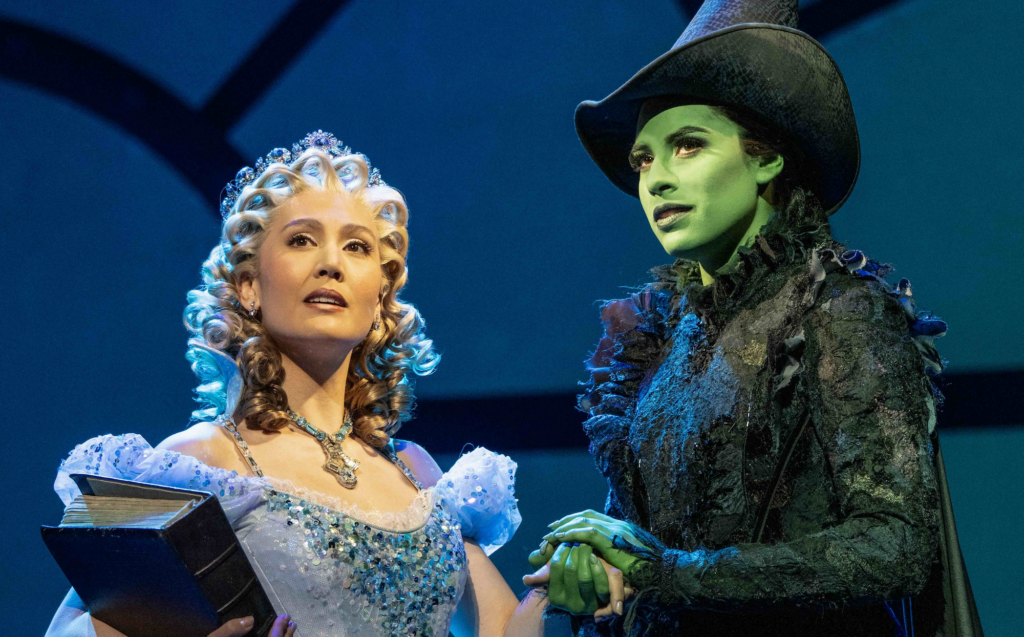
Glinda, played by Claudia Bennett, whom I was lucky enough to interview before the show, opened with an impressive rendition of “No One Mourns the Wicked” in the stunningly classic blue bubble dress. Bennett commanded the attention of the audience with every hair toss and high-pitched note.

Photo by Joan Marcus
Elphaba, played by Aline Mayagoitia, was truly incredible, both as a singer and an actor. The final image of her lit up at the end of “Defying Gravity,” clutching a broom and looking out into the audience with a fierce, willful expression, is still burned into my brain. Mayagoitia and Bennett’s “For Good” hit me particularly hard as someone who is moving to another state soon.
I was finally able to see “Dancing Through Life” live, sung by Ethan Kirschbaum, who played a very charming Fiyero and performed in accordance with my high standards for the character as a fan of both Jonathan Bailey and Aaron Tveit, who played him in 2008 and 2009. I also learned that a CGI goat is not a better substitute for a human man in a goat costume, as Dr. Dillamond, played by Drew McVety, was a brief but enjoyable part of the musical.
Susan Cella’s Madame Morrible and Pablo David Laucerica’s Boq were well-played villains, and both actors had a particularly effective stage presence.

Photo by Joan Marcus
The true and most unexpected outliers for me during the show were the Wizard and Nessarose, played by Tom McGowan and Cristina Sastre, respectively. McGowan gave a nuanced and sympathetic performance, while Sastre’s voice and range had me at the edge of my seat. Because of the actors, these characters were able to shine in a way that I didn’t notice in the movie.
As a true Kansas girl and Dorothy apologist at heart, I was very much looking forward to a sneak peek of her, even if it was just a shadow behind a screen. It wasn’t until the end of the first act that I realized I had inadvertently dressed like Dorothy, although I did choose the blue shirt with poppies and red Converse on purpose. My dark wash jeans and long brown hair definitely added to the effect.
Not only is Wicked a timeless musical because of the catchy songs and quirky humor, but the underlying politics and themes of equality still ring true to this day. With President Trump and MAGA’s policies threatening people of color, women, the LGBTQIA+ community, wildlife, basically anyone who is not a white man of high social status, Wicked’s message of tolerance offers an opportunity to educate theatergoers on why exactly we should never judge a book by its cover. Everyone really does deserve the chance to fly.
Wicked runs at the Music Hall from August 12 to August 30.