Steamboat Arabia might have a new home, but what about the preservationists?

Photo by Maisie VanSlander
For a couple of years now, the staff and owners of the Steamboat Arabia Museum knew their time was limited. November 13th marked the end of the lease. While everyone had hoped the lease would be open for renewal by the city, the reality is that the 30,000-square-foot building will be stripped and cleared for the next tenant.
The owners of the exhibit are shopping the collection around to multiple interested parties, and the Arabia’s future seems bright. However, workers who have kept the preservation and discovery going over the years are struggling to find where they fit within the Arabia’s future. Preservationists and archivists work to uncover mysteries still hidden within the ship, and while the collection may have a new home, what about them?
The team will have approximately six months to have everything moved out, including the two-story, functioning water wheel. A huge undertaking, Matt Hawley, the museum manager, will solicit help from professional movers and current staff who want to stay on to help. The building was built around the water wheel, so most likely, the front of the City Market building will have to come off to haul the hulking construct out.
Famous to Kansas City and the history of the River Market, it is hard to imagine where the exhibit would fit better. Currently, there are four frontrunners for towns that will house the uprooted dig site: Leavenworth, KS, St. Joseph, KS, St. Charles, MO, and Pittsburgh, PA, with the Heinz History Museum. Pennsylvania might seem like an outlandish destination for a Midwest discovery, but Hawley explains the connection.
“The boat was built in Brownsville right outside of Pittsburgh. A bunch of steamboats came from there, and we have loaned them artifacts before, some 1300 a couple of years ago. The people of Pennsylvania would see it as the Arabia coming home.”

Photo by Maisie VanSlander
The museum has been the cornerstone of the River Market District since 1991. The City Market was built around it.
“When the place opened, the neighborhood wasn’t what it is now. It’s very cool to see the River Market grow into what it is. As a dad, my kids will come down here, and we will walk around, and you couldn’t do that 30 years ago.”
Hawley hopes for a decision on a new home for the Arabia, since it would mean moving the artifacts from museum to museum with no layover in storage. It will also greenlight more excavation trips to dig up other sunken steamboats like the Malta, which sank in 1842.
“We would be able to put preservation aside and have everyone start playing in the mud to dig up our next ship. It’s a big hurdle to overcome, but finding a new home will unlock so many opportunities to continue doing digs.”
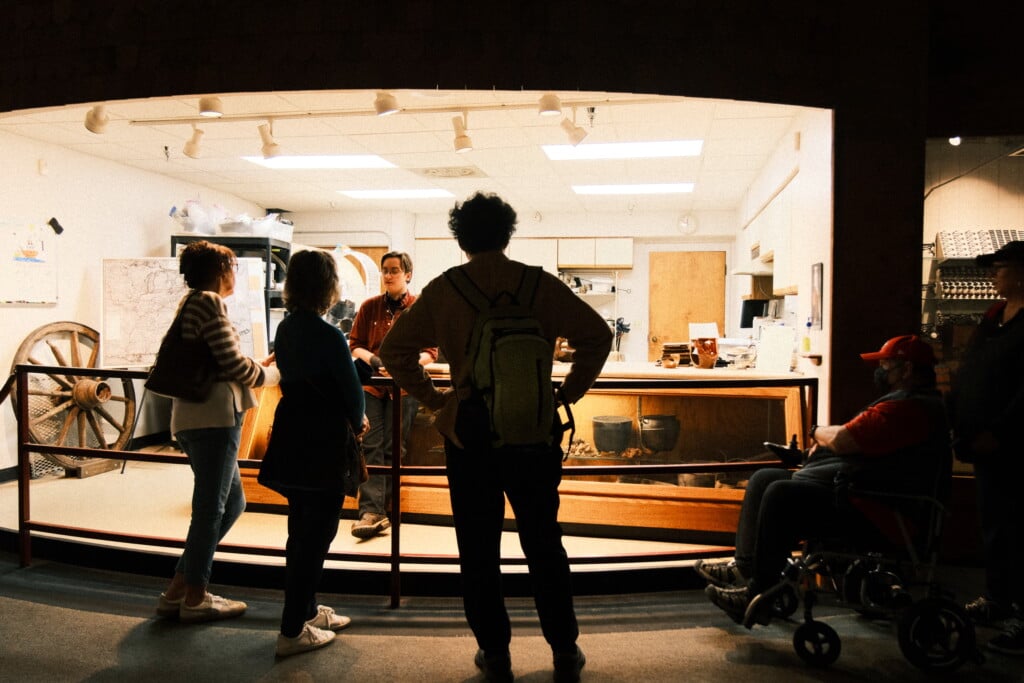
Unable to be put in storage and set aside for a later date is the team of preservationists that have worked in the museum. They work in an open-air lab, allowing visitors to watch and ask questions about the pieces they are working on. The task of cataloging, cleaning, and storing the artifacts is a hyper-specific profession and cannot be done using unskilled hands. These archeologists, anthropologists, and preservationists are as crucial to the Arabia as the space it sits in, so where will they go?
Leonard Whitehead (Len) is a preservationist who has been working on the Arabia for four years. He studied anthropology, focusing on Southwest Indigenous archaeology.
“I never thought I would end up in a steamboat museum.”

Photo by Maisie VanSlander
Even though he knew the building’s lease would end years prior, the weight of the imminent closing piles on. His job security waxes and wanes as new announcements come in about the two-week extension.
“I don’t like it. The city keeps changing things, and I am finding out as news articles are being published. I had a friend call me about the extension because they saw a story, and I hadn’t been told.”
The uncertainty continues when considering the unstable destiny for the Arabia collection. Len hopes to stay on as long as possible to see his work pass to the next stage.
“I want to be able to train at least one person and pass down what I have learned. It is not an easy job, and there is nothing like this in the area, let alone the U.S. Freshwater archaeology is barely a thing, and to have preserved items like the Arabia is unheard of.”
Hawley hopes he can keep the preservationist team on for as long as possible to help with the move, but the chance they’ll stay with the Arabia afterward is very slim.
A good question that many people have been asking is what is going to go into the shell of the museum? There is a working water feature and an almost three-story mezzanine that will make it hard for a plug-and-play installation.
The city already has plans to build a boutique, high-end hotel where the Arabia currently stands. They are looking for three-star hotel candidates to “enhance tourism.” Additionally, the planned hotel would tower seven stories, and the lower artifact space would be converted to parking.
“People are going to look at the Hyatt (or some other brand) and say, ‘Remember when that was the steamboat museum?’” Hawley adds.

Photo by Maisie VanSlander
By refusing to renew the lease of a historic site and focusing on developing hotels and parking lots, the city is sending a clear message about the area’s priorities. Instead of leaning into the identity of the River Market with walkability and heritage, the city plans to bulldoze character and create more infrastructure for cars. Suffocating a neighborhood’s individuality to convert it into a Plaza clone seems to be the City’s north star.
So many people are focusing on where the steamboat will go next and what will take its place, but the people who dug the ship up in the first place and continue to educate visitors on the artifacts need futures too. Preserving Kansas City is not just the job of city developers, but those who sit in a lab and share the story of an unlikely discovery. If the Arabia can find a new home, that might mean people like Len can keep doing what they love and preserve more Midwest history.
And who doesn’t love a good history lesson?