Savior Complex: Inside the right-wing money machine behind anti-trafficking performance politics connecting Missouri and Utah

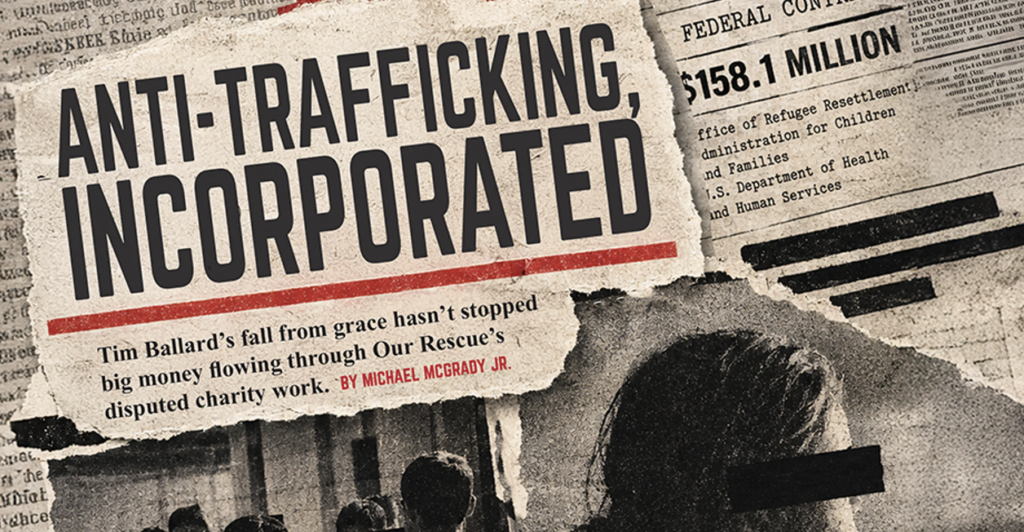
Courtesy Salt Lake City Weekly
The following article was developed in collaboration with Salt Lake City Weekly. Companion reporting can be found at cityweekly.net.
The anti-trafficking movement is sprawling in structure. The amalgamation of competing narratives of what rescuing trafficking survivors looks like includes over-militarized policing, advocacy, public interest litigation efforts, and digital media strategies.
Hundreds of secular and religious organizations exist in this space, working to counter human trafficking. Many of these groups are led by recognized human rights activists and human services practitioners, emphasizing care and recovery in the overarching frameworks of bodily autonomy, gender equity, and mutual respect.
Many of these so-called “anti-trafficking” groups, however, are antithetical to the human rights viewpoints on these matters, citing “tough on crime” and mantras characteristic of the many right-wing and far-right groups operating in this space.
Missouri and Utah are what I consider two leading hubs of an explicit brand of anti-trafficking activism that is a blend of modern white slavery myths and conservative, dominionist Christian nationalist viewpoints of our society. In collaboration with Salt Lake City Weekly, The Pitch uncovered and traced a powerful influence network of so-called anti-trafficking and anti-pornography activists, law enforcement officers, and far-right politicos all tied, directly or indirectly, to the highly controversial Tim Ballard and the charity he formed, Operation Underground Railroad (OUR), which rebranded to Our Rescue in the years since his tenure.
Actor Jim Caviezel starred in the 2023 film Sound of Freedom, a major motion picture release from Angel Studios—a publicly traded Christian film company based in Provo, Utah.
The film made Ballard famous.
Fame and an Image Problem
Caviezel has appeared in Christianity-coded films, such as playing Jesus Christ in Mel Gibson’s film adaptation of The Passion in 2004, and has also proven his mettle for prestige war dramas with his acclaimed role as Private Witt in the 1998 film adaptation of Jim Jones’ The Thin Red Line. Caviezel portrays Tim Ballard, a former federal law enforcement agent. Now, Ballard is nothing more than a right-wing social media influencer rather than an activist. But Caviezel praised the role at the time, reflecting the actor’s own QAnon views and religious beliefs. The film, ostensibly based on Ballard’s life and work in foreign countries to save women and children from the clutches of human traffickers, was a box office hit, earning over $250 million.
Such commercial success was unexpected for a Christian film studio, and it gave fans a romanticized, glamorous take on vigilante crime-fighting. The film gave Ballard a much-needed ego boost and goodwill in the conservative-leaning media before the meteoric fallout of sex abuse and trafficking allegations from several women who worked with him at OUR/Our Rescue.
As of this writing, Ballard is still the subject of a lawsuit alleging abuse and trafficking, which was brought in a Utah federal district court, according to dozens of news outlets and the case docket. But the show must go on. And that is exactly what OUR/Our Rescue did: try to go on and move away from Ballard’s controversies and shed the sexual abuse and legal accusations. Our Rescue did not respond to repeated requests for comment from City Weekly and The Pitch.
The ‘Human Trafficking Training’ Center
Tim Ballard’s era at Our Rescue brought major changes to the organization, which critics and investigative journalists like me saw as a cult of personality. One of those is Damion Moore, the editor and founder of American Crime Journal, who has spent years on the path of Ballard and the supposed work of the personality in fighting human and sex trafficking.
“Our Rescue has changed leadership, changed its board, changed its operational emphasis, and publicly distanced itself from Tim Ballard,” explained Moore, referring to the current leadership of the charity. Derek Benner, the former Trump administration official who led the Immigration and Customs Enforcement (ICE) division, Homeland Security Investigations (HSI), is the chief executive officer of Our Rescue. The charity quietly rebranded in 2024. “Those are meaningful changes. But institutional rehabilitation requires more than rebranding and new management,” explained Moore. He pointed to his outlet’s reporting, like the work of journalist Lynn Packer, on the sexual abuse and trafficking allegations a class of women filed against Ballard in federal court. Reporting by journalists Anna Merlan and Tim Marchman of Vice News, and a body of reporting by Utah news outlet KSL-TV, an NBC affiliate owned by the Church of Jesus Christ of Latter-day Saints, augment Moore’s remarks.
But what I found for City Weekly and The Pitch presents a new dimension. For those who have seen Sound of Freedom, the Caviezel-portrayed Ballard engaged with “raid-and-rescue” operations in countries such as Honduras and Colombia.
He is depicted actively playing a white savior figure, who works with local law enforcement to hold human traffickers accountable through violent and ethically dubious vigilante justice.
Lo and behold, this legacy of the dramatic “raid and rescue” moment with OUR/Our Rescue never went away.
It evolved.
In the companion reporting published in the City Weekly, we mention the for-profit Human Trafficking Training Center (HTTC) and Our Rescue as strategic partners in a bizarre relationship of public-private partnership influencing policing tactics across many states.
Dan Nash founded HTTC after a career with the Missouri State Highway Patrol. When reached for comment, Nash declined to speak to the City Weekly and The Pitch—a glaring and verbose move considering the company his organization keeps and his own record as a law enforcement officer. Nash was a sergeant in the Highway Patrol and served as a key prosecution witness in the 2009 murder trial of Brad Jennings, who was convicted of killing his wife and sentenced to over 25 years in prison.
According to court documents for the case The Pitch reviewed, Nash led the investigation, in which he had formally requested a gunshot residue test on a bathrobe belonging to Jennings. But the results of the test—results potentially proving innocence—were sent to his office but were never disclosed to prosecutors or defense attorneys during the trial. Years later, a judge in 2018 overturned Jennings’s conviction after finding that the failure to disclose was a Brady violation of the defendant’s civil liberties. Based on the U.S. Supreme Court ruling in Brady v. Maryland, a Brady violation also occurs if evidence that is favorable to the defense is withheld in a criminal case. While Nash testified that he was unaware of the test results, and that Jennings later sued Nash for violating his civil rights in a federal court, the Eighth Circuit Court of Appeals ruled that Nash did not conspire with another officer to withhold the test results. The state, instead, was found to have failed to prove the case, therefore infringing on Jennings’ rights.
Nash’s work in law enforcement, whether indirectly or directly, shows a blatant disregard for civil rights. Ample evidence exists of that claim, but it was litigated to the result that Nash was not liable. Nash retired from the Missouri State Highway Patrol in 2021, after a 27-year career.
Working with Alison Phillips, Nash founded the Human Trafficking Training Center (HTTC) the same year he retired to “help put an end to human trafficking.” HTTC does this by being the self-proclaimed leader in offering “the most comprehensive skills-based human trafficking training programs for law enforcement, prosecutors, probation [and] parole, CPS, and medical professionals.”
As sex workers’ rights activist and academic researcher Tara Burns told City Weekly and The Pitch in the companion reporting, the partnership between Our Rescue and HTTC is central.
The HTTC was awarded a total of $264,037 in recent years to deliver trainings to local law enforcement all over the United States with the backing of Our Rescue, according to the City Weekly reporting. Our Rescue’s Form 990 for the 2025 fiscal year shows $245,000 for in a grant for similar programming, totaling an overall sum of over half a million dollars in a five-year period. Given Nash’s profile and the involvement of Phillips at the beginning of the organization’s operations, there is much to consider from her background that’s instructive.
Eric Schmitt’s Human Trafficking ‘Tsar’
Though no longer listed as a co-founder of HTTC for reasons we were unable to identify at this time, Phillips worked for Sen. Eric Schmitt, a Republican who recently made an idiot of himself and has been accused of promoting white supremacy in the past, when he was Missouri Attorney General. During the tenure of Schmitt, Phillips led the state attorney general office’s Anti-Human Trafficking Task Force and led the “Hope Initiative” to target illicit massage businesses (IMBs) across the state, which launched in 2020. The Hope Initiative reportedly closed 40 percent of the state’s IMBs, though that figure has not been independently verified.
The Pitch found that Phillips has longstanding ties to conservative Christian anti-trafficking advocacy networks that additionally take on anti-pornography activism that is characterized as anti-LGBTQ+ and anti-human rights.
Phillips was also profiled in 2022 by the anti-LGBTQ+ conservative Westside Family Church in Lenexa, Kansas. She described experiencing a religious calling after being shown a documentary produced by the highly controversial anti-pornography “advocacy” group Exodus Cry. The group originated from the wheelhouse of International House of Prayer Kansas City (IHOPKC), which has been classified as a charismatic evangelical ministry tied to Christian dominionism, which is a form of Christian nationalism ideology that seeks to bring governments and public institutions under the authority of a particular Christian worldview.
I covered similar Christian dominionism movements in the summer of 2025 for The Pitch in the four-part “Show Me Hate” investigative series.
An investigation by journalist Jason Wilson for The Guardian, in 2024, openly classified IHOPKC as a constituent of the extreme Christian right, with Exodus Cry’s founder and chief executive officer Benjamin Nolot being a case study in the “human trafficking” myths that are propagated by far-right Christian personalities like him. Nolot believes that the entire “global sex industry” should be abolished, while additionally holding extremist views on LGBTQ+ people and the concept of bodily autonomy.
An indication of this was made clear in 2020 when Emmy Award winner Melissa McCarthy withdrew her support for Exodus Cry upon learning of this. In further context, Exodus Cry has worked with fellow anti-pornography group the National Center on Sexual Exploitation (NCOSE) to restrict LGBTQ+ rights in African countries like Uganda.
Phillips additionally contributed articles to Exodus Cry, including a 2019 blog post opposing the full decriminalization of sex work and advocating for the so-called Nordic Model that penalizes sex buyers rather than sex sellers. The Nordic Model of regulating sex work is quite common in countries such as Sweden, Norway, and Iceland. Policies like these have been characterized by a slate of human rights organizations, such as Amnesty International and the Joint United Nations Programme on HIV/AIDS, as being a direct threat to the safety and well-being of consenting sex workers.
Phillips’s advocacy has also intersected with controversial activist Laila Mickelwait, the former director of policy and public affairs and director of abolition at the Exodus Cry group. In 2023, the connections to Exodus Cry and the HTTC were solidified as Phillips confirmed that the anti-porn group participated in a human trafficking prevention training session that was hosted by the police department of Lee’s Summit, Missouri, at the time.
Together, these connections do raise questions about how religiously informed the “abolitionist” views of commercial sex work have influenced the anti-trafficking strategies Phillips incorporated into HTTC’s curriculum. And that curriculum, on the front of IMBs (per our City Weekly reporting), informs policing.
Operation Coast to Coast
The clearest and most direct example of Our Rescue engaging in public-private partnership with federal, state, and local law enforcement through HTTC can be seen with the ongoing conduct of Operation Coast to Coast.
The first mention of the operation and the so-called coordination of law enforcement through the fusion of private and public resources dates to August 2024. For example, the Iowa Department of Public Safety announced a sting operation under the HTTC coordination of Coast to Coast in August of that year. Missouri Attorney General Catherine Hanaway, the current Republican who replaced Andrew Bailey after he joined the U.S. Federal Bureau of Investigation (FBI) in September 2025, announced in April 2026 that Our Rescue, the HTTC, and area law enforcement agencies all helped coordinate actions operationally tied to Coast to Coast.
That announcement explicitly names the former Missouri State Trooper Dan Nash as the co-founder of the for-profit company and lauded it as a central, leading entity. Other private companies and NGOs involved with Operation Coast to Coast include Delta Air Lines, Safe House Project, and the small artificial intelligence company, Marinus Analytics. Delta Air Lines has been sued in federal court, alleging that an employee of the company falsely accused a father of sex trafficking and abusing a teen girl who has turned out to be his daughter, who was crying out of fear related to turbulence on a flight. Additional cases like these exist, as noted.
A statement from the organization Safe House Project endorsed Robert F. Kennedy Jr. during his confirmation process to serve as President Trump’s Secretary of Health and Human Services. Safe House chief executive officer Kristi Wells said that Kennedy would bring “transparency” to Trump’s Department of Health and Human Services, including on the front of mitigating human trafficking. Critics argue Kennedy has not done that. Marinus Analytics was spun off from the Robotics Institute at Carnegie Mellon University in 2014, as it developed a predictive concept built around “predictive patterns” of alleged sex trafficking online.
Federal law enforcement agencies such as Customs and Border Protection and Immigration and Customs Enforcement (ICE) have contracted with Marinus in the past, according to a 2023 report by the Government Accountability Office on facial recognition software. Marinus is one of several technology firms involved, including mass surveillance company Flock Safety. Flock faces national regulatory scrutiny, especially in Utah and Missouri, over its artificial intelligence-powered automated license plate readers, backed by the Department of Homeland Security. Flock praised Coast to Coast, adding that it is “incredibly proud” of being involved. Operation Coast to Coast is still active, too. And it is causing fear and damage among individuals who aren’t trafficking victims.
The emphasis on IMBs is notable, as law enforcement agencies across the country seem obsessed with targeting these businesses, even when no illegal or non-consensual activity occurs. In our companion reporting, HTTC and Our Rescue emphasize IMB law enforcement strategies and racial profiling against Asians, including folks who work at massage parlor businesses. I spoke with representatives from the Massage Parlor Outreach Project (MPOP), based in the Seattle metropolitan area, Washington.
MPOP advocates for the labor and immigration rights of Asian sex and massage parlor workers.
MPOP explained to us, “We are combating a general lack of awareness about the nuances of the massage industry and the institutions that control it, which include law enforcement and so-called anti-trafficking organizations. One of the challenges [that] we face in communicating to a wider audience is challenging the mainstream anti-trafficking [narratives].”
“The rescue narrative is so emotionally compelling that it shields the people who deploy it from scrutiny, so that law enforcement and anti-trafficking charities are presumed to be acting in good faith, and any criticism of their methods is heard as opposition to saving victims,” explained a representative for MPOP. “This is compounded by the fact that the people best positioned to describe the harm—immigrant massage workers—risk arrest, deportation, and public stigma if they speak out, which means abuse and misconduct often go undocumented and unchallenged. The public hears almost exclusively from the organizations and agencies carrying out the raids.”
Anti-Asian Racism Justified and Platformed
Organizations and agency representatives for MPOP include the HTTC, Our Rescue, Exodus Cry, and scores of law enforcement agencies at the local, state, and federal levels across all fifty states. MPOP points to the 2021 Atlanta massage parlor shootings and how such messaging and framing from organizations such as these was a direct contribution to the deaths of eight people. The 21-year-old Robert Aaron Long, a self-diagnosed sex addict, is the shooter in this case and was sentenced to four consecutive life sentences without parole plus 35 years. His “sex addiction” claims further conflicted with his underlying anti-porn religious viewpoints.
MPOP explained, “Current media coverage has co-opted the language of survivor support. Because anti-trafficking enforcement has claimed the language of survivor support, critiquing it gets mislabeled as defending traffickers, when we are in fact defending workers from the very systems that harm them. Beneath the rhetoric sits a set of structural barriers that are themselves expressions of systemic racism.”
And that systemic racism informs the HTTC.
The HTTC trains law enforcement to investigate and rapidly dismantle suspected IMBs using its so-called “Four Corner Strategy.” The training emphasizes identifying businesses, coordinating investigations, gathering evidence, seizing assets, and pursuing criminal prosecution or business closure. Although HTTC describes its approach as victim-centric, its emphasis on shutting down commercial-sex establishments raises concerns about conflating formats of consensual sex work with human trafficking.
Independent research, as The Pitch has determined, has not validated the strategy’s effectiveness, and HTTC-associated enforcement operations have included arrests for prostitution, raising questions about whether these initiatives prioritize the protection of human trafficking survivors or suppressing consensual commercial sex.
The record proves the opposite.
Michael McGrady Jr. is the political columnist for The Pitch.