Author Kara LaReau’s Licorice is a middle-grade thriller sure to appeal to everyone

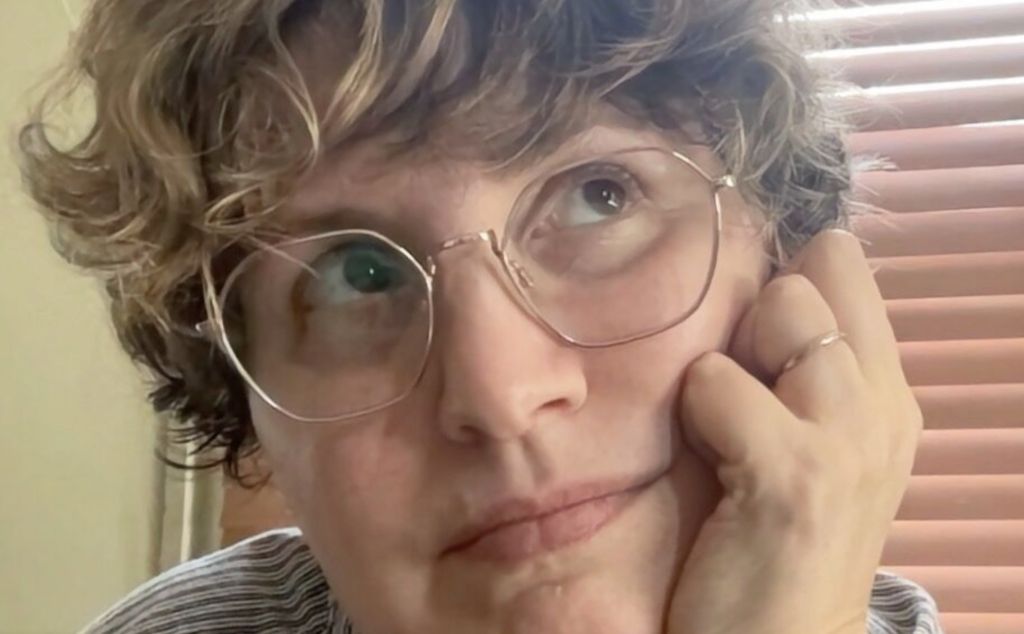
Kara Lareau. // image courtesy the author
You wouldn’t expect one of the most emotionally affecting books you’ll read all year to be a middle-grade adaptation of a classic thriller that replaces all the human characters with animals, but that’s exactly what author Kara LaReau‘s Licorice ends up being. Out next week from Scholastic, and featuring perfectly-suited illustrations from artist Kelly Murphy, Licorice is a retelling of Daphne Du Maurier’s Rebecca from the perspective of Kitty, a young kitten taken to the house at 5 Manderlay Lane, after her new owner, Max, rescues her from the Mount Charles Animal Shelter.
Kitty ended up in the shelter after “the rain that came and swept everything… everyone… away.” She’s all alone in the world, “a scrawny and scared kitten,” and the fact that the memory of Max’s previous cat, Licorice, dominates the house in which Kitty now finds herself only makes the transition more difficult.
Despite the anthropomorphic nature of it all, the characters in Licorice feel real, as though the reader gets a glimpse inside both the world of the animals when their people aren’t around, as well as a first-rate thriller. It’s a delight for adults as well as middle-grade kids, and we were thrilled to hop on Zoom with author Kara LaReau to discuss everything Licorice ahead of its release.
The Pitch: What is your relationship with cats?
Kara LaReau: Oh, I’ve been a cat person my whole life. And I currently have two cats. They are sisters, and they’re very sweet, and one of them is a little bit of a ham, so she sometimes likes to walk behind me when I’m in a Zoom meeting.

Licorice cover. // image courtesy Scholastic
What made you want to adapt Rebecca for kids? It works amazingly and it affected me very much emotionally, but it was just such a wild thing when I first read about it.
Yeah, I get that a lot. I think it’s just like a testament to how my mind works. I got the idea during the early days of the pandemic. There was a Rebecca remake streaming somewhere [Netflix]. I was just watching that and that kind of revived my love for Du Maurier and her work and so that was kinda swimming around in my brain.
At the same time, we had just lost one of our cats who lived a very long life and we were planning to adopt these two kitten sisters. I was wondering–I don’t know- I had this thought: once they came into the house, could they sense that other cats had lived here before, and what were they sensing? My heightened sense of pattern recognition kicked in and those two ideas collided and that’s kinda how the idea happened.
I think it’s actually the logical conclusion to when you see a cat looking off into the middle distance, staring at a corner. The thing is always like, “They’re looking at ghosts.” What challenges come with adapting such an adult story for middle-grade readers?
Of course, I wanted to tip my hat to this story of Rebecca and to Du Maurier and her fans, but first and foremost, I wanted to make sure that I was writing a really good story for the middle-grade audience and that I was finding a way to connect with those readers and telling an animal story in the classic tradition.
These animals in the story are really just avatars for emotions. They’re avatars for kids and the emotions that they’re feeling, whether it’s loss or grief or belonging, jealousy, finding a sense of home, inadequacy–and honestly, those are emotions that we feel at any age. I certainly do. And so, I was really focused on that. I think the fact that the framework is based on this classic is a bonus, especially for grownups sharing the book with kids. When I write, I like to write with layers. I like to include a little something for everyone.
You get at what made it appealing for me, but also what makes me see what could make it appealing to kids–the way you get inside the head and explain the various things that pets do. We all anthropomorphize our pets. But how do you make sure that you’re not oversimplifying or overexplaining? Because you walk a really tight line, and I really appreciate that.
As far as trying to channel what is going on in the cat’s head, as a writer, as an artist, I try to be really observant and so I spend a lot of time with my cats here and cats I’ve known. I think there is a tendency when you’re a pet owner to ascribe certain meanings behind certain things. Some of it is that. Some of it is my research into cat behavior.
I tend to be a very spare writer; I don’t overwrite and then have to go back and pare down. I underwrite, and then I have to go back and flesh it out. My first draft was spare as usual, and I just went back in and looked at all the different moments with Kitty and just thought, “How can I flesh this out? What could she be thinking here? What would I be thinking here if I were in her paws?”
A lot of different things went into it. But I’m glad to hear that it feels balanced and right.
This book is coming out in October. It’s a spooky read. Are there some middle-grade or elementary gateway creepy things you read when you were younger that you looked to for inspiration when writing Licorice?
I would say that I wasn’t looking specifically for inspiration, but there’s so much in my brain that’s swishing around and I talk about this a lot. One of the things that really influenced me was classic kind of scary animal stories like Watership Down, The Secret of NIMH, and Bunnicula. I was also influenced by the animated movie adaptations of Watership Down and The Secret of NIMH.
Those Don Bluth movies and their drama were frankly incredibly scary for kids, and they were formative for me because they didn’t pull any punches. They really trusted that kids could handle that, and I really appreciated that as a kid. I didn’t know that’s what I was feeling, but I know now that was very cool that they didn’t soften the edges.

Licorice illustration. // image by Kelly Murphy
It’s great that you mentioned Bunnicula because I get big Bunnicula vibes from Licorice specifically because of how well your writing works with the illustrations from Kelly Murphy. How closely did the two of you work? Because some of those illustrations, I’m not gonna lie, I’ve seriously considered them as tattoos.
Yeah, same. First, let’s get this out of the way. Kelly Murphy is a genius and as far as how closely we work together, we didn’t work directly together when we were making the book. I have an editor, and Kelly has a an incredibly talented book designer, Elizabeth Parisi, that she works with. We became a team that Kelly and I never spoke directly, but our go-betweens were incredible.
Also, I’m gonna back up and say Kelly and I live very close to each other and I know her. She’s a friend of mine. I live in Providence, Rhode Island, and I’m looking out my window now, and she lives maybe three blocks away from me. I’ve always loved her work, and so when I was writing it, I kinda had her in mind.
She does such great animals, and she just does she has such a great sense of light and shadow. And I also love her architecture, like how she can create a sense of place. All of those things were dead-on for, I think, what the story needed, so when Scholastic–when we were talking about artists, I was like, “Kelly is the one in my mind,” but she’s so in demand, I was like, “We would have to wait forever for Kelly because her dance card’s always full.”
I’m so grateful she loved the story and made time to bring it to life, which she absolutely did.
You’ve done so much stuff that’s in series. How was it for you to step aside and do something standalone after so many different series you had going at any point?
I was a series machine for a while. I have written a chapter book series called The Infamous Ratsos, and then a middle-grade illustrated series called The Unintentional Adventures of the Bland Sisters, and then a series called The Zombert Chronicles also about a cat, but very differently told.
When you’re writing a series, especially the middle-grade series, you have so many balls in the air. I knew that I wanted it to have this particular arc, and you have to kind of seed that arc with details early on that you’re gonna bring up later to try to make it really satisfying. There’s so much planning involved, and then there’s so much pressure that with the first book you really want to start off with a bang and draw readers in, and then the second book you wanna keep the momentum going, and then with the third book you really wanna resolve it in a truly satisfying way.
Oh my gosh, there’s so much to keep in mind so, in a lot of ways this was a relief from all of that, but you kinda have to do all of that in one book. It’s a different kind of pressure, but I love a challenge. I love trying new things and taking leaps and I feel like that’s part of having a creative life. It was a fun challenge, for sure.
Kara LaReau’s Licorice is out Tuesday, October 20, from Scholastic.