The Crystal Method’s Scott Kirkland reflects on 25 years of Tweekend ahead of Friday’s Madrid show

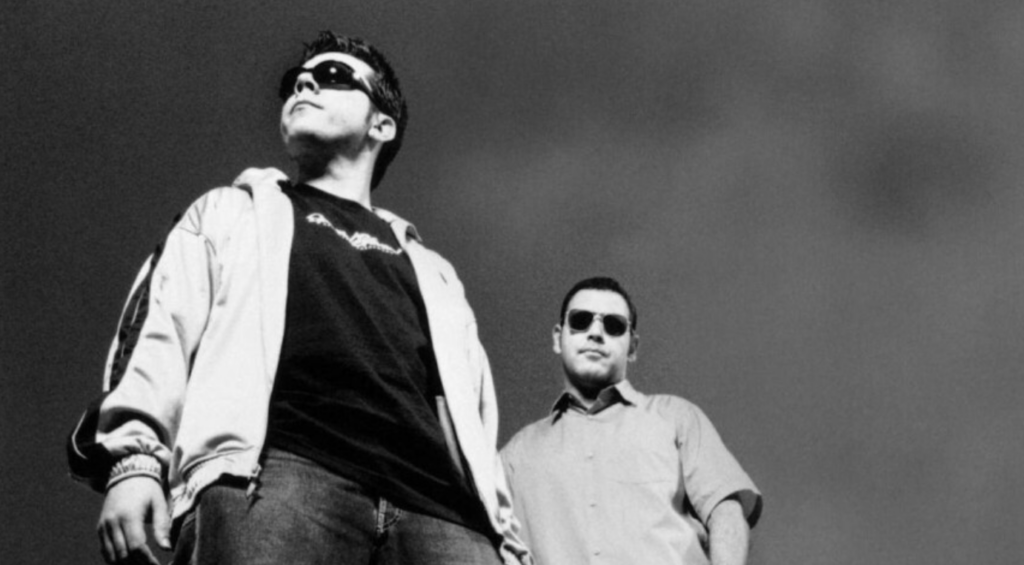
The Crystal Method (Scott Kirkland, Ken Jordan) in 2001 photographed for their Tweekend album release campaign. Credit: Ralf Strathmann
This year, the Crystal Method’s sophomore album, Tweekend, celebrates 25 years as a groundbreaking combination of rock and electronic music. Coming two years after their debut, Vegas, the follow-up showed just what the duo of Scott Kirkland and Ken Jordan had learned over the course of numerous tours and festival appearances. Pulling together a varied array of guest talent that included Rage Against the Machine’s Tom Morello and Stone Temple Pilots’ Scott Weiland and spawning the massive hit that was “Name of the Game,” Tweekend is being honored with a new double vinyl release and a remix of that hit by Paul Oakenfold.
The Crystal Method is also on tour with Paul Oakenfold, and that tour hits Madrid on Friday, October 2. Ahead of the stop, we spoke with Scott Kirkland, who is now the sole member of the Crystal Method, about Tweekend‘s anniversary and making “electronica” in the age of EDM.
The Pitch: How does it feel to realize that this album–that I’m sure to you feels like you made it just yesterday–is 25 years old?
Scott Kirkland: It is weird. It’s like watching your kids grow up or something; it happens so quickly. It doesn’t seem like it was yesterday, that’s for sure, because our lives were obviously so different back then. This is post-Vegas .. I think we started working on it in earnest in ’99.
We were touring excessively, extensively for Vegas. I think we were coming off the Family Values Tour in ’99 and–you have your whole life to make your first album, then everything’s condensed down. I remember there was a lot of pressure–not necessarily external pressure, but we just felt we wanted to do something different. We wanted to branch out and explore our different tastes and our different influences. After touring for three years in Vegas, we just felt that there was no way we could go in and do Vegas 2.0.
We didn’t believe that was in us, and we didn’t believe that was gonna be something that was gonna be beneficial to our career. Because again, things, especially in this world of “electronica,” as it was called back then, things were changing; sounds were changing. Moods were changing. The scene was changing. The club scene was changing.
It all started when we brought Tom Morello on board. Of course we wanted to cater some tracks around his riff style. And so that’s where “Name Of The Game” came up. We came up with “Name Of The Game,” and then we kept finding these other pieces, and he’s like, “Oh, I’ll play guitar on that” or “I like that song. Let’s …”
I don’t even think it was ever said he’d help co-produce it. It was just, he was just there. He was just such a really great, creative person. Obviously, he’s super talented, and so when we had him in the room, we took every advantage of it.
What I’ve always really appreciated about the Crystal Method is the amount of cross-genre collaborations you’ve done. Obviously, Tom Morello on Tweekend, but you’ve worked with Filter, you’ve remixed P.O.D., you’ve done all of this stuff that makes it really hard to pigeonhole your sound. And I feel like that’s kind of the appeal–that you played the Family Values Tour and that, and now you’re touring with Paul Oakenfold. That is the width and breadth of what you can do as an electronic artist. What leads you to work with all of these folks I think that most people might not think of an electronic artist collaborating with?
Yeah. I think it’s just our influences growing up. My parents were really young when I was born. They were, like, 16 and 15, so I grew up in a house where they had a lot of music. My mom loved disco and pop and the odd culturally significant albums, like just things that grabbed her attention. She was always listening to music. And then my dad was into progressive rock and Pink Floyd and Led Zeppelin and things of that nature. And then he also had a friend. He also liked classical music, and he played odd Japanese synth albums, and he liked Switched-On Bach.
Neither one of them played an instrument, but they both loved music. So I was always around music. And then in the ’80s, I think I took one of the first cassettes I think I ever borrowed from theirs was, like, Aerosmith’s Greatest Hits and then I started getting into heavy metal and Metallica and Mötley Crüe and Ratt and glam metal and pop metal, and Iron Maiden and AC/DC, and I’d go to the concerts.
It was just that I was always around music. Then I discovered Depeche Mode, and I was still living in this world where I was listening to Black Celebration but also listening to And Justice for All or Master of Puppets. I always liked to air drum. I always wanted to play drums. I thought it was the most fun and spoke to me in a way, but my mom never would.
She always said that she’d never get me a drum kit because my uncle, her brother, was always in the garage playing with his band, and it always drove her crazy. So she swore she’d never have a son who played drums or whatever that nonsense was. So I did take guitar lessons, but I would always air drum. I’d have one drumstick and one stick from the yard, and I think that’s where I got my good sense of timing, and that really helped when I started to produce. It was just all these different layers of it.
We were going out to the rave scene; we gravitated towards things that were big drums, aggressive, distorted sounds and then, when we started making our own music, it was like, “Let’s get that synthesizer and plug those three guitar pedals in the back of it” and then it became our version of what we were hearing out in the early ’90s. And that just took off to create our own sound.
The collaborative aspect of what The Crystal Method has done over the years is so fascinating because you’re not an insular act. You invite people in to expand your sound. Is it just the idea of “these people make music that we like, I wanna bring them in, I wanna work with them and see how that process works and what we create together”?
Yeah, I think it’s as simple as that. With the Filter thing, our manager also managed Filter, so when they were putting together that Spawn soundtrack, the very innovative and creative lead on that was this guy named Happy Walters. He was the guy that came up with this concept of “let’s bring these new producers from the world of electronic music”–Prodigy and Orbital and The Crystal Method and many others–“and let’s push them together with heavy rock acts like Filter and [Kirk Hammett].”
The Spawn soundtrack has all these collaborations, and we just had a relationship with Filter through our manager. We were working on our album, and we were supposed to go to Chicago and collaborate with them on something, but we were really running behind on making Vegas. And so Richard, our manager, sent them the first track, “Trip Like I Do,” and of course it didn’t have any vocals, it just had some vocal samples and Richard Patrick and I think it was Brian, came up with the sort of the rock side of that track.
It was a perfect blend. And so from that point on, we knew that our sound worked with a heavier sound, so when we got to the end of the Vegas album cycle, we just decided to explore that.
You’re going on tour with Paul Oakenfold. The two of you together just feels like the golden age of when electronic music really started to find its way into the mainstream. What’s it like making the music you do in a world where, like, EDM has become what people associate with electronic music?
It’s a good combination too. The band collectively has known Paul for 25 years. I think maybe we did a couple festivals together, but nothing where we were one-on-one on a lineup. Of course, my manager Richard also managed Paul years and years ago, and there was a relationship there.
The last couple of years, I did a tour with Rabbit in the Moon, which was also a little bit more of the rave scene or the underground US rave scene. That was a good collaboration and a good tour. Then it just Paul was looking to do more dates in the US and looking to play markets that, that were outside of the big cities.
The Crystal Method played a lot of these towns like Tulsa and Kansas City and Austin and we’re playing Fayetteville, Arkansas, on this tour. That’s not a place that I think Paul’s ever played before. We’re playing Knoxville on this tour. It was just this really great idea of bringing the two of us together and creating this one plus one equals three concept. Also, just the Venn diagram of our individual audiences coming together, it’s a pretty strong connection.
I think those that lean more towards Paul appreciate little things that I bring to the table, and vice versa with my fans. I think it’s just like you said–it is Family Values to Paul Oakenfold. There is a lot of space in between those two worlds and I think that’s one of the things that we’ve always been very fortunate as a band, Ken and I, over the years, is that we play radio festivals because we had songs on alternative radio, so there would be these opportunities for us to go play live at,The End Fest in Seattle or the KROQ Weenie Roast in LA or WHFStival, which was the big festival out in Washington, DC for their big radio station.
Or there’s radio stations in Chicago and Boston and so we’d play after Outkast or Green Day or, all these number of bands that were, again, leaning more towards alternative rock but we were always bold enough and confident enough to–just, “We’re gonna push our gear out there, and we’re gonna do our show,” and it was always at night so we always got this hazy light show going, and it just worked out really well.
We bridged the gap between a lot of those grunge alternative fans that came out of the ’90s and were looking for, something else. We have been told many times that we are the gateway drug to electronic music, if you will. It’s been a fun ride. We’ve been, like I said, not shy about going out and just playing our music.
The Crystal Method plays the Madrid with Paul Oakenfold on Friday, October 2. Details on that show here.