Spinning Tree Theatre’s Teen Writers Fest showcases humor, vulnerability, and creative inevitability

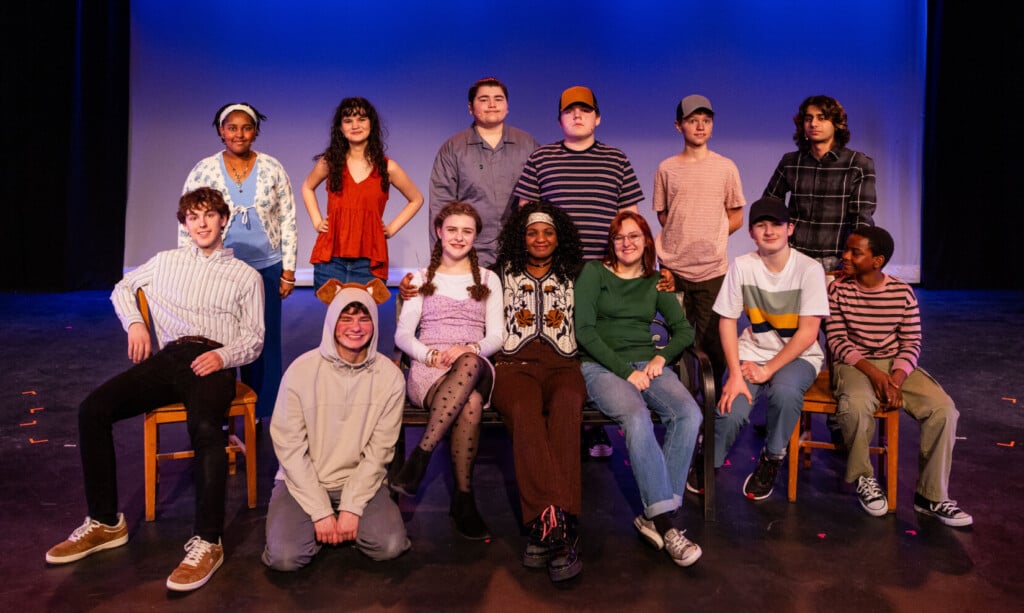
The cast of the 2026 Teen Writers Fest // Photo by Brandon Parigo
Do what you can’t not do. Write what you can’t not write.
That was the advice UMKC playwriting instructor Frank Higgins gave mentee Amelie Barnes, a sophomore at Shawnee Mission South High School. She was preparing for Spinning Tree Theatre’s 2026 Teen Writers Fest.
What Barnes couldn’t not write was a narrative about witches, a dog-turned-not-quite-dog, and good intentions gone fatally wrong—twice.
As she created her story for the Fest, so too did a select cohort of two other playwrights from the Kansas City metro. Each worked with professional one-on-one mentors and producers to put on plays that featured their peers with a cast of teen actors. The three writers showcased this year were Blue Valley High senior Mia Mondry, Platte County High senior Hansen Karlberg, and, of course, Barnes.
The Fest capstones months of work from the playwrights, fellow youth actors, as well as their mentors and the stage crew. What’s special about Spinning Tree’s oversight of the program, too, is the organization’s focus on inclusion, as it bolsters accessibility to art across the spectrum of disability, finances, or other perceived barriers.
“Spinning Tree’s work is rooted in the belief that theatre can be both excellent and accessible, both joyful and transformative,” Spinning Tree directors Andrew and Michael Parkman-Grayhurst write in this year’s program. “Storytelling is richer when more voices are invited to the table.”

Ben Kuykendall and Maggie May Cain in “Jonah!” // Photo by Brandon Parigo
This year’s Fest took place over the weekend of Feb. 6 at the Johnson County Arts and Heritage Center, with Spinning Tree’s fifth cohort of teen playwrights and actors. Because this group comes mostly from the acting side of theatre, this was among their firsts in creating something entirely new and having it brought to life before
Reflecting the artistic interests and intentions of this year’s writers, the plays staged a variety of genres, tones, and personalities. Shared among them was a convincing through-line: the earnest and vulnerable expression of honesty, earned only through the painful confrontation of dishonesty.
“If the Mask Fits…”
Mondry starts the night with a play that is equal parts relatable yet distinctly impressionable.
Dangling from the stage’s ceiling is a collection of paper masks, each depicting a fixed, somewhat uncanny smile. Here, Maggie May Cain takes the lead as Charley, a young girl navigating the social and emotional turmoil of high school with the goal of coming across as outwardly normal as possible—with the metaphorical help of said masks. Unfortunately, she spends the play losing her best friend, getting in big trouble for cheating on an exam, getting dumped at the school dance, and hitting a football player with her car.
As a result, Charley comes off (at least, to herself) as the worst teenager in the whole entire world. And even if we don’t get the easy resolution of yes, everyone has their own ugly set of problems that would go away if we were all somehow more forthcoming with each other. Mondry leaves us, realistically, at a better place of understanding toward what we don’t know about the people around us than what we’d walked in with.

Alice Johnson in “If the Mask Fits…” // Photo by Brandon Parigo
“Jonah!”
Karlberg gives us the Fest’s only musical, with the grounding storytelling and guitar of “Jonah!”.
Ben Kuykendall is the titular lead, who has fled home and kinda-sorta lied to his family about making it big as a musician. While he couldn’t be farther from home and the truth, everything unravels with the news of his estranged father’s death. His sister Lisa (Maggie May Cain) retrieves Jonah from his bus stop busking spot and, once home, pushes him to reveal the truth to the rest of his sisters. This includes the adoring youngest, Jessica (Alice Johnson), who worships him as a purported celebrity—at least, until he isn’t one anymore.
But, Karlberg reveals to both Jonah and the audience that in hiding from his family—and by extension, his upbringing—Jonah also loses a vital part of himself: loving memories of his father, who also taught him to play his guitar in the first place.
“The Witch’s Apprentice”
And Barnes presents a fantastical fable of sorts as Alice Johnson plays her protagonist Isabel, a young girl who resides in a village with her mother (Azaria Martin) and beloved dog Bo (Tro Monson—who, in fact, bear crawls across the stage with diligent realism).
When Bo is accidentally killed in a game of fetch, Isabel conspires, against her mother’s wishes, with the wittiest witch of the west (Mya Kinney) to bring him back to life. Except, nothing ends as Isabel so innocently wishes. Bo becomes a creature belonging to neither here nor there, and it’s the sight of him by other villagers that puts Isabel in the real-life place of the witch they’d all come to fear in their heads.
She doesn’t see the end of the play, but her mother—from whom Isabel hid the resurrection ritual all along—does. Struck with grief, she repeats the cycle by attempting to bring her daughter back. Barnes spares us from what happens next.
If this is what the young writers of today can’t write—not without that earnest sense of truth and enough belief in their own ideas to share them—then I think we’re in very good hands.
Applications are also open for Spinning Tree’s 2026 Teen Writers Studio—a two-week writing program that selects one playwright to create an original play with close mentorship and culminates in an invited reading.