Director Sharon Liese discusses upcoming Marion raid documentary Seized

The Marion County Record // image courtesy Seized
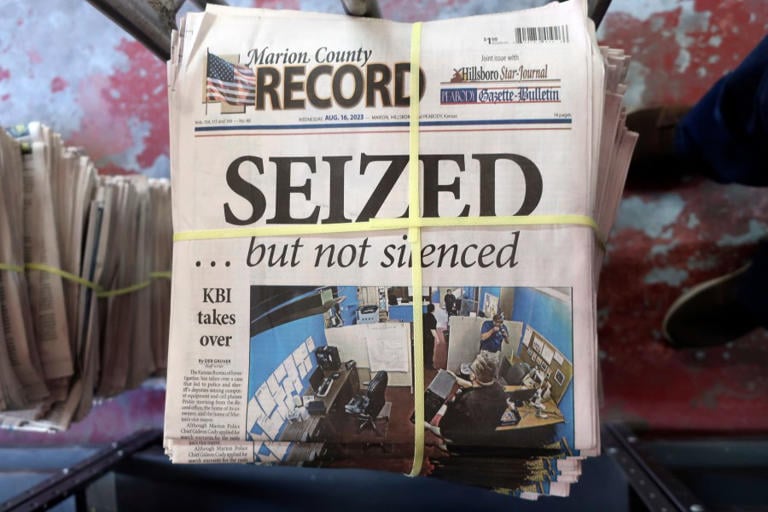
In August of 2023, a newspaper and two homes were raided in Marion, Kansas. Eric Meyer, the editor-in-chief of the Marion County Record, was the public face of the national news story. The raid ultimately contributed to the death of his mother and the newspaper’s owner, Joanne Meyer, the day after the raid. Over the next couple of years, legal battles have continued, with only a few lawsuits settled, but there does not seem to be an easy answer for why this happened. The national spotlight has moved on from Marion during the two and a half years since, however, Sharon Liese was there to document and give a voice to this small Kansas town.
Sharon Liese is a Kansas City-based director and producer of documentaries. Sharon’s filmography includes Flagmakers, Parker, and Transhood–many of which are set here in Kansas City. Her newest film tackles the police raid on the Marion County Record and the relationship between the Town of Marion and the Record.
The Pitch spoke with Sharon to talk about her new documentary, Seized, premiering at Sundance on January 25.
The Pitch: Not only are you an award-winning filmmaker, but you are local to Kansas City—even your stories pull directly from here. What is the importance of using stories from home?
Sharon Liese: The truth is, independent filmmaking is getting tougher and more challenging to accomplish, in terms of getting resources and buyers to actually distribute your films. There’s been a lot of contraction in the industry itself; it’s been rapidly shrinking. Being able to do something in your backyard and something close to home takes the weight off of traveling for these shoots, which is one of the biggest financial hurdles. I could get to Marion, Kansas, in two hours and fifteen minutes. If I found out there was something going on in town the next day, I could get a crew together and show up.
Also, I enjoy doing stories from Kansas City because the people where I live are kind and interesting. People here are inundated with stories that are from the coasts and big cities. I think there is interest, intrigue, and curiosity about people and communities in the Midwest. We are in a fertile ground for interesting storytelling. People in these areas want to see their voices reflected. Representing Kansas City is really important to me. I love raising the voices of people in this area because they don’t always get that kind of attention and visibility. That train of thought is always going on when I approach my films.
How has your approach to documenting people changed from your early projects, like High School Confidential?
Well, High School Confidential was my first project. I’ve grown and evolved as a filmmaker since then. I do some things differently now, but many methods have stayed the same. The most important thing is having patience as people develop a relationship with you—it’s vital for faithful storytelling. Helping people feel at ease so they trust you’ll handle their story with care ensures it feels real and authentic, reflecting how they see themselves. I usually go from the inside out, from an intimate story, and then broaden it to things happening in the world that are important.
Seized is not my usual type of story to tell, because I usually do something much more intimate and focused on individual voices. For instance, Transhood is this intimate story with four kiddos in Kansas City, and nobody else was vying to tell their own story. Even though with Seized, I was stepping outside my usual style, I was following the Marion story, knowing it had major implications for our society, both politically and culturally. But this story was in the national international spotlight, and I really had to take a minute to think, do I want to go? Do I want to try to compete with all the other filmmakers from the coasts I know will be there?
Can you explain how you first heard of the story? What was Marion like when you first arrived?
I kept hearing about it on the radio and reading about it in the news. I finally said, “This story is just too compelling and important, and it’s right in my backyard”. Marion was only a 2-hour and 15-minute drive away, making the logistics incredibly convenient. Meanwhile, all of the Marion County Record’s electronics had been seized, so I was guessing that most documentary filmmakers were having a hard time getting hold of them. So, I got in my car and drove there. There had already been a big scene there; it was only the media and journalists, and no filmmakers. Eric is a tried-and-true journalist; he respected me for being the first documentary filmmaker on the scene. He said, “You’re the first one here. You’re probably going to get the scoop.”
Eric Meyer is a very open person. He’s an open book, and he will talk. He’ll talk to anybody, and he’ll do an interview with anybody. He evaluated me and my background when I first showed up. He wanted to know what my intentions were and what kind of story he felt like I was going to tell. Eric was adamant that he did not want any control over the story. He gave us access to the story, and then he let come what may.
I knew the heart of the story would be Joanne Meyer; I imagined the emotion would come from Eric, but he’s a tough cookie. He wasn’t going to let his guard down and open up about how he was feeling. In fairness to him, for the first year I was filming with him, he was nonstop trying to get the paper out. He was nonstop doing interviews and getting awards. I don’t believe he really had much time to process what was going on. It was clear that he had a lot of respect and love for his mom, and what motivated him was seeking justice for her.
Finally, you wanted to do right by the entire town. The general media consensus differs from how many people in Marion felt. They were feeling like the media had swooped in, gotten their audio bites, and then left. They said it didn’t really tell the whole story. When the town’s members finally sat down with me, they told us different versions of what happened and why the raid occurred.

How did the story evolve the longer you were in Marion?
I first went into this thinking it was a story about violations of the Fourth Amendment and the Privacy Protection Act. I thought I was walking into a true crime story. While it does unravel like a true crime thriller, it’s actually a stranger-than-fiction story the deeper you go.
I think the film outlines why it’s important for people to learn about our Constitution. It is interesting to see how many badge-wearers are unfamiliar with the rights afforded by the Constitution. That was a powerful message I wanted to get across. At the same time, this is a story about a small town that was thrust into the international spotlight because the police raided two homes and the local newspaper. It’s when you start to dissect that the story reveals itself. How did this happen? There are things that don’t meet the eye right away. It reveals the relationship between a small community and its newspaper. This conflict festered into a perfect storm, allowing the events in Seized to unfold.
There is not only a single reason why the events in Marion, Kansas took place. That’s what is so confounding about the story: it’s inexplicable how this happened. What led the police to feel empowered to raid a newspaper? There are layers and layers–it’s just a tangled ball of yarn when you really start to understand how this came to be. I think people can learn from this story beyond the violations of the Constitutional amendments; it represents a microcosm of what’s happening in the country. We need to understand why it continues to happen. Why are we confused by what we call ‘abuses of power’ or ‘violations of the Constitution’? We need to begin understanding why these situations are fostering this behavior.
Now you look to premiere Seized at Sundance on January 25th. Can you explain your previous experience there?
My first Sundance was in 2013, when I produced a film called Selfie. I got the opportunity to win a competition put on by the Sundance Institute to give a pitch for a documentary Dove would support. Well, we ended up winning, and I made the short with Cynthia Wade–she was the director, and I was the producer. Then, my second documentary, Parker, premiered at Sundance in 2023. It featured stories from Kansas City and was a 13-minute short documentary.
Seized will be my first time as the lone director of a US feature doc in competition for the US documentary category. They only pick 10 documentaries for this category, so it’s an exciting achievement. It is going to be a hectic weekend for promotions and screenings to get through. Our sales team and publicity team will be traveling to support the effort. We will be premiering and already have two screenings sold out, but Sundance itself is mayhem. My schedule is jam-packed with screenings, panels, interviews, and various events. To give you a snapshot of the chaos: panels, press lines, and midnight edits fill my days. It can be very overwhelming.
Any last thoughts before the premiere of Seized?
I received a lot of support from Kansas City, including many people who do not typically fund films. I also found the people of Marion to be truly charming, with many of them being quirky in their own unique ways. It was a joy to meet all of them. For us, it was crucial not to focus solely on the wrongdoing in Marion, but rather on how good people are navigating a difficult situation. This holds significant meaning within the film’s broader constitutional themes; it explores the intricacies of justice and human resilience at the local level. It stands as a reminder of working towards a fairer society, honoring our constitutional rights along the way.