Plaza renovation plan brings economic hope alongside tough questions
A Texas developer is moving forward on its plans to renovate the Country Club Plaza. Its plans include several much taller buildings, as well as better sidewalks and a new public square.

Under the plan, many of the Plaza’s Spanish-style facades will be preserved, even if the rest of the building is replaced with new construction. (Vaughn Wheat/The Beacon)
The Country Club Plaza’s future is coming into focus a year and a half after the property was purchased by Texas investors.
It’s no secret that the Plaza has been struggling for years. In 2023, its former ownership group defaulted on nearly $300 million in debt as the shopping center struggled with slumping sales, vacant storefronts and concern about crime. The new owners, Gillon Property Group, reportedly acquired the Plaza for a discounted price of $176 million.
Now, the Plaza stands at a crossroads.
Within the next few weeks, the Kansas City Council will consider an update to the Plaza’s Master Planned Development plan, or MPD, which could allow significant changes to the landmark shopping district.
That includes several much taller buildings, a new public square and improvements to pedestrian and bike infrastructure. Gillon’s plan calls for investing about $1.4 billion on the Plaza. Besides office and retail space, the plan includes hundreds of new apartments in multiple buildings and two boutique hotels.
Before the City Plan Commission voted to recommend the MPD to the City Council on Dec. 17, Vice Chair Tyler Enders said he expects the conversation to continue and encouraged members of the public to keep in touch with their council members.
“This is the most robust MPD that we’ve seen in any of our tenure,” Enders said before the unanimous vote to recommend the plan to the City Council. “And it’s warranted. It’s a site that people care about. It’s an important site economically, culturally, historically. … There is much more opportunity for discussion.”
Gillon Property Group argues that adding density to the Plaza will finally make it financially viable. And city leaders hope that the MPD revisions will carry it forward for the next century, generating much-needed tax revenue to bolster government services.
But some of those proposed changes — particularly the prospect of taller buildings — face opposition from groups like Historic KC, nearby neighborhood organizations and the Kansas City chapter of the American Institute of Architects (AIA).
“We are so excited about the majority of the improvements (Gillon) wants to bring to the Plaza,” said West Plaza resident Hannah Holland at the Dec. 17 meeting. “However, we also know that the main concern of (Gillon) is not the historical significance or the gratification of Plaza residents — their number one priority is their bottom line. I believe it is the responsibility of our representatives in the CPC and City Council to know the line between rejuvenation and greed.”
What’s in the development plan?
The MPD plan that the City Council is set to review is a city planning document that details what kinds of buildings and landscaping are allowed in the Country Club Plaza.
The plan covers 15 city blocks — all controlled by Gillon Property Group — and sets rules for what the buildings should look like, how tall they can be and what architectural elements need to be preserved.
The plan recommends that the developer include roof ornamentation, bell towers and glazed tiles in building designs. It also says that for any new buildings, at least half of the facade must be made of materials like tile, terra cotta, brick, stucco or stone (as opposed to concrete, metal or wood).
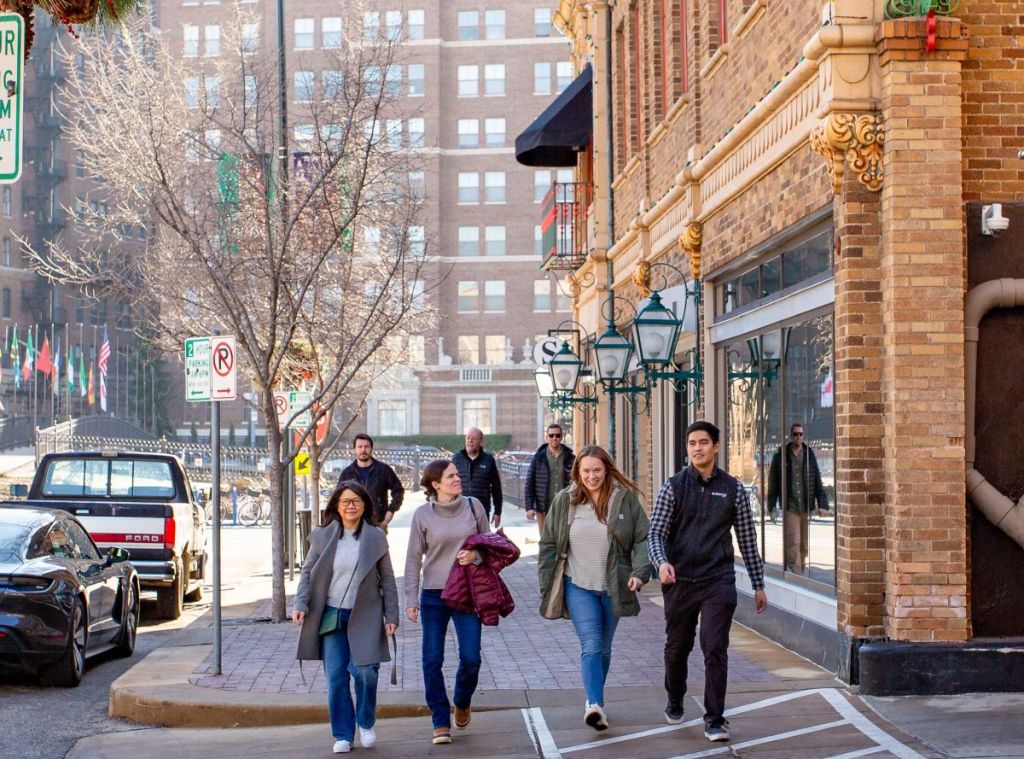
If the City Council approves the plan, it will also recommend improvements for pedestrians. That could include more benches, sidewalk dining areas and improved crosswalks and bike infrastructure.
“You are incentivized today to stay at your home and order Uber Eats or Amazon hour-delivery,” Dustin Bullard, vice president of partnerships and place with Gillon, said at a Dec. 3 City Plan Commission meeting. “And so how do we create places so that you want to get out of your house?”
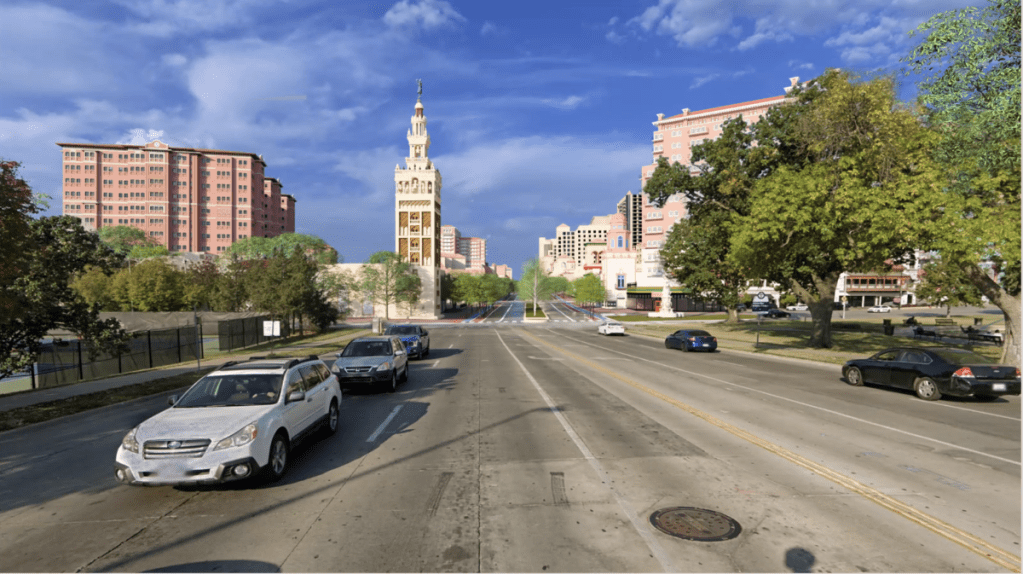
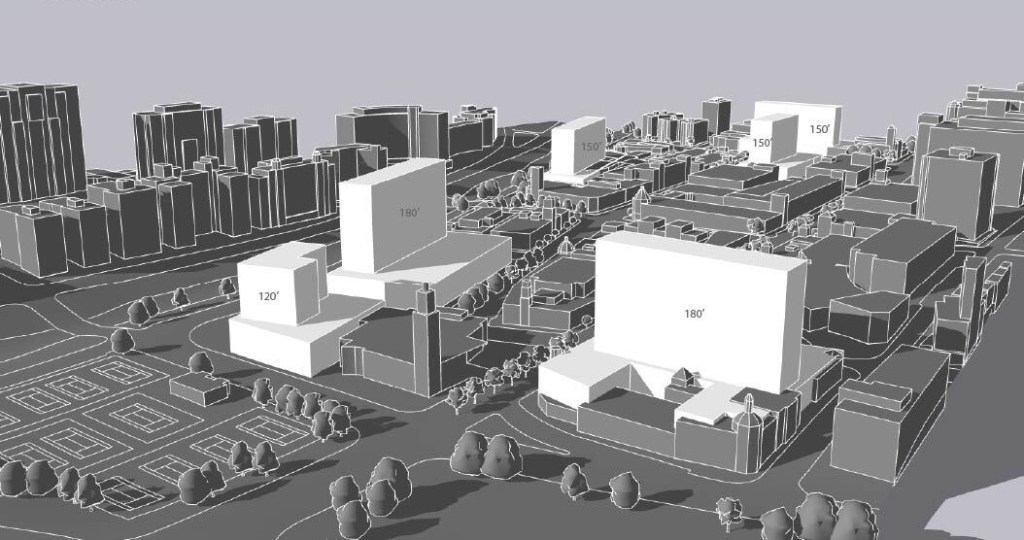
More controversially, the new owners of the Plaza are also asking the city to allow much taller buildings in some areas.
That includes one 178-foot tall building, one 150-foot tall building and three 120-foot tall buildings, in addition to the already approved 275-foot tower at the western edge of the Plaza.
And that’s where the Plaza’s owners lose support from various neighbors and advocates.
Taller buildings versus historic preservation
The initial proposal, which was presented to the City Plan Commission at the beginning of December, asked for even taller heights — including three 200-foot buildings.
For reference, that’s slightly shorter than the Liberty Memorial.
Then the City Plan Commission voted on Dec. 17 to shrink some of those proposed buildings — all three new buildings along Ward Parkway now have been set at a maximum of 120 feet tall.
Vicki Noteis, the president of Historic KC, said that Gillon reached out to Historic KC early in the planning process to get feedback on the proposal, and she credits them for being much more collaborative than other developers have been in the past.
But she raised concerns about increasing the height of buildings on the Plaza.
“What’s unique about the Plaza,” she said, “it’s changed from Sears and tire sales to Gucci and back and forth over the years. It still is an integrated part of the whole neighborhood area around it, and that’s really different than anything else.”
Noteis was Kansas City’s director of city planning in the 1990s, when the city was implementing a Plaza area plan that sought to preserve shorter buildings on the Plaza while allowing taller buildings at the edges of the district.
That concept, called the “Plaza Bowl,” was codified by the City Council in 2019.
Noteis is now concerned that those proposed heights in the new plan would create a physical barrier between the Plaza and the neighborhoods around it.
That barrier — the 120- to 178-foot tall buildings lining Mill Creek Parkway and Ward Parkway — would hide the Plaza from view for people who live in or drive through Midtown.
“It’s going to create a ring around the Plaza,” Noteis said before the latest changes, “that caters to a more elite community that would come in there, that they would then become the new patrons of the Plaza. They get all the great views, they get the preferred parking, and it’s like, well, what’s happening to Kansas City’s Plaza?”
Dominique Davison, speaking on behalf of the Kansas City AIA at the Dec. 17 meeting, said she’d far prefer small density increases on all blocks, rather than a few spikes of taller buildings.
“At a five- or six-story height, you can still look at your outdoor window and recognize the faces of people on the sidewalk below,” Davison said. “This humanizes us and allows for a stronger sense of community in neighborliness, rather than allowing for us to be anonymous and invisible in our glass towers.”
Kansas City Councilmember Johnathan Duncan, who represents the 6th District including the Plaza neighborhood, said he believes that Gillon is earnest about preserving the neighborhood’s character.
“All of the buildings that they’re talking about are hypothetical,” he said.
Under the revised MPD, Gillon will be required to get a second approval once they have a specific design in place, before any taller building can move forward.
“What most people want to ensure is that the Plaza remains the Plaza,” Duncan said, “that you’re not going to remove the Classic Cup and replace it with some glass monstrosity. And I think largely, their development plan does that.”
Gillon does intend to demolish some buildings in the Plaza to make way for new construction.
According to the MPD, the developer will be required to preserve many of the historic facades — what architects call a “facade-ectomy” — to create new buildings that integrate the same facade as what’s there now. A recent example is the former Katz Drug Store facade that was preserved as part of a new apartment complex at Main Street and Westport Road.
Some of those facades on the Plaza include the balconies lining Mill Creek Parkway, as well as the colorful tiles on the Plaza Time Building housing the Capital Grille.
But Noteis wants to make sure Gillon is being diligent about identifying all of the historic buildings and facades to be preserved.
“I think these are good guys,” she said. “I think they may be the best development group we’ve seen and we have a good relationship with them. I don’t think all of that means you have to give up everything to get them approved.”
The future of the Plaza
At the same time, city leaders are wrestling with what the Plaza needs to become a sustainable and tax-generating asset for Kansas City for decades, if not the next century.
The most immediate concern is Lockton Companies, which uses Valencia Place at the north edge of the Plaza for its headquarters. Its lease expires in 2030, and the Kansas City Business Journal reported that it’s exploring a move elsewhere — potentially to Leawood.

That explains some of Kansas City’s urgency to make progress on the Plaza’s development plan, as well as Gillon’s request for a 30-year tax break through Port KC. The developer also is seeking to use a tax-increment financing plan to help cover the cost of redevelopment.
And some progress has been made — notably on the site on the western edge of the Plaza that was slated to become a Nordstrom store until the plan fell through in 2022.
A new plan is moving forward for Gillon to construct a 275-foot office tower on that site, subsidized by tax incentives from Port KC. That tower could become Lockton’s new home on the Plaza.
But looking at long-term sustainability, the developer said that the Plaza needs more density in order to convince businesses that opening a shop in the Plaza will bring a reliable customer base.
“Density is important for the long-term health of the district,” Bullard said at the Dec. 3 meeting. “Leasing decisions are oftentimes not just made on the vibes or the feel of the space. They’re made with spreadsheets and back-end math.”
City leaders like Duncan see density — including apartments and hotels — as an important way to get better tax revenue to pass the benefits along to government services.
“We have to have density,” he said. “And if that density comes in a very intentional, deliberate way, in keeping with the stylistic elements of what people identify as the Plaza, I think the initial shock will fade.”
This article first appeared on Beacon: Kansas City and is republished here under a Creative Commons Attribution-NoDerivatives 4.0 International License.