One of the Good Ones disrupts, dismantles the American Dream at KC Rep

Photo by Don Ipock
When you come from a family of immigrants, how do you know when the American Dream has finally come true?
Is it when you build a smart home with a remote-control fireplace? When you hire chefs to cook the family recipes, because building generational wealth is a too-busy undertaking? Or is it when you stumble over the sounds of your ancestral language, so distantly forgotten that the words themselves have become a dream of their own?
Let’s talk it through over dinner.
One of the Good Ones is a comedy play that opens this conversation, and one such family’s dining table, to the audiences of the KC Rep (and soon, the greater Kansas City community—free of charge).
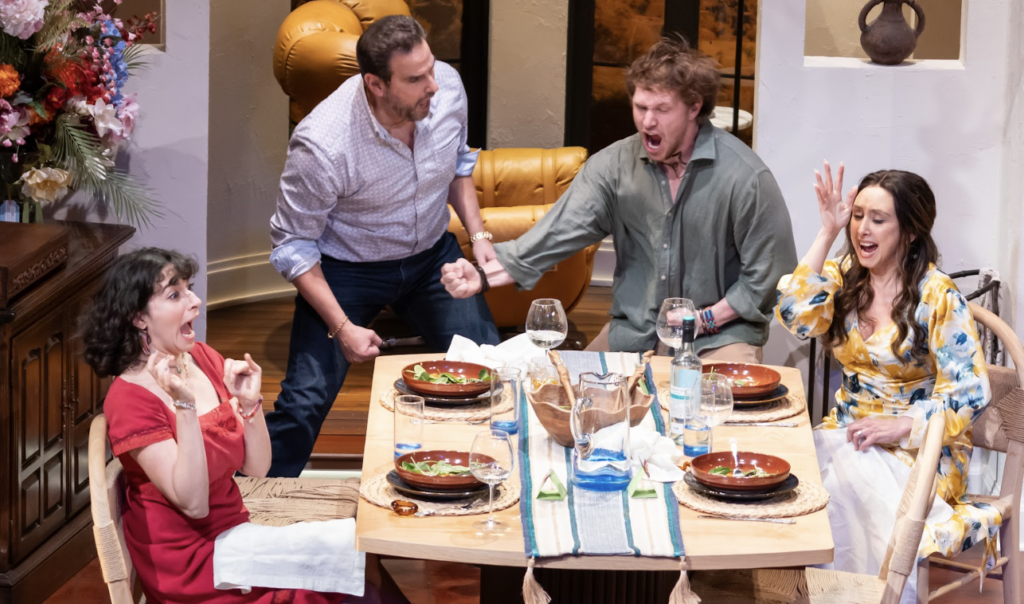
In it, we follow Yoli (Isabella Campos): recent college graduate, third-generation Latine American, and all-time advocate for healing generational trauma. Having just returned home from studying abroad in Mexico, she reunites with her stuck-in-his-ways father Enrique (Gene Gabriel) and well-meaning yet culturally tactless mother Ilana (Natascia Diaz). They’ve got a guest, too: Yoli’s new but very serious boyfriend Marcos (Tyler Lindquist).
What ensues is a high-energy, zero-intermission game of catch-up over salad and wine. There’s truth nuke after truth nuke, as the play puts the cast’s—and audience’s—preconceptions of heritage, nationality, and attainment on blast from all sides.
Yoli and Marcos want the night to go as well as possible, with ulterior motives. Ilana wants to impress Marcos as she compensates for her Americanized upbringing. Enrique finally wants to assume the role of intimidating patriarch with the Latino son he’s never had.

Photo by Don Ipock
Truth nuke one: Marcos “Cruz” is really white boy Marcos Cruise, who shows up, to everyone’s dismay, with a piñata. He is Mexican, though, if you count simply being born in the country.
Truth nuke two: Enrique’s gone to therapy while Yoli was away. Because he survived a heart attack.
Truth nuke three: Ilana’s family has actually been on the land far longer than three generations, a legacy erased by the American annexation of Mexican territory. Yet, she feels as if she belongs nowhere.

Photo by Don Ipock
Truth nuke four: Yoli, despite her idealism, is deeply pressured by all the above—especially as she and Marcos have even bigger news to reveal.
And it’s through the play’s unrelentingly quick sequence of revelation after revelation that it works to address as much of the conversation on Latine identity as possible. The execution is engaging if not highly entertaining—from the slapstick humor of Gabriel’s anger, to the force with which Campos projects Yoli’s therapy-speak, to the dizzying whirl of Diaz’s movements across the stage, and especially Lindquist’s spot-on interpretation of woke Overland Park himbo.
At risk of sounding like I’m selling you something, I’d be lying if I didn’t say that there’s something for everyone in attendance.
As the show progresses, it becomes clear that its premise isn’t a clash between the older generation, damaged by their struggles as immigrants, versus their kids’ patronizing presumptions as they hope to break the cycle of trauma, or even necessarily white guy vs. Latine family. Rather, it’s everyone’s baggage laid bare at once. Face-value diaspora tropes are treated with greater depth as the characters work to explain themselves to one another, and behind every neurosis is an earnest explanation rooted in the past—not to mention, the desire to hold onto it in the face of change, or to forget it in order to make some material progress.
For instance, Marcos’ story of being a not-quite-Mexican Mexican puts a new comparative spin on whether immigrants in America should be perceived as fully American, and if that’s something they’d actually prefer. Hell, he even directly acknowledges himself as a “colonizer.”
But, this is also where we see part of the play’s ambition to address everything fall short. As we unpack the question of Marcos’ Mexican passport vis-a-vis the family’s American-ness, we open the door to larger questions that the play simply doesn’t have time to address, like his white parents’ fetishization of a different country. Such is the case, too, in terms of directly addressing other questions like what, exactly, was the agent behind the family’s generational trauma besides its own doing? To be fair, I will say that this play is stronger in showing us a loving family and forgoing the heavy-handed immigrant angst we’ve seen time and again.
But overall, and most effectively, the play puts the American Dream—or “Ancestors’ Wildest Dream”—into unsettling question. Have you really reached the good life if you lose who you are along the way? Is it otherwise fair game if you’ll choose your aspirations over that identity?
According to the play, there doesn’t seem to be an answer or perspective that’s more correct than the others. We’re not set in a position to make a judgment but to understand, with some amnesty, why these things have become the way that they are, for better or worse.
And if it’s as Yoli and her parents come to realize, maybe they should be the ones in charge of their own dreams.