KC’s public budget hearings prove the people and the City are not on the same page
Kansas City's 2026-2027 budget roundup. “Fully fund out buses” and other public requests.

Kansas City is in the midst of its budget approval cycle for the 2026-2027 fiscal year. The Office of Management and Budget (OMB) introduced a $2.5 billion financial plan on February 12, mirroring the prior year’s allocation. As the city aims to cut the previously projected general fund deficit from around $100 million to $55 million, the city council will vote on March 24 to endorse the recommended budget.
If you want some dry, yet important reading material, the 904-page document is found here. The OMB also creates a more digestible version.
To ensure residents are informed and involved, Kansas City held three public forums on February 23, March 2, and March 9. These sessions allowed citizens to learn about the planned budget and express concerns directly to city leaders regarding the FY27 financial plan (which begins in May).
Kansas City budget basics
Every year before November 1, the city council passes a citywide business plan that includes council goals, a financial strategic plan, and a five-year planning model. These objectives, assumptions, and priorities are set forth by Kansas City’s elected officials and are informed by an annual resident survey. The end goal is to guide the City manager and OBM in proposing a budget aligned with the city’s values.
Each year (and as deemed necessary during a mid-term review), the council can review and update the goals and objectives to reflect any potential desired changes. The current business plan was authorized in September 2025.
As for the fiscal plan, this year marked the first full year the OMB will use priority-based budgeting (PBB) to allocate fiscal resources. “This new approach allows the city to be more responsive to resident priorities and better equipped to deliver municipal services with greater efficiency,” the city website explains of PBB. In other words, it quantifies the importance of city goals (such as public safety and infrastructure) and distributes resources accordingly, using metrics like cost recovery.
Prior to the FY27 plan adoption on March 26, the city council will have the opportunity to introduce amendments to be included with the final budget. All proposed budget changes will be discussed at the finance committee meeting on March 24 at 9:15 a.m.
FY26-27 budget highlights
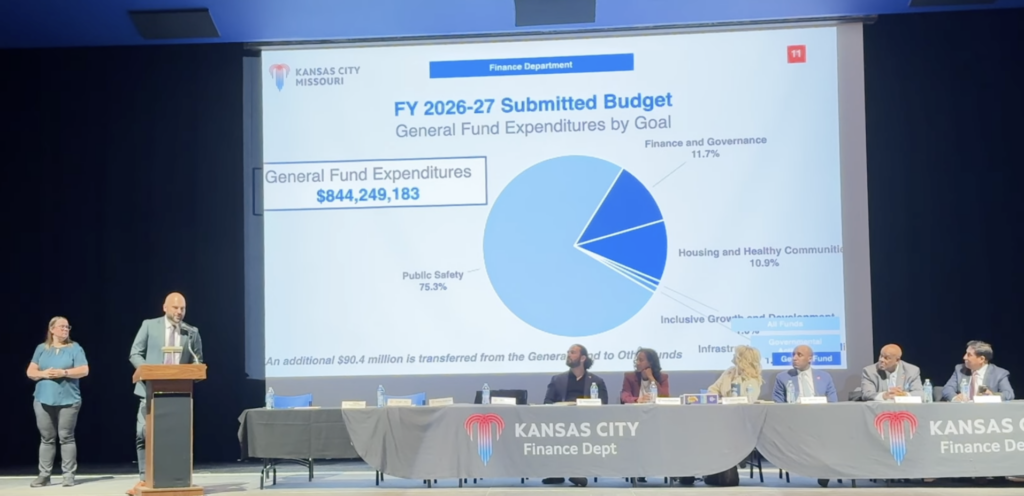
Before the public meetings, a presentation provided an overview of what is included in the 2.5 billion dollars to be allocated. Discussion began with an overview of the fiscal sources: $1.7 billion from government activities (mainly tax revenue) and $880,000 from business-type activities (water services and aviation).
Programs highlighted in the proposed budget included support for affordable housing ($12.5 million), animal control operations ($3.9 million), and free trees ($250 thousand). Other business and resident improvements highlighted were capital improvements to T-Mobile Center ($5 million), snow removal operations ($5.7 million), and preserving existing support for public transit ($77.8 million). Additional noteworthy initiatives included street resurfacing ($30.9 million), new police and dispatcher staffing ($4.2 million), and the newly created Department of Community Safety ($26.3 million).
During public comment, the topic of a 5% boost to KCPD (resulting in $17 million more) was repeatedly brought up. While this raise aims to address staffing concerns, this comes at a time when police-related legal settlements are a financial burden. However, Missouri state law requires the state-controlled police department to receive at least 25% of the annual allocation.
Below is the full budget presentation from the city:
Public comments by the numbers
Spread out over three different public sessions, the following is a breakdown of the common issues members of the public brought to the attention of Kansas City’s elected leaders regarding the recommended budget:
33 Comments – Fund public transit
The Kansas City Area Transportation Authority (KCATA) projects that the current budget allocation will result in cutting eight weekday bus routes and 20 weekend bus routes, reducing the total by more than one-third.
Kansas City residents turned out in force to demand the reinstatement of public transportation funding. Locals, activists, and KCATA filled the majority of the seats at the Guadalupe Center on March 2, wielding signs that said: “FULLY FUND OUR BUSES”.
“I’m a fourth district bus driver and a leader with the Kansas City Bus Riders Union. And I’m here to testify for more funding for KCATA-operated and union-operated bus service”, began a resident at the start of the hearing. “According to an email correspondence I received from the budget office today, seven point nine million dollars from the PMT fund will be spent on street preservation, specifically roads, and another million dollars towards street lights,” continues the
The PMT fund refers to the public mass transit sales tax, a source of funding that was raised by multiple members of the bus riders’ union, who hope to reallocate these funds.
23 Comments – Local art programs
“The arts are not a luxury. They are public goods, and access to arts programming is part of the city’s infrastructure. The cultural, educational, and economic benefits that the arts provide return value to our community,” the arts and education manager at Englewood Arts explained during the second hearing.
The budget proposes an approximate 70% reduction to ArtsKC and the elimination of the DROP program (totaling a $ 325,000 investment). The Drop provides members of the community who face financial and locational barriers to attending art programs with an additional resource to reduce prices.
“I believe now is not the time to weaken the cultural infrastructure that helps define our city,” the program manager continued. “Investments in the arts should reflect long-term community values, not rise and fall with moments when the city is in the global spotlight. I am asking you to consider the people behind these numbers.”
15 Comments – Violence prevention and neighborhood grants
A common theme of the hearings were safer neighborhoods and less violence. About 15 community members pleaded for continued support of various grassroots violence-prevention initiatives, including the violence prevention fund, the strong program, and the community capital fund.
“The fund has three levels of investment. We have programs that are serving direct interventions so those at the highest risk can reach success, targeted prevention, and then also community strengthening,” explained Dr. Marijana Kotlaja. Dr. Kotlaja is an evaluator for the violence prevention fund and was tasked with tracking the success back in 2024.
Later in the evening another resident highlighted the success they have seen in their own neighborhoods, “Homicides went up in 2023 to 185. We’re now down 20%. And now you want to take the money from the Violence Prevention Fund and give it to police officers, but when the neighborhoods and the community can, we can figure out our own problems. We just need for you guys to continue to believe in us, continue to fund us.”
12 Comments – Worker wages and conditions
City employees showed up at public hearings to encourage the city council to provide competitive wages to workers responsible for public works, KCWater, trash and recycling, and dozens more who provide essential services for Kansas City.
“This budget has to be evaluated to make sure we have competitive wages so we can recruit every time we have over 67% of our members who have four years or less in the city,“ explained a city worker representative. “Over five hundred members provide the service. So I just want to thank you all, but I wanted to let you all know that we’re here because we want to be back.”
10 Comments – Pedestrian safety
Vision Zero, a program highlighted during Mayor Lucas’ state of the city address, is facing a $1.3 million cut. While additional funding may be considered with capital processes, there is uncertainty.
“As someone who has lost a loved one to traffic violence, I was devastated to read that Kansas City is once again one of the most dangerous cities in America for cyclists and pedestrians,” a fourth district resident tells the city council during the second hearing.
“Vision Zero funds critical infrastructure improvements and programs to increase safety for us all, but especially the most vulnerable road users, including children and the disabled. At my child’s school, we’ve been told that we can’t have a crossing guard because it’s too dangerous for an adult or firm to perform those duties on our boulevard.”
10 Comments – Affordable housing and unhoused services
A local business owner, Sarah Sommerkamp, argued for the continuation and increase of affordable housing initiatives during the second public meeting.
“First, please allocate funding for the enforcement of affordable housing set aside and a quantitative nexus study to ensure public subsidies support public benefits like affordable housing. Second, we strongly recommend funding to implement the vacant land activation Initiative to prevent, stabilize, and manage vacant, abandoned, and deteriorated properties,” began Sommerkamp.
“Third, please allocate resources to continue implementing and funding programs and services that provide assistance and address the root causes of homelessness, such as the Housing Gateway Program. Fourth, please allocate resources to continue improving and implementing the permitting and entitlements process to shorten timelines and reduce uncertainty in the development process.”
While the current proposed budget looks to address affordable housing with a $17 million expense, there is worry of execution and delivery on these promises from residents.
8 Comments – Police divestment
Multiple residents directly referenced the increase being diverted to the KCPD. “You’re eliminating the risk funding and other programs that community centers work alongside libraries and neighborhood organizations. So I would ask that we take the five million dollars from the police department and reinvest it in those things,” one resident said during the second public hearing.
6 Comments – Telehealth services
Essential Families, an organization that aims to provide affordable telehealth and case management services for underserved community members, spoke on $1.8 million in funding to continue these offerings. “Since 2023, Essential Families has supported more than 1,000 Kansas City families through initiatives that strengthen parenting, economic mobility, and family stability,” explains a case worker with Essential Families.
She continues, “The support is responsive, trauma-informed, and accessible when they need it most. Our team of sixty digital case managers provides twenty-four over seven telehealth and case management support, meeting families where they are and often preventing small challenges from turning into the kinds of crises that later show up in our schools, courts, and emergency systems.”
4 Comments – Domestic violence services
Therapists and advocates came out to warn that any cuts to domestic violence resources, such as those at Hope House, could lead to victims being turned away. “More funding cuts will result in more jobs lost, fewer resources for survivors, and more women and children going back into dangerous situations,” explains a domestic violence therapist during the third hearing. “One out of three women experienced violence throughout their lives. I’m asking that no further cuts be made regarding the support that we offer.”
Hundreds of residents came out to share their thoughts on the proposed FY27 budget. As for what action the city council will take to address these in the final budget adoption, all suggested budget amendments will be discussed at the finance committee meeting on March 24 at 9:15 a.m. The FY27 financial plan and all ratified changes will be formally adopted on March 26.