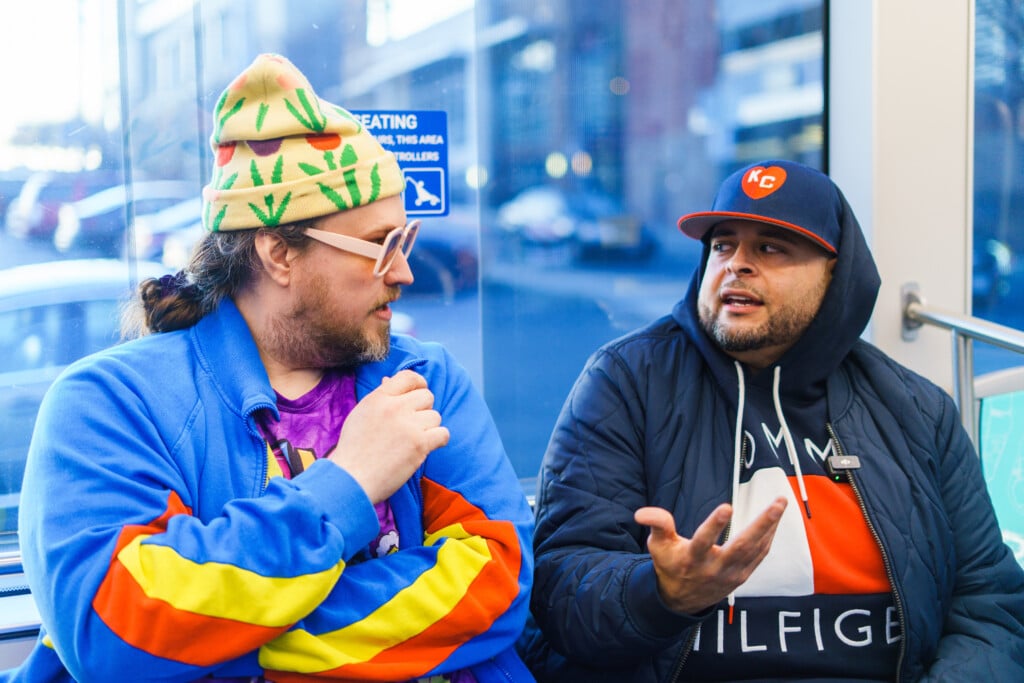
It’s not all fun and games for KC-based IGN reporter Rebekah Valentine

It’s not all fun and games for Rebekah Valentine.
As a senior reporter for IGN, the world’s biggest gaming news site with over 479 million monthly viewers, it’s her job to peel back the glitter and dopamine of a multibillion-dollar industry to expose patterns of harassment, misogyny, and unfair labor practices. “I love video games, they’re great,” she tells me. “I would still be a journalist if I did not love video games.”
When layoffs rocked IGN staff in early August, it came as a blow—but not a surprise. Layoffs in early 2024, consolidation, slashed budgets, and voluntary buyouts all presaged that IGN would not be spared the specter of restructuring that has haunted similar sites over the last few years. But thanks to the efforts of Valentine and her colleagues, they had something with which to defend themselves: a union.
“We see the world writ large knocking at the door,” said Valentine. “We see the pangs of politics, and a disrespect for labor, and money, and venture capital, and all those things just sort of tapping on the window, and we would like to protect the things we love.”
The games industry is something of a Wild West in the media landscape, with much money to be made and relatively little oversight. But while powerful cash flows could easily wash away Valentine and her peers individually, their union has made them a much tougher stone to budge.
How IGN was unionized
Despite unions being entrenched in culture and enshrined in law, the process of forming one is shockingly medieval. “It was done in secret,” Valentine said. “It’s kind of rough and ready.” What began as a conversation over drinks grew into a Discord channel, then an organizing committee. The NewsGuild, a subsidiary of the Communication Workers of America, trained those organizers on how to proceed without provoking potential union-busting tactics. “You don’t want to end up in a situation where you walk up to your coworker and say, ‘Hey, you wanna join a union?’ and then they run to the boss and rat you out.”
Unions are legally protected, but when it comes to reprisal, things aren’t so simple. “If I become someone who’s outspoken at work—if I start walking around in a union T-shirt with a union pin, if I start posting on Twitter about the union, if I show up to a rally and hold a sign—then my manager is going to see that and think I’m not loyal to the company.” Disloyalty is not a fireable offense. But as with all matters relating to corporate restructuring, it’s never quite clear why people end up on the chopping block. ”That’s a real fear people have, and it’s not unfounded!”
So Valentine and her co-organizers made a list of coworkers they could be sure would come on board.
Next, they approached those they were less sure of, before finally testing the waters with potentially anti-union colleagues. Having garnered a supermajority of support from IGN’s editorial and creative teams, the union was ready to make itself known.
In February 2024, the newly minted IGN Creators Guild anxiously awaited a response from their corporate owners at Ziff Davis, a multi-billion dollar media conglomerate with holdings as miscellaneous as CNET, Everyday Health, Mashable, AskMen, and BabyCenter. To their relief, both Ziff Davis and IGN voluntarily recognized the union, an olive branch corporations might extend when it’s clear that a union won’t be easily busted.
How unions protect their own
The IGN Creators Guild was hardly able to catch its breath following this victory. Over the next year, IGN lost many members and regained few. Layoffs, voluntary employee buyouts, and general attrition placed greater pressure on the existing team, while a hiring freeze and slashed freelance budgets concentrated that effort more squarely on the already haggard employees. “Every department feels shorthanded,” Valentine said. “When I got hired, our news team had five people. We have three now”— that includes IGN’s gaming and entertainment divisions—”and two of them are in the UK.”
All of this culminated in the August layoffs, which came at the tail end of a busy summer. National press events like Summer Game Fest and San Diego Comic-Con demanded nonstop reporting, as well as the company’s own inaugural IGN Live fan event, an “all hands on deck” operation which drew crowds with events and demos from big names like Nintendo and Critical Role. Meanwhile, the daily news cycle continued at its regular clip.
Then, a statement released by the IGN Creators Guild announced that 12% of the union had been let go due a cost-cutting mandate by Ziff Davis. (Its sister union, the Ziff Davis Creators Guild, lost 15% to layoffs just days prior.) “This is perplexing to us,” the union wrote, “as we are told again and again that IGN Entertainment has had a tremendously successful year thus far thanks to [affected employees’] hard work.” Despite year-over-year revenue growth, several “costly acquisitions,” and assurances that IGN staff were necessary to compete with the rising tide of AI, already threadbare teams were further winnowed.
As seismic as these cuts were, the IGN Creators Guild won its laid-off members significantly better severance, including an extra 30 days for IGN’s failure to notify affected members in advance; two months of company-paid health insurance; and a recall list, ensuring that if vacated job titles are rehired, they will be filled by the people who originally occupied those roles.
The union’s bargaining position also allowed them access to information, cutting through some of the confusion. Corporate strategy is opaque at the best of times, but as often as the union’s questions were buried in legalese—Valentine recites, “‘A lot of your inquiries are highly duplicative, overly broad, unduly burdensome, subject to attorney-client privilege, otherwise not relevant to this matter’”—many were ultimately answered. “And now we can share information with each other.”
On the one hand, a bargaining unit can only do just that: bargain. “There’s no world in which a union is going to be able to fully prevent all layoffs everywhere ever.” But with the visibility provided by a union, restructuring can be knocked down the list of viable strategies for corporate owners looking to boost their year-end revenue. “We can make it really annoying—annoying and expensive—so that way if they’re laying us off, we want to make it so they’ve exhausted every other possible option before doing that.”
Currently, the IGN Creators Guild is taking proactive measures to make the company put its money where its mouth is. The union’s work-to-rule initiative (affectionately called their “do our job” strategy) encourages members to work to the letter of their job description: keeping normal hours, not taking on additional projects left by laid-off coworkers, and taking back overtime when necessary. Journalism is an unpredictable field at the best of times, and the hope is to highlight the necessary role played by laid-off IGN employees—like senior features editor Matt Kim, streaming editor Amelia Emberwing, and video editor Chelsea Reed Miller—to the success of the site. With their peers’ solidarity, the intent is to bring some of these people back.
The state of games media
Video games pull in upwards of $180 billion annually, according to 2022 data collected by Forbes. That same year, the film and music industries brought in just over $50 billion combined. And yet, despite the scrutiny that such a profitable industry ought to demand, games are not particularly mainstream. The Game Awards are not the Oscars; Xbox Game Pass is not Netflix.
As Dr. Emily Price, a columnist for the gaming magazine Unwinnable, notes, “About half the people in the world play video games of some kind, but coverage of them outside specialized outlets is almost nowhere.” And author and industry insider Jason Schreier estimated early this year that there are “maybe two dozen people with full-time jobs in the video game press right now.” He gave that estimate before Polygon, one of the only gaming news sites to rival IGN, was purchased by Valnet and subsequently gutted.
The incentives to suppress journalism in this space are clear. With so much money to be made in games—an industry that receives special attention from Saudi royalty, including its recent $55 billion purchase of Madden publisher EA; an industry in which the exorbitant profits of Microsoft’s gaming division directly funded surveillance of Palestinian civilians until recently; an industry where critically and commercially successful games are met with studio closures and mass layoffs—dedicated watchdogs like Valentine face severe resistance. As the apparatus monitoring the industry withers, the need for its remaining defenders to band together only amplifies.
Games make an excellent petri dish for the agonistic relationship between laborers and private equity. In fact, games media and games themselves have wound up on opposite ends of the struggle: games, phenomenally profitable, continue to have their protections dismantled to achieve unchecked (and highly consolidated) growth; games media, foremost among those protections, continues to shrink, resulting in a workforce that is underpaid and overworked.
But the endless funnel of wealth via mergers and acquisitions, constant restructurings, and ill-advised pivots to AI affect all industries. Unions represent a means by which employees can stand toe-to-toe with these machinations, reminding corporate owners that their profits originate from labor. As the IGN Creators Guild put it, “Without us, there is no IGN.”
Tending the garden you’re in
For Valentine, unionizing doesn’t come from a sense of enmity for IGN’s management or a desire to reshape its identity. Quite the opposite. “I love my job!,” she says. “I want to keep my job!” With so many of her peers going independent, the benefits of working under a larger umbrella are drawn in sharper contrast. “Like boo capitalism or whatever, but we have a functioning HR department. That is incredible.”
Opportunities for advancement across industries seem ever-dwindling, especially for young people just now entering the workforce. For many people, switching jobs seems like the clearest path to securing advancement. The IGN Creators Guild’s members opted for a different path, one built out of a sense of responsibility for the conditions in their industry. “They loved the work that they did, they loved their colleagues, and they wanted to do more of those things. But they saw everything that was happening around them in the media landscape, and they said ‘Man, this might be coming for us. We want a shield against that.’”
It’s been a consuming and sometimes risky endeavor. But at the same time, what started as a conversation over drinks has resulted in real protections, allowing Valentine and her colleagues to continue doing the important work that they love.“Unionizing my workplace was probably one of the most fulfilling things I’ve ever done.”
In addition to securing better working conditions, Valentine says that the process has built solidarity between her coworkers across departments. People she had never spoken to previously are now fellow union members she knows she can rely on. “You can accomplish so much when you get everybody pushing together in the same direction.”