For trans KC, joy as an act of rebellion is a permanent path

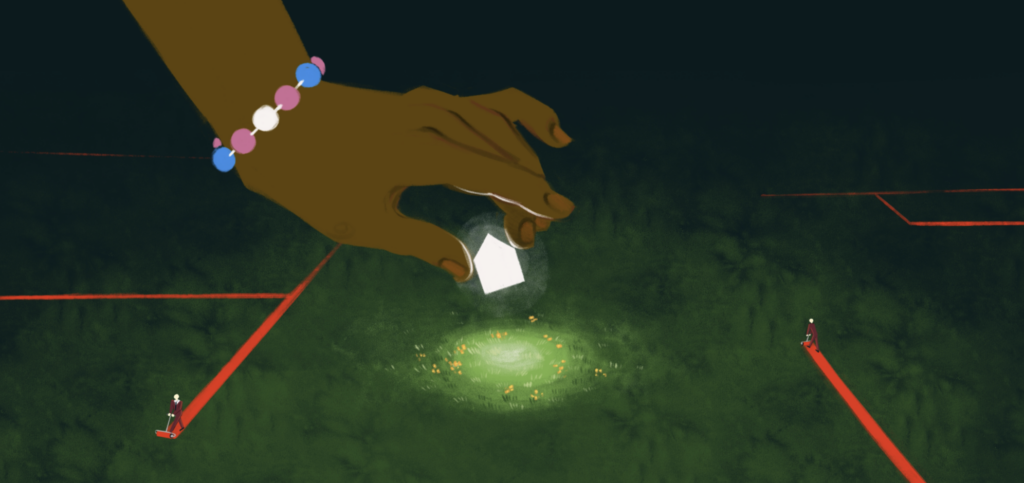
Art by Teddy Rosen
THEY HAVE TRIED TO ERASE US WITH MAPS
In early September 2025, Missouri Republicans advanced a redistricting plan that would split Kansas City into three separate congressional districts.
The plan threatens to divide Black, immigrant, and LGBTQ+ communities, voters who currently stand together in Missouri’s 5th District. The Missouri NAACP called the proposal unconstitutional and filed suit within days, warning that it was created to push communities of color out of political power. This is not just a political move. It is an attack on voice, belonging, and visibility.
And still, we move.
Not because life is easy, but because we have made it ours.
Advocacy groups are in Jefferson City and across the state doing important work to track bills and fight for protections, but the work of staying human happens closer to home. It happens in kitchens. It happens in living rooms. It happens in the small, unplanned moments where community becomes a verb instead of a title.
I felt that truth settle in again the night a group of us gathered for fried fish and spaghetti.
Yes, I know some people insist those two things should never share a plate, but they taste good when the right hands cook them and the right people sit around them.
We ate family style and laughed until we forgot half of what we meant to talk about. Sitting there, passing plates across the table, I realized every person in that room carried a different piece of what joy and resistance look like in Kansas City. These were not random voices. These were people who shaped the way I understand care, memory, and what it means to stay rooted.
RESILIENCE HAS A ZIP CODE
Kansas City has a way of turning ordinary days into reminders of how much people care about each other.
This summer, families filled parks for picnics and movies. Drag brunches doubled as voter registration drives. Local artists used gallery openings to tell the truth about what our communities face. Pride season brought more than celebration. It brought purpose. People passed out water on hot days. They offered rides to hearings. They checked in on friends who had spent hours testifying at the Capitol. Elders shared their knowledge with younger activists. High school students created affirming spaces in towns that did not always feel welcoming.
These are not isolated moments. They are a pattern shaped by what people in Missouri are up against.
Research from the Williams Institute shows transgender people face violent victimization at more than four times the rate of cisgender people. Everytown Research reported in 2024 that most transgender homicide victims were killed with firearms. Housing is another pressure point. According to the Williams Institute, nearly one in five transgender adults experienced homelessness in the past year. LGBTQ youth make up an estimated twenty to forty percent of young people facing homelessness in the United States.
These realities influence how people move through Kansas City. They shape why community networks have become essential. The small actions people take every day are not random. They are part of a larger system people built because the official systems rarely meet the need. Sitting at my table that Thursday night, surrounded by people who show up without being asked, I saw the same pattern. Support does not always look formal. Sometimes it looks like people gathering after a long week simply because being together keeps everyone steady.
The support people offer in Kansas City is not accidental. It comes from years of organizing experience, survival knowledge, and community leadership. Across the state, individuals and organizations push back against harmful legislation. Some show up at the Capitol. Some gather signatures. Some mentor young people. Others focus on local networks that help people manage daily life. In Kansas City, that work takes many forms.
Community members share housing leads and health resources. They run supply drives with no cameras present. They offer rides to medical appointments. They help someone get through a hearing or a court date. The work is steady, practical, and often unseen.
This type of support is a response to real gaps.
Redistricting battles, limits on gender affirming care, and underfunded housing programs all create instability. Community networks help fill those gaps before they grow into crises. The planning underway for Dee Dee’s House is one example. It will be an independent living program for trans people named for my aunt, Dee Dee Pearson, who was killed in 2011. The space is not open yet, but the preparation work has already brought people together.
It reflects a simple truth: When systems fail to create safety, communities build their own structures.

THE PEOPLE WHO SHAPE THE WORK
These are the people who remind me what this work feels like in real time.
For me, the story begins with Korea. I met her when I was thirteen. She became my chosen mother long before I had the language to explain what chosen family was. Now I am 37, which means she has walked with me longer than almost anyone. When I asked her what keeps her going when life gets heavy, she answered without hesitation.
“Family and friends. And sometimes just solitude.”
For Korea, solitude is not isolation. It is music. It is cooking her favorite meals. It is making food for others so they feel cared for. She sees Kansas City reconnecting in ways that feel familiar, almost like the early 2000s. People are meeting up again. People are finding each other in person instead of only online.
“People are starting to connect again. Like they used to.”
Beside her sat Pam, my sibling in the House of Cavalli. She is a newer addition to the family. The elders recently approved her to bring banana pudding to Thanksgiving. That might sound simple, but in our world, it is a clear sign that someone belongs. When things feel heavy, Pam looks for one thing that helps her slow down.
“I find one creative outlet. A craft project or reorganizing a room. It helps me calm down.”
She sees people showing up for each other during holiday drives and community meals, especially for the unhoused. What she is trying to protect right now is peace.
“There is so much going on. It is easy to feel forgotten or alone. People need a peaceful and healthy community.”

Art by Teddy Rosen
Across the table was Romeo. Most people know him on stage as Romeo Eros Shawn, but to us, he is Niquo. My big and little brother. The protector. The one who lifts the heavy stuff and fixes things girls like me do not want to deal with. But it is deeper than that. He cares. He pays attention. He is getting married in February to our sister Marie, also known as DJ Smiles. Their relationship gives me hope that I might eventually stop working long enough to focus on the love department.
When I asked what he is holding onto right now, he kept it simple and honest.
“My family and my chosen people. They choose me and I keep choosing them.”
Next to him was Jamez. The baddest in any room he walks into. We have performed together, and no matter how long it has been, we fall back into sync like we just rehearsed yesterday. When things feel heavy, he goes back to his roots.
“I look at where I came from. I pray. And then I remember where I’m going.”
He sees the gaps in support across the performance scene in Kansas City. He sees who gets uplifted and who gets overlooked. What he wants most is a community that does real work outside the spotlight.
“Give back by doing actual work in the field. Not just a benefit show.”
Then there was Xolani. They describe themself as a quiet teddy bear, and that is exactly right. They do not talk a lot, but when they do, it means something. Movement keeps them grounded.
“Listening to music and dancing. No distractions. Just me and the music.”
What they are protecting right now is simple and true.
“Self-respect. And the chance for people to accept one another.”
And then there is Chloe Parish. I have judged her in pageants and watched her grow. She does not just sing. She stands flatfooted and sings with her entire spirit. Her voice fills a room so fully that it becomes its own kind of prayer. That is why I booked her for Trans Women of Color Collective’s Rhythm of Resilience Festival in 2024. When life gets heavy, she goes back to music and the goals she sets for herself.
“There are so many songs that relate to how you feel. But I keep going because I want to reach the goals I set. I know I can achieve them. I never give up and I keep looking forward.”
She sees Kansas City as a place that knows how to show up.
“Kansas City shows up for Kansas City. Always. It does not have to be charity. People show up for each other in many ways.”
What she is protecting is her light.
“People try to take it. You have to stay strong in who you are. When we protect that light, it keeps us strong and it keeps the community strong.”
Listening to her reminded me that strength can be quiet. It can be soft. It can be a voice rising inside a crowded room.
WE ARE STILL BUILDING
We organize pop-up markets. We host affirming clothing swaps. We build tools that help people find housing and healthcare. We share food. We rest. We learn. We remind each other that we are not disposable.
Missouri can redraw maps as many times as it wants. Those lines will never capture the lives being lived in this city. They will never show the creativity, memory, or strength that holds people together.
We are not waiting for joy to arrive.
We are building it ourselves.
One meal. One gathering. One neighborhood at a time.
And if fried fish and spaghetti can taste this good together, imagine what else we can make work.