Bill to make transgender athlete ban permanent passes Missouri House
Despite unclear enforcement mechanisms for restrictions on transgender athletes, House lawmakers approved legislation to remove the law’s expiration date.

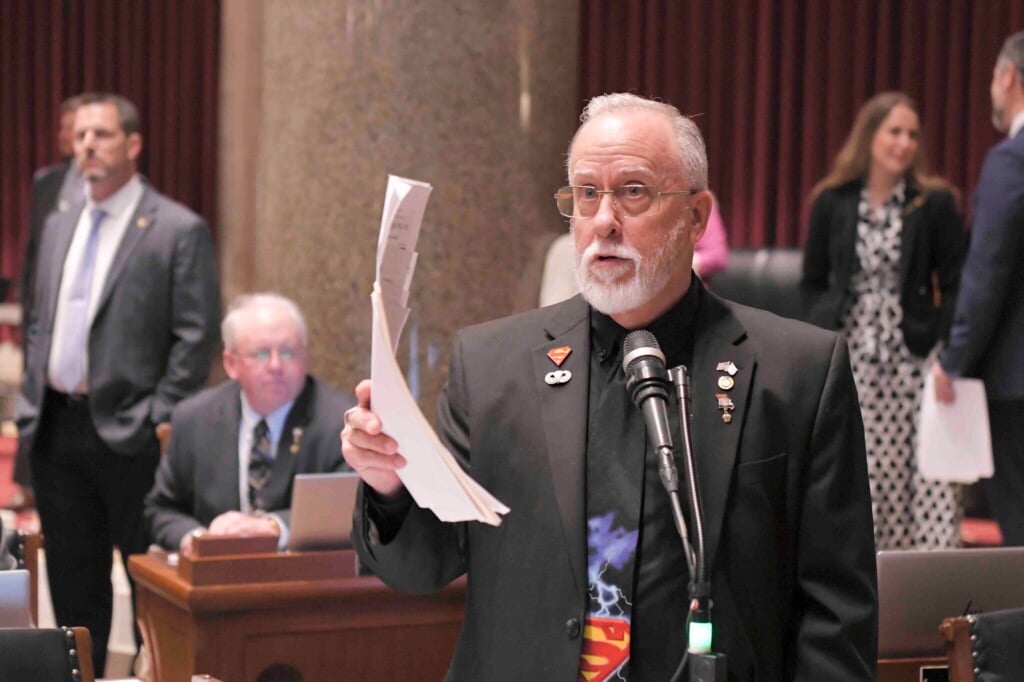
The Missouri House on Thursday passed a bill sponsored by state Rep. Brian Seitz, a Branson Republican, that would remove a sunset on the state’s law barring transgender athletes from competing according to their gender identity. He is shown speaking in a March 2025 House debate. // Tim Bommel/Missouri House Communications
The Missouri House passed a bill along party lines Thursday that would remove the expiration date on the state’s restrictions for transgender athletes.
In 2023, the General Assembly passed a law that prevents transgender athletes from competing according to their gender identity alongside a ban on gender-affirming care for minors. Democrats in the Senate filibustered the bill, leading to a compromise that added a four-year expiration date.
Every year since the law’s passage, lawmakers have filed bills seeking to scrap the sunset.
During Monday’s debate, House Democrats said that the provision gave lawmakers time to consider research on transgender athletes and determine whether restrictions were fair. That learning process, they argued, is not complete.
“Removing the sunset should only happen if we as a collective have undertaken a thorough review and study about the topic,” said state Rep. Pattie Mansur, a Kansas City Democrat. “We have not discussed this topic as a collective.”
The bill’s sponsor, state Rep. Brian Seitz, a Republican from Branson, said the expiration “was just a matter of capitulation.” Making the restrictions permanent, he argued, is necessary to “give female athletes a level playing field.”
Allowing transgender women to compete “undermines the fairness and opportunity” for women to succeed, he said.
Other House Republicans spoke about maintaining a competitive environment for women’s athletics, saying transgender women had an “advantage.”
“If we erode sex-based protections in athletics, we do not expand opportunities,” said state Rep. Cathy Jo Loy, a Republican from Carthage. “We would collapse the very category that allowed generations of women to compete fairly.”
Prior to the law’s passage, regulations on transgender athletes were left to organizations like the Missouri State High School Activities Association and the National Collegiate Athletic Association. MSHSAA’s policy allowed transgender athletes that have been taking hormone-suppression medication for at least one year to compete according to their gender identity, opening the door for 12 transgender athletes to try out for school athletics from 2012-2022.
State Rep. Wick Thomas, a Kansas City Democrat and the House’s first nonbinary member, pointed out that more bills have been filed targeting transgender athletes than the number of transgender athletes in Missouri high school sports.
“That seems like an incredible misuse of time and taxpayer dollars to spend so many hours, every single year constantly attacking those 12 kids who tried to play recreational sports with their friends,” they said.
Thomas also worried about the law’s enforcement, saying “anyone deemed too masculine will be under investigation.”
The law gives authority to the state’s education and higher education departments to establish enforcement mechanisms, but neither created such rules. A year after the law became effective, education department officials denied any responsibility, telling The Independent that the department “is not involved in school athletics and activities.”
The legislation also gives students and their guardians the ability to sue if they are “deprived of an athletic opportunity” because of a transgender athlete in Missouri.
State Rep. Raychel Proudie, a Democrat from Ferguson, told lawmakers Monday that she didn’t intend to speak during the House’s debate of the bill. But thinking about how people might try to enforce the restrictions worried her.
The law may have an outsized effect on Black women, who Proudie says are too often “masculinized.”
“How do we enforce this when someone decides they don’t want to face an athletic team and says the players look a little too masculine,” she said, worrying that they might inflict “invasive tests” to determine an athlete’s sex.
Seitz did not comment on the prospect of athletes being subject to physical inspection, reiterating that the bill was only “removing the sunset” from a law currently in effect.
The bill now heads to the Senate for consideration.
Missouri Independent is part of States Newsroom, a nonprofit news network supported by grants and a coalition of donors as a 501c(3) public charity. Missouri Independent maintains editorial independence. Contact Editor Jason Hancock for questions: info@missouriindependent.com.