Beck Kubrick’s Dead Girls is a subversive slasher graphic novel you need to read

Beck Kubrick. // photo by Beck Kubrick
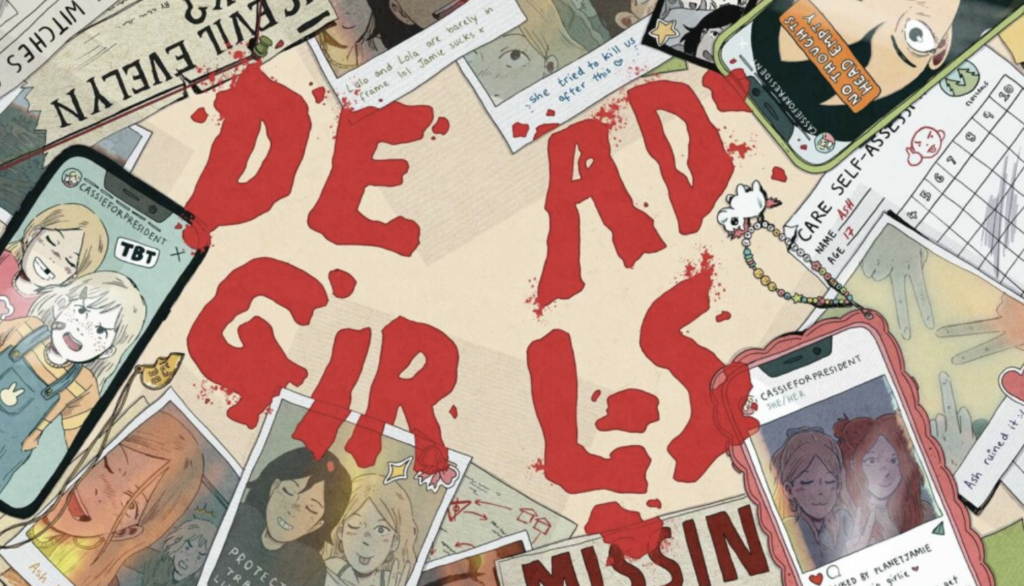
The cover of Beck Kubrick’s debut graphic novel, Dead Girls (out now from Simon & Schuster Books for Young Readers), features its protagonist, Ash, spotted with blood, holding an ax, and standing atop a pile of furry heads.
The tagline reads, “Girls Just Wanna Get Even.”
If you’re not immediately tempted to crack this one open and devour it on the couch, we don’t know what to say.
In Kubrick’s Dead Girls, “The teen daughter of an infamous serial killer must prove she isn’t the one behind recent copycat murders” in “a campy, feminist send-up of slashers that both celebrates and subverts classic tropes. It’s a delightfully illustrated graphic novel that’s, by turns, brutally violent, viciously funny, queer as hell, and will definitely make you cry. The book is the perfect read to kick off your creepy season, and you’ll definitely find yourself recommending it to everyone you know.
We hopped on Zoom with Beck Kubrick to talk about Dead Girls and how their debut came to be.
The Pitch: I saw on your site that this originally went out as a pitch back in April of 2023 and is coming out in September of 2026. That’s almost three and a half years. How has this process been for you?
Beck Kubrick: So I don’t think it actually went out in April 2023. I really wanted it to. I think maybe I was just being, like, really optimistic. I think at the time there were just some timing issues with other projects and other pitches, so it did actually go out later in the year. It’s not that insane, but it’s still, yeah, it’s pretty insane.
It’s been really good. I’ve come from a small press world where I’m in charge of everything, and I can make a book in two weeks and get it printed in a week, and then it’s out in the world, so there was something really interesting about metaphorically having a bunch of other people standing around my desk looking over my shoulder and being like, “Do a good job,” and it is a long time, but book marketing takes a long time. It’s pretty standard for novels or anything.
Also, drawing takes a long time. The Mona Lisa took four years, and that’s just one drawing. So not to brag, but I’ve done so many more drawings than that. Yeah, no, it’s been really cool. There is also an interesting thing that maybe–I didn’t know it, so I’m assuming other people don’t know it–but there’s a lot of things in publishing I find out that are very common knowledge to the average person I just somehow didn’t know.
You need at least nine months from sending to print to release day, ideally a year. A third of that time was just, I finished the book; now we wait.
 The finished product is this amazing thing, in addition to what is between the covers. The hardcover edition is just awesome. It’s got foil print on the title. It’s got a dust jacket. Were you expecting such a deluxe release?
No, not at all. When we pitched this book, I had been trying to, let’s say, I’d been trying to contort myself to fit what I thought was editorially attractive. I was trying to appeal to editors. I’d been given certain bits of advice that sort of pigeonholed me, so I was like, “I need to do this to get any traction,” and that’s a really terrible way to work.
I wasn’t really getting much going, and then I was like, “I’m just gonna make something that’s painfully me,” and my agent was like, “Ooh, should we maybe tone down some of the weirder bits?” and I was … my agent is lovely. She’s never censored me but she was like, “Oh, should we maybe tone down some of the violence and the weirder bits?” and I was like, “Let’s pitch it as is, and we’ll see,” and then they just liked it, and it feels like I don’t know how I keep getting away with this.
Some of the scenes that I won’t spoil, but I added that got even weirder. I don’t think the unicorn was maybe in the first pass, but when we were negotiating how violent can you be in a YA, I was like, “What if it’s really cartoony?” so then I was super lucky with everyone I worked with: editors, designers.
I’m so glad you brought up the unicorn because Cassie and Dr. Almond Butter are my favorite parts of the whole book. I wasn’t expecting Cassie to turn into this. Obviously, as the book progresses, it becomes more of an ensemble piece rather than just being strictly about our main character. You mentioned that the unicorn wasn’t originally in there, but how did these characters find their voices for you?
I think, as I said, it started quite selfishly: I wanted characters and a story I would really enjoy and that I really liked. I love The Walking Dead and the comics, the game, everything, but by season 10, we’re having this conversation again of, “Ooh, is killing morally okay?”
I think we’ve established the universe rules in action films, and it’s like–the action hero can kill a million henchmen, but then when it gets to the final showdown, now we have to think about morality. I think there’s something really weird there, and there’s something really funny when you step back. In my real life, I’m a total pacifist. I don’t kill bugs. I’m still really upset about a fly I killed when I was, like, eight years old.
But there’s something in fiction where you are just like, “Just kill him. Just do it.” That’s the solution. That’s the narrative. Close the loop. Relating that to my friends, people I’ve grown up with, people I want to see more stories about.
Typically, final girls, horror stories–there’s such a complex history with women and girls where it’s been really groundbreaking and amazing, but also been a bit “ew”–who gets to survive and why, because they’re really pure and virginal and whatever, and then how they are portrayed.
“Not like other girls.”
“Oh, pretty, but she doesn’t know it.”
There are a lot of things. I’m not saying I’ve solved every problem ever. We just need more stories from more people. But yeah, the characters were really just, “I want people who feel real.” I think for all of my characters, I try to find what their desire is and how that motivates them. Even the bad guys, even the baddies, even the furries. They’re all people I know and love
The whole of Dead Girls does feel very real and drawn from a real place because it does feel like that friend group that you get into when you’re at the fringes of high school. You’ve got your very outcast character. You have your very happy, bubbly, anime-loving friend. They all just come together and coalesce in a way where they can only be friends with each other. I love that, where it’s the found family aspect of it, which I think is really important, given that you have a character who doesn’t really have a family anymore as the impetus for all of this.
Yeah, I have a weird relationship with the found family trope, ’cause it’s obviously so beloved and I’ve written a story about it, clearly love it. But there’s something about the title that, again, selfishly, Ash is sort of me. I’ve definitely been her at one point in my life, and I think even the term “found family,” at one point, would’ve annoyed me.
I was like, “No, no family, just based on the word alone. How dare you?” and I think Ash is very much that, and that’s why there isn’t really a moment where it’s like, “I have my family. You’re here.” It’s more about the actual action of showing up and doing this and killing some people together. That’s the bond. It is the hard work.
Going back to what you were talking about at the beginning, it’s the fact that everybody comes to the conclusion via a different path, but everybody in this friend group kinda gets to the point of, “Yeah, we gotta take down these fuckers. This is how we stop this. We can’t muck about and do it halfway. Let’s get some weapons. Let’s make a plan. Let’s take ’em down,” which is very different, I think, from your usual teen slashers.
No, absolutely. I do jokingly say that Dead Girls takes place in a world that’s a lot like our own; everyone’s just a little cooler with killing. That’s it. I do like those sort of heightened realities. I think of Twin Peaks or Widow’s Bay, where everyone’s just a little quirky, a little off. They wouldn’t necessarily be out of place in our reality, but they’d be the guy that you warn someone about.
I wasn’t consciously thinking about feminist theory or critique or anything like that. I was truly just thinking about my life, the expectations that you feel growing up, and just that frustration you feel when you watch films sometimes, and you’re like, “Just do this,” “Don’t go in there. The killer’s in there.”
You want the characters to do everything right. And I’m not saying my characters do everything right, but I feel like I tried my best to make it all feel justified and logical. There was a little “We need the convenience,” so the killer gets them again. I find myself really drawn to stories that trust the audience, so I was trying to trust them to know these tropes. I didn’t want to have a page where I explain, “These are the tropes of horror films,” or whatever. Maybe that would’ve been more helpful. I don’t know. Readers, let me know. But I’m trusting them.
There’s a film called Palm Springs with Andy Samberg. I hate time loop films or stories, and part of the reason is that they spend so much time showing you the time loop. They spend so much time explaining it. We all get it. After Groundhog Day, we all know. And then in that film, Andy Samberg’s character just comes down, and they’re just like, “Hey, stuck in a time loop?” “Yeah, you too? Great,” and we get on with it, and that’s just what I wanted.
I just wanted that evolution of we get it. We get the tropes. We get the moral quandaries. We get all of that. Let’s have some fun. Let’s be a little silly.

Dead Girls splash page. // image courtesy Simon & Schuster
The book is fun, and it’s silly even as it is extraordinarily violent. The thing I really appreciated about your art in this is that it’s detailed. There’s so much stuff to be found in the background, especially the splash pages at the beginning and very end of the book, which I think are great bookends. But it’s also bright. This is a colorful horror graphic novel which I feel is very different than a lot of the stuff I’ve read. It’s not all blacks and reds.
No, absolutely. And I’m really glad about that because that was something I didn’t want it to look really boring and samey. We’re drawing pictures. We can have fun. Just with my pen, I can change the reality. I can change the art style. I can change the medium to reflect the characters’ emotional states, their imagination, their dreams, whatever.
I was working with Knack Whittle, and they had worked on a book called The Hills of Estrella Roja as a colorist for my friend Ashley. I really loved that their nighttime scenes weren’t just “slap a gray filter over everything” to make it dark. I think also because a huge part of the story is this dichotomy of we traditionally think of girls a certain way and expect certain things of them, and then there’s all this horror and insanity happening, and it’s combining that.
I think the art style reflects that: reflects them having fun, reflects their emotions, reflects all of these things. I love a desaturated color palette. Sometimes, Knack would send me a page and I’d be like, “That’s really bright, but it works. It works. It’s great. I love it.”
Did you have a soundtrack for when you were putting this together? It feels very punk rock, but I don’t wanna put anything on you musically.
No, I didn’t. When I write, I can’t listen to music with words. I listen to instrumental math rock, Home Alone by Totoro, or The Sims 2 soundtrack.
But inspiration, ideas, stuff like that? The idea came from “Dead Girls” by Penelope Scott and a lot of true crime. Those were the main ones. It’s a very subtle inspiration, having the exact same name as it. But there were tons of artists who inspired it. Kiki Rockwell has “Burn Your Village Down,” where the child not embraced by the village burns it down to feel its warmth, and it has these witchy, spooky vibes.
That’s very much Ash’s story of, she’s been told she can’t be innocent. She has to be angry. She’s grown up into this angry person, but they’ve accidentally made her really strong and cool, and now she can fight, and now she’s gonna save the day. You accidentally made a hero, guys.
And then, yeah, just the longest line of cool not even necessarily punk, just anyone who’s doing their own thing. I love hyperpop. I do like punk, artists like Ashnikko, Slayyyter. I think Ash definitely has that aesthetic of she’s a bit grungy. There’s a line in Juno, the Diablo Cody script, the way she’s introduced is “artfully bedraggled,” and basically just every character I write, I’m just like, “Yeah, they’re artfully bedraggled.”
True crime plays a good part in Dead Girls, and I feel like we’re going through like a mild reckoning with true crime right now, in terms of the good or possibly bad it can do. Are you a true crime person, or was that more research for the book?
I have thoughts on true crime. I’m a person who really likes facts. I really like information. My goal in primary school was to stop reading non-fiction books because I was just reading the Guinness World Records and Horrible Histories and just being like, “Hey, everyone, wanna know a fun fact?” I do like information. I totally get it. I was very into the JCS YouTube channel when that was really big, when he would just post this hours-long footage of interrogations and explain stuff. I think it is really interesting, and I totally understand the desire to know about morbid and messed up things.
As the Penelope Scott song “Dead Girls” explores, and lots of true crime, I think there is a sensationalization around it. There is a commodification and mishandling of victims, of who gets to be a victim, who’s the right victim. We all like stories. We all like scary stories. We like urban legends. They’ve been passed down. They keep us safe. They’re amazing things. Not to sound like I’m 14 and just read Nietzsche for the first time, but capitalism ruined it all. If we could just tell each other spooky stories, that’d be great, but no, you have to turn it into a podcast, and it has to be shocking. You have to have a thumbnail where you’re doing a big whoa face. Every gory detail has to be bigger than the next, and the autopsy photos are on Patreon for $20 a month, and it gets a little crazy.
That’s why I just wanted to have a conversation about it in the book. I didn’t wanna be like, “This is the worst thing in the world,” or, “This is the best thing in the world.” I just wanted to say, “Hey, that’s a little crazy, isn’t it? Maybe we don’t need to be doing all that.”
I do love the fact that at the end of it, Dead Girls is, as you said, telling a scary story. We get to go along for this ride of both redemption and vengeance, which are two things I don’t think we get enough of in the world today. Thank you so much for giving me 300-plus pages of that.
No, absolutely. There’s all this good for her and the rise of coming-of-age films, and there’s so much warranted rage to be felt and to be explored, but I also wanted to do it in a way that compounds with Ash just being a bit emotional. She’s a teenager; that’s hard. That’s its own horror story. Your brain is developing, your body is changing. You’re growing, you’re changing. There are weird goopy bits. It’s a whole thing.
I think we all go through that, hopefully with less serial killers. Ash is becoming her own self, but within the confines of what people have projected onto her. Is she technically a serial killer? Who’s to say? It’s if you kill more than two people, maybe she has done that. Who knows? But she’s done it on her own terms, and sometimes that’s all you can do.
I think, technically, ’cause a lot of it does take place over one night, she’s technically a spree killer at this point.
That’s what you think.
Beck Kubrick’s Dead Girls is out now from Simon and Schuster Books for Young Readers.