Being Heumann screenwriter Rebekah Taussig discusses telling disabled stories
Taussig, a Kansas City-based writer, will present Being Heumann at Glenwood Arts Nov. 13.

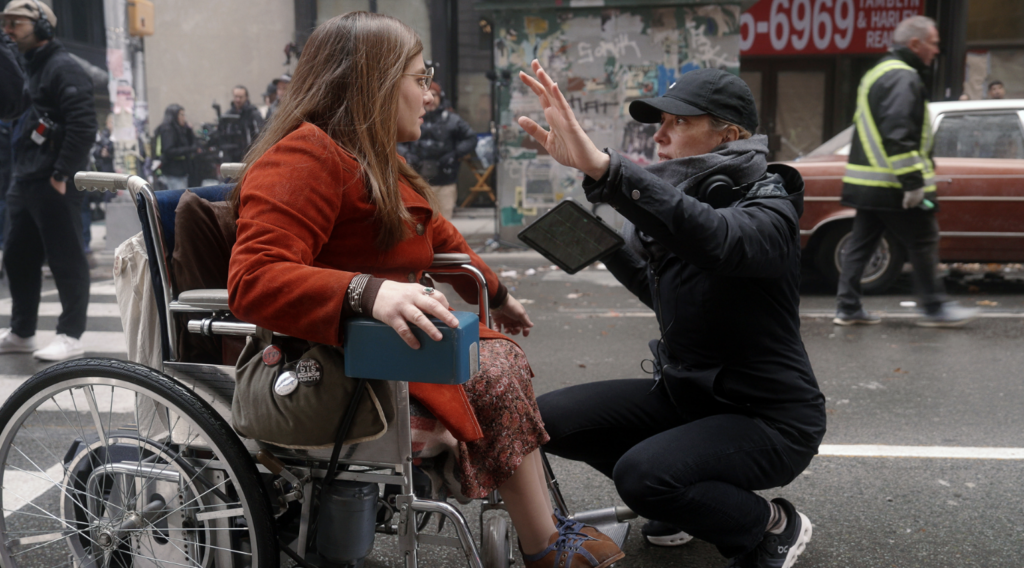
Ruth Madeley and Siân Heder in “Being Heumann,” premiering November 13, 2026 on Apple TV.
Kansas City writer Rebekah Taussig is no stranger to sharing her perspective with others. Her 2021 essay collection Sitting Pretty: The View from my Ordinary Resilient Disabled Body shared intimate, honest, witty observations from her life as a disabled person. She followed that book up with We Are the Scrappy Ones, a picture book, last year. Her Instagram account, sitting_pretty, boasts nearly 66,000 followers.
Now, Taussig is adding a new accomplishment: Screenwriter. In her latest venture, Taussig collaborated with Oscar-winning writer-director Siân Heder (CODA) on the screenplay for Being Heumann. The film, adapted from disability rights activist Judy Heumann’s memoir of the same name, is a biopic of Heumann’s life and her role in the landmark San Francisco sit-in pressuring lawmakers to sign section 504 of the Rehabilitation Act of 1973, one of the first U.S. federal civil rights laws offering legal protections for people with disabilities.
Taussig will be at the Glenwood Arts Theater for a special Q&A following a screening of the film this Friday, Nov. 13, to talk about her experience working on the film. The screening will have open captions, with audio-visual aids and wheelchair accessible seating available, and an ASL interpreter assisting during the Q&A portion. Full details on accessibility resources are available on the theater’s website.
Abby Olcese, The Pitch: How did you get connected with this production?
Rebekah Taussig: Siân Heder read Sitting Pretty around the time she first joined the project. She appreciated the immersion into the perspective of someone who moves through the world the way that I do. We had a Zoom call back in 2021 just to talk about her project and my book. It was a great conversation.
I started out as a consultant, and after that invitation to consult, I had access to this delicious archive of research, old news footage, documents, and papers. I dove into the research and was completely captivated. I’d read Judy’s book, and also read about the 504 sit-in as part of disability studies literature, but my understanding of it was legislative. The story grabbed me so hard I became a little…a lot obsessed. I was sending Siân ideas and character arcs. Eventually she asked if I wanted to co-write it with her, since I pretty much already was at that point.
What’s the process of adapting a person’s memoir into a film script like?
We had access to Judy’s book and mined that for all the juicy details. The thing about the real-life events of this story is that there were just like all these gems about what really happened. We also had access to all this archival research and interviews, and Siân did interviews too with people who participated and were still alive.
In earlier drafts, we really did try to include more of Judy’s entire arc. When you hear her story, it’s full of incredible moments. We wanted to include more of her origin story in this film, but it was just so clear in every attempt that the energy and momentum were off. It was hard for me, actually, but it was clear we had to get into the action faster, so we focused on the sit-in itself.
In terms of adapting it, that’s the portion of her story we focus on. The 504 sit-ins changed American history so profoundly, and it’s such an incredible, quintessential David-and-Goliath story.

Andrew Pilkington, Siena Rafter, Charlie Rush-Reese, Dylan O’Brien, Roberta Colindrez, Ruth Madeley and Madeline Delp in “Being Heumann,” premiering November 13, 2026 on Apple TV.
Was screenwriting a fairly new thing for you in general? What was that experience like?
I had minimal experience with screenwriting, so that was a steep learning curve for me. It was incredibly intimidating, because I had much more experience in essay and memoir and creative nonfiction, and Siân had just won an Oscar for CODA. Like, “I’m gonna take my first steps in front of this expert!” It was an exciting medium to shift into, and I was soaking up as much as I could with Siân. It was such an honor to learn from her.
Initially, it felt like I was used to the seven tools I use in writing, and suddenly five were taken away. It’s showing and telling, action and dialogue. I think a lot of people in creative mediums, once those parameters narrow, find it intimidating, but restriction is great fuel in creativity. Once I acclimated, it was exciting and fun. I want to do more of it. I’ve been working on a pilot and TV concept about a mom who uses a wheelchair, which is my own experience.
While we’re on the subject, what parts of your own experience as a disabled person were you able to integrate into this movie?
One of the things I recognized in the accounts of the protestors, one of the reasons I got so obsessed with this story, was recognizing myself in some of these stories of the people in the building during the 504 sit-in. For a lot of them, they hadn’t really ever spent a lot of time in community with other disabled people and they didn’t understand the mission.
Judy was so focused on the mission. That idea: “If the world was more accessible, we wouldn’t be different than anyone else. We have every right to be included like everyone else.” So many of these people hadn’t understood that. They grew up thinking disability makes exclusion inevitable. For them to come into this building and spend time with peers and friends and this cohort, for them to transform in the presence of each other, it’s easier to understand why the world is better when it includes your friend who is disabled. If you can see it for this friend and that friend, you can see it for yourself.
I grew up thinking exclusion was inevitable in a lot of ways, but a different kind of exclusion, the 90s kid version of it. Meeting other people changed that for me. That was an exciting thing for me to bring to the story. The scene where Judy convinces the protestors they need to stay in the building, that they’re not the problem, that the world should be so lucky to have them in it, that scene for me is the one I get emotional about. The words we put into Judy’s mouth in this scene are the ones I would have said to myself, that disability is not a good reason to shut someone out of community.
Also, the steamy freight elevator scene (between Judy and an ASL interpreter) is special to me, wanting to include a scene that has disability intimacy, and the way care can be playful. That felt important to me. It’s amazing how little we see steamy disability scenes.
I really liked that moment! It actually reminded me of a lovely post I saw recently from Bella Roberts, who’s a film editor and influencer in the UK, about the relationship in Notting Hill between Tim McInnerny and Gina McKee’s characters, that scene with him carrying her up the stairs.
For a long time, Notting Hill was my only picture of a romantic relationship that included disability. It wasn’t even a huge part of the movie, but it was incredibly powerful for me to see. It’s such a great picture of a way that storytelling makes its way into real life!
View this post on Instagram
My first exposure to Judy Heumann and the disability rights movement was the documentary Crip Camp. How did you first learn about her?
I probably first learned about Judy just through my disability studies work. Reading her book was incredible, and it came out the same summer my book came out. I got to meet her that summer when I moderated a panel she was on through KU.
There is something really different between reading something academically and then having it brought to life in memoir and interacting with her over Zoom. Her presence was astounding, even through the Zoom screen. You could feel her command of the space, even through that little portal. And she had so much warmth; she was deeply empathetic and warm and kind and fierce and unwavering.
Once I was brought on to the project, I had a few phone conversations with her as well. I wanted to convince her that I was going to put my whole self into this. The Americans with Disabilities Act was passed when I was four, and I’ve written so much about the work that’s left to do that I didn’t spend as much time acknowledging the work that had been done. I wanted her to understand that my life is fundamentally different because of the work that she did.
Between Being Heumann, Crip Camp, and last year’s documentary Deaf President Now!, about the Gallaudet University student protests in the 80s, it feels like this part of American history is finally getting the attention it deserves. What do you think is driving that?
I hope that it’s something that continues! I think for a long time, people in culture-making positions have thought of disabilities as a niche story. When I wrote my book, we pitched it to lots of networks for optioning, and it felt like the response was interpreting it as sad before anything else, or niche. There are default intrinsic beliefs about what disability stories can be. I think Crip Camp ripped a hole in some of that, with all these stories that are full of heart. Once you get traction there, you realize there’s an audience for that stuff.
My deep hope is that we’d recognize disability stories as human stories, and that we (disabled individuals) get to participate in more of these stories. That’s the pressure that stories including disabilities often feel. Like “We have to represent all of disability in this, because we only get one shot.” I think the range should be reflected in the stories we tell.