The Federico García Lorca-inspired La Bola Negra may only hit the right nerves in Spain

Courtesy Netflix
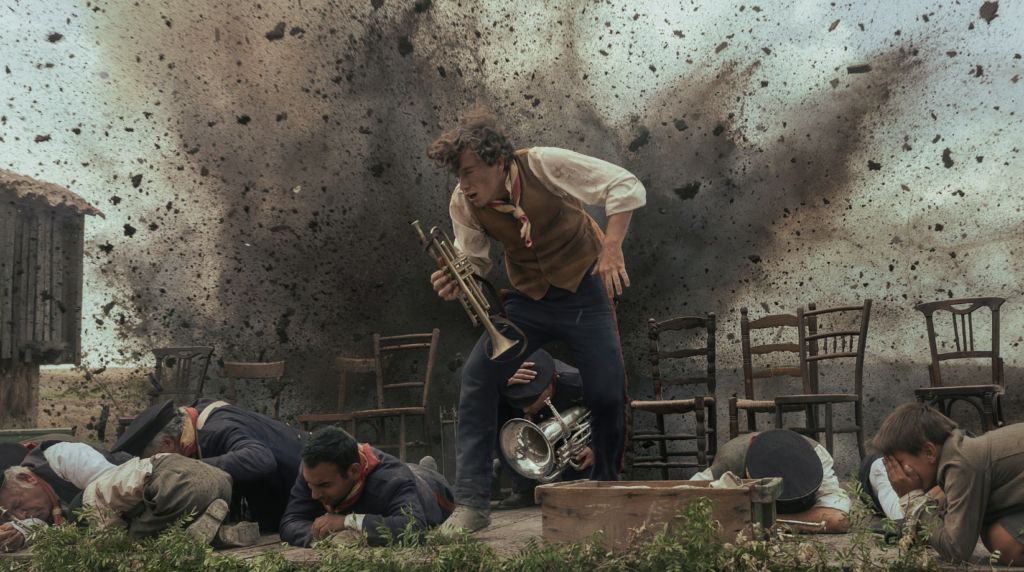
I’ll give it this: Javier Ambrossi and Javier Calvo’s La Bola Negra certainly feels like a grand epic of operatic beauty and tragic love. There are shots that make your chest swell with the kind of sensory overwhelm few big-budget movies produce anymore. Every shot feels full, passionate, and interesting, like Goya paintings transported onto the landscape of the Spanish Civil War. This is a movie that strives for greatness.
But looks are only part of the equation. Is the movie, in fact, great? That answer probably has more to do with how much you, the viewer, personally know about the Spanish Civil War and the 40-year fascist dictatorship that followed under Francisco Franco.
To Spanish audiences (and those with an extensive interest in Spanish literature and history), La Bola Negra, named for and inspired by a play by Federico García Lorca, may well feel like the epic it wants to be, and that’s great.
You—presumably an American with no background in either—may be forgiven for finding the enterprise oddly empty.
La Bola Negra follows three intersecting threads. The first, taking place in 1939, follows Sebastián (Guitarricadelafuente), a young trumpeter who barely escapes his village after an Italian air attack by joining the Nationalist army. He scrapes by until he meets Rafael (Miguel Bernardeau), a Republican prisoner of war with a personal connection to Federico García Lorca.
The second plot, set in 1932, introduces Carlos (Milo Quifes) a young man in Granada hoping to gain membership at the swanky casino his father is part of. The club’s voting members blackball him (there’s your bola negra) based on rumors that Carlos is gay, causing a crisis of what Carlos should do (or even if he should do anything) to refute that dangerous claim.
In the final 2017-set plotline, queer writer and historian Alberto (Carlos González) learns that his maternal grandfather, who he never met, has died and left him an inheritance. At the encouragement of his supportive partner Juan Pablo (Julio Torres), Alberto heads to his grandfather’s remote country house to claim what he’s been left, sparking a discovery of massive historical importance — for the world and for Alberto personally.

Courtesy Netflix
All three parts have their moments. Carlos’ portion of the film contains rich visual beauty and moments of surrealism. Alberto’s plot provides a 21st-century perspective on the Spanish Civil War and the scars it left behind. Sebastián and Rafael’s story is La Bola Negra’s beating heart, with rich visuals (peep Penelope Cruz as a Marlene Dietrich-styled singer in a stunning Cabaret show) and a star-crossed lovers conflict that we know from the start can’t lead anywhere good.
The way these stories connect to each other (particularly Sebastián and Alberto) is intriguing enough to keep anyone engaged. Carlos’ story, however, gets short shrift in both its screen time and the later revelations around it. When you’re watching any given portion of the film, it’s hard to wish you were watching a different one; they all suffer from being so broken up.
There’s also a nagging feeling that we’re missing some pieces of information that might make these three stories cohere a little more — information that the writer-directors probably don’t feel compelled to include, since Spanish audiences are already well aware of the history of their Civil War and the ongoing pain both it and the Franco regime that followed caused for the country.
For the rest of us, it’s a little like watching a story through a glass wall. There’s an inevitable sense of remove.
Not every movie needs to cater to every audience, but the lack of universality is what keeps La Bola Negra from becoming a whole that transcends the sum of its parts. It’s a gorgeous movie with compelling performances, but between its culturally specific subject matter and piecemeal storytelling that never quite goes beyond its characters’ surfaces, it never quite hits the stratosphere. Maybe it plays better in Spain. If so, I’m not about to rain on that parade.