Ed Perkins’ new documentary explores ‘very profound and tragic consequences’ of Clown Panic

Clown Panic. // image courtesy Hulu
Clown Panic is now streaming on Hulu.
As you may recall, back in 2016, creepy clowns became A Thing. Not limited to internet memes, these clowns made their way into the real world and caused a commotion, leading to “school lockdowns, police investigations and a nationwide media frenzy,” as the press release for director Ed Perkins’ new documentary, Clown Panic, puts it.
Out now from Lightbox and streaming on Hulu as part of its Huluween offerings, Clown Panic explores “the collision of fear, social media and modern America at a moment of deep national anxiety” via first-person interviews with those involved, as well as commentators, film clips, and contemporary news stories to present the full story of the creepy clown saga for the first time.
We spoke with director Ed Perkins via Zoom about Clown Panic and why the story matters.
 The Pitch: Why did you wanna make a movie about evil clowns?
Ed Perkins: I didn’t at first, if I’m totally honest. I haven’t made a film about clowns before. And not many people in the doc genre have, to be honest. I was a little skeptical at first, if I’m totally honest, that this had anything more to say about the world or people than you might imagine about a film about creepy clowns, but fortunately I was very wrong.
Honestly, at first I thought it was one of those social media memes that just blew up for a moment and then disappeared, and because I was in Britain, not America, and because in Britain we had a quite different reaction to the clowns–the clowns didn’t come with quite as much force, let’s say. They did come here, but not quite as aggressively. I don’t remember it as being a big deal.
But the last few years of making this film–and it’s taken 18 months to make–I’ve been really surprised at just how much depth there is to this story because I think when you peel away all these layers of clown absurdity, I think what you find is a story that is deeply human, and is actually around fear. That’s ultimately what it was about for me. Because, when I look at the things that spread on social media, the things that turned this from a small story that started in South Carolina to a viral epidemic that sweeps across America, these grainy videos that went viral of clowns freaking kids out, these sensationalist headlines … behind them was often someone who was genuinely scared, often shit-scared of an experience that, that they’d had.
So the big driving question for me wasn’t “Were the clowns real?” or even who was behind the mask. We tried to address those in the films but for me, the more interesting question was around the fear that these clowns inspired, and what does that fear say about the communities in which it spread–because it didn’t spread in all communities. The clowns never really made it to white-picket-fence America. And also, what does it have to say about America at large in 2016?
What challenges do you face in tracking down all the material? When you’re talking about viral videos and things like that were on social media a decade ago, how do you go down that rabbit hole and find that information for the documentary so that we can see and have our memories refreshed? Or is it just that because it went viral, it’s everywhere?
We were very lucky. We have an amazing archive producer whose job it is to scour the internet and try and find this stuff. But sometimes, when you’re telling retrospective stories, someone’s written the book. Someone’s done the journalism on it and told the story, and that’s such a relief because then you just have to adapt the story. But on this one, no one had done that work. Some people had made YouTube videos exploring it, but no one had really done the heavy lifting of sifting through what turned out to be many hundreds of seemingly unrelated, dislocated sightings all over America.
And it’s a tricky story. There’s no central protagonist. There’s no kind of central mystery. There are all these dislocated, seemingly unrelated events. There’s no obvious beginning, middle, and end. And so your job as a storyteller, as a filmmaker, is to take all of that information and figure out “What’s the emotional arc that I can take audiences on?”
In terms of the archive itself, a lot of it was still up on YouTube, a lot of it had been chopped up and put in compilation videos, and so we were finding second-, third-, fourth-generation versions, often pretty bad quality. And yeah, it was a treasure hunt for this stuff but once you start to find the right parts of the internet, there are these dark corners of the internet where this stuff exists. As you can see from the film, more than enough of it.
When did you start deciding how much pop culture would make its way into the film, in terms of the clips you chose and the films and television series you drew from?
When I started interviewing people and asked them about what they’d gone through in 2016, so many of their stories and anecdotes sounded like something straight out of a horror movie.
Of course, the creepy clowns in South Carolina lived in a creepy abandoned house by a creepy lake. Of course, a red balloon floated on the lake. I don’t doubt for a second that’s what people believed, and maybe even what was true, but it lived in this strange world between reality and the fictional world we’ve all consumed for the last 30-40 years through Hollywood horror movies, and that was fascinating.
And when I started to feel that from people, I started to think, “Of course, if you’re in the middle of a pandemic and everyone’s shit-scared of clowns, and you’re walking through a graveyard at night, and you hear a twig behind you, it’s not a ghost, it’s gonna be a clown.”
As we’re animals, we’re built for this kind of stuff, and we all got swept up in this story. So, the mechanics of that story, where that story comes from, was obviously part of this, and yeah, dipping in and out of these famous horror movies was fascinating. I think also tonally there was something interesting.
I grew up watching Scream, movies that are both funny and scary and very aware of their own tone, and that’s not a tone documentaries often embrace, possibly for good reason. It’s a hard tone to find because this is a story that does go to some very difficult, complicated places at the end of the film.
But at the beginning, it has some amazingly rich, entertaining characters telling stories that sound outlandish. Navigating that journey, finding a tone that was fearful and horrible but also funny, and then shifting to something serious, was important. I’m just fascinated by this strange give and take between pop culture and the real world.

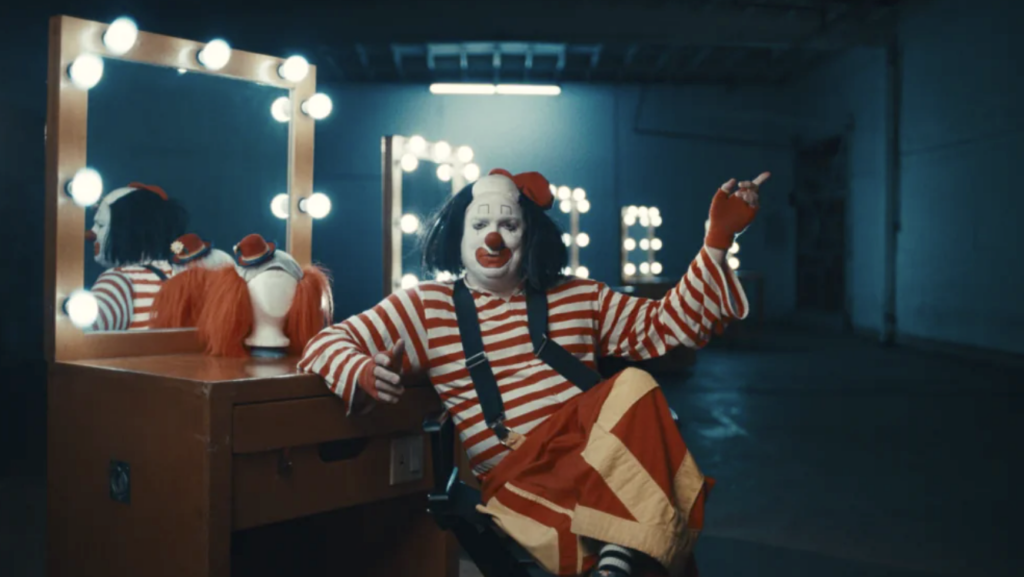
Gilly the Clown. // image courtesy Hulu
The idea that you have a good clown in the film really goes to it. The commentary he offers really grounds the stories, in a way. I didn’t expect him to point out the fact that “They’re not clowns. They’re not doing tricks. They’re just guys in masks.” How did that idea come about? It feels silly, but you can see how upset he’s and how much he wants to correct the record.
The good clown in our film is Gilly the Clown, and I think, in some ways, he becomes one of the film’s emotional hearts. I think there’s something very surprising that happens, which is that, for the first half an hour of the film, the only clowns we see are creepy clowns that are coming out to scare kids, right? Then you meet this guy who’s in full clown makeup, and we let him be a clown at the beginning. We let him purposefully be funny, and do his clown shtick.
But then, there’s this strange thing that happens throughout the second half of the film, which is that the clown almost becomes the most human character in the film, in some sense. The paint, albeit metaphorically, kinda comes off and through to the person beyond, which is, of course, the thing that lots of people weren’t doing at the time.
I also think that seeing a clown like that forces us to think of our own prejudices when we look at people, and we don’t immediately gravitate towards, but actually, as you start to get to know Gilly through this, you reveal that beneath that, there’s something very human and relatable. On a basic level, we got very lucky because he’s an extraordinary person, and his insight into what happened is very powerful.
It’s also important to say that he represents a viewpoint that we might think of. When you first hear, “The clowns went out of work,” we think, “Oh okay. Yeah. It’s not a great loss.” But it is, because an entire profession suddenly lost much of its ability to make money and became enemy number one. When everyone got scared of the clowns, some people decided to fight back.
Also, going back to your pop culture question before, there’s this strange, almost surreal pop culture consequence to this, which is that–because of the clown panic of 2016–Ronald McDonald was fired, and he’s never come back. This figure that, short of Santa Claus, is one of the iconic figures in American pop culture, someone who’s served me many hamburgers as a kid–is now no longer there, and it’s because of this thing.
So I think Gilly plays a really important role in our film. I think he grounds the film in many ways, and toward the end, he has some important, really human things to say about the extremes of this story and what happens when fear takes over.

Clown Panic. // image courtesy Hulu
That’s the entire thrust of Clown Panic that I really appreciated: the idea that, 10 years on, we can see the big picture, as it were. It’s more than just a viral internet thing. It is something that did, in fact, happen, and how it happened might not be how we thought it was, but it has strangely far-reaching consequences, which I think is what you want from a documentary, and I appreciate what you did with that.
I hope so, yeah. Obviously, it is entertaining. It obviously takes people on a crazy ride, but I do think it –look, this is gonna sound like an overly profound thing to say, but I think if you wanna understand modern America today, and it’s a very complicated thing to understand. And by the way, I went to university in America. I lived in America. I passionately love America, and a lot of my films are trying to understand modern America.
This is a strangely insightful place to look, because through all the absurdity and the clown, this strange, grotesque abstraction of the human form, you do find a story that says something about what happens when fear runs amok. You’re right that, on the face of it, it’s a story about social media. We’ve always had moral panics throughout history, going back to the Salem witch trials. Often, we talked about this story in development as a the Salem witch trials of the digital age and I think the underlying sort of sociological message of this film is there’s always like a latent anxiety in a society and there are times in a society’s growth and history where that anxiety builds and builds. It’s like a pressure cooker.
Then eventually it bursts, and I think 2016 for me was one of those moments, for lots of reasons: culturally, politically, economically. There was an enormous amount going on, and we understand why people in that moment felt an enormous amount of anxiety around their own identities, around their families, around their futures, and when that pressure cooker boils over, and there’s a lot of fear and a lot of anger, that has to go somewhere, and when we look back throughout history, that often gets targeted against the marginalized or the vulnerable or the other.
The clown stands as this kind of strange, absurd representation of the other in this story, but if this film is anything, it’s hopefully a cautionary tale about what happens when fear does take over, and the fact that this happened on social media is important because what happens and starts on social media does not end on social media.
This had real-world consequences, very profound and tragic consequences for numerous families across America, and we wanted to take audiences on that journey.
Clown Panic is now streaming on Hulu.