Taika Waititi’s Klara and the Sun is charming, but avoids the source material’s darker themes

Courtesy Sony Pictures
Kazuo Ishiguro’s 2021 novel Klara and the Sun is a hard novel to pin down tonally.
The book is set in the near future and told from the perspective of Klara, a lifelike robot called an “artificial friend” (AF) designed to be a companion for tweens and teenagers. Klara’s perspective is limited; she’s learning about the world at the same rate as a young child. As such, Ishiguro’s novel contains moments of childlike wonder, heartfelt empathy, and dark cynicism about human nature.
On the “man-made being learns to love” storytelling spectrum, Ishiguro’s novel is closer to A.I.: Artificial Intelligence than Pinocchio. Klara serves a family whose situation she learns in pieces. Combined with the character’s preprogrammed naivete, this can make for a frustrating read. We don’t know the rules of the world Ishiguro’s built until over halfway through the book. It takes just as long to figure out why the characters are moody and hard to read. Until we get the full picture, we have to endure Klara’s childish interpretation of their mercurial behavior.
Depending on how you feel about that approach, Taika Waititi’s adaptation of Klara and the Sun may either feel like an improvement on the story or a bizarre misread. Waititi’s film removes many of the book’s thorns by quickly laying most of the nuances out in the open instead of holding back details. But by applying his warm, offbeat humor to a book with little of it, Waititi overlooks the source material’s depth.
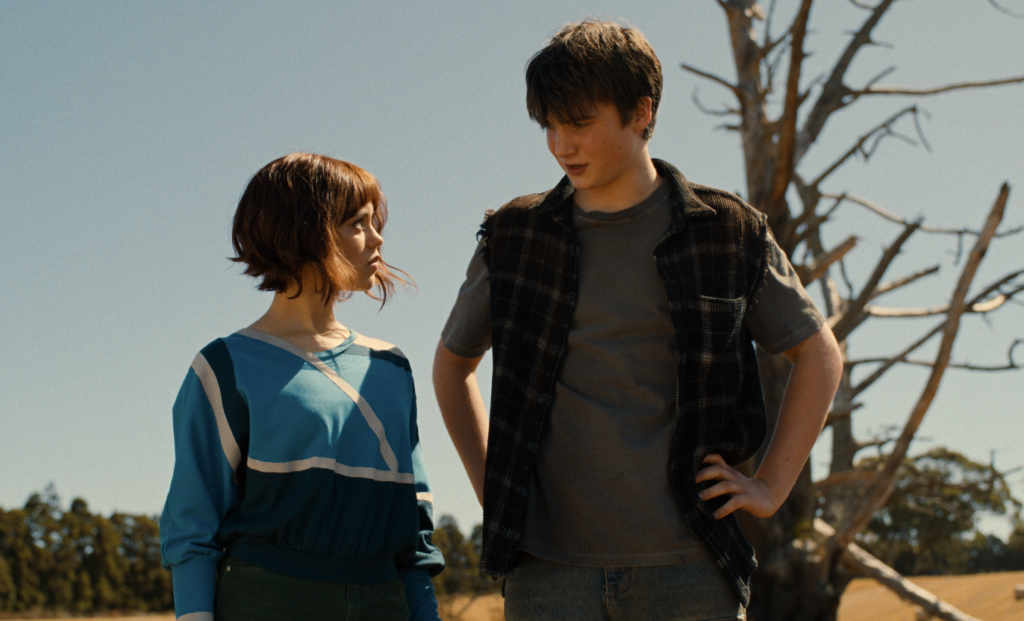
We meet Klara (Jenna Ortega) in a store where she and her fellow AFs jockey for the attention of lonely boys and girls and learn about the world from their Store Manager (Natasha Lyonne). One day, Klara catches the eye of Josie (Mia Tharia), a sickly teen. Josie begs her mom Chrissy (Amy Adams) to bring Klara to their home in the countryside. There, Klara meets dubious housekeeper Melania (Rachel House) and Rick (Aran Murphy), Josie’s affable best friend and neighbor.
Josie is “lifted,” meaning she’s been genetically modified for intellectual superiority. However, the process caused major medical complications. This, plus a tragedy early in Josie’s life, has left her bitter, and the grieving Chrissy mostly absent. Klara believes Josie’s condition can be saved by praying to the Sun (being solar-powered, Klara believes the sun is a divine being). The film explores faith, grief, hope, and sacrificial love as Josie’s condition worsens and Klara’s desire to save her friend grows more desperate.
Visually, Klara and the Sun creates a colorful futuristic world that recalls Wes Anderson, Jean-Pierre Jeunet, and Terry Gilliam in its playful attention to detail. Some of its vision is a tad unoriginal (the crowded, polluted cityscape where Klara’s store is located just looks like Blade Runner), but it’s a pleasant place to spend time—warm and fun rather than cold and clinical. That warmth is also present in Ortega’s joyfully energetic performance as Klara.
The film’s problem mirrors Waititi’s 2019 WWII comic drama Jojo Rabbit: It’s hard to tell what he takes seriously and what he’s playing for glib jokes. The film’s quirky atmosphere, buoyed in part by Ortega’s committed charm, often clashes with really dark themes—particularly Josie’s illness and her mother’s failure to deal with it.
The disposability of Klara and other AFs (one of the book’s most heartbreaking commentaries on love and growing up) is also played trippingly. This includes a running bit where the Store Manager’s bedtime stories to her robotic charges include Grease and The Little Mermaid, tales about changing your identity to fit someone else’s desires. It’s not unusual to find yourself thinking, “Wait, should I be laughing at this? Is the director laughing at this?”
Typically, I try to avoid comparing an adaptation to its source because a work should stand on its own. But even taken separately from the novel it’s based on, Klara and the Sun feels off. For all its frustrating elements, Ishiguro’s novel is damning in its conclusion that we throw away or forget what we love when it no longer serves us. Through Waititi’s filter, that idea gets shrugged off.
It’s true that if you think too hard about how disposably we treat each other, that truth opens up a black pit of sorrow in your heart that hurts to consider. But the best response probably isn’t to ignore that truth completely. In Klara and the Sun’s final moments, you can almost feel Waititi shrugging his shoulders and whistling off into the sunset. It’s hard to know how to feel about that.