Unicorn’s staging of Red Like Fruit has potential, but lacks nuance
Come for strong writing and a powerhouse female lead, but don’t be surprised if you leave unsatisfied.

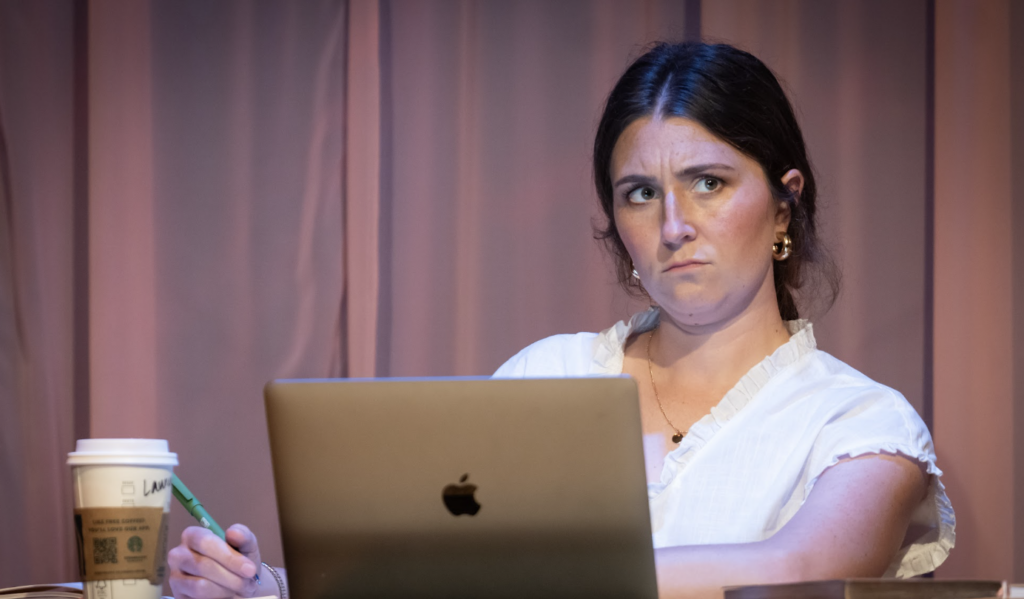
Photo by Don Ipock
Red Like Fruit runs at Unicorn Theatre in KC through Oct. 25, 2026. Tickets are here.
People without extensive access to live theater will likely know Red Like Fruit playwright Hannah Moscovitch’s work only through her screenwriting. Moscovitch has written several episodes of AMC’s excellent Interview with the Vampire series and will showrun its fourth season. Her episodes—especially season one’s “A Vile Hunger for Your Hammering Heart,” season two’s “Don’t Be Afraid, Just Start the Tape,” and season three’s “The Failures”—rank among the series’ best and most probing.
It’s also notable that many of those episodes on some level address sexual assault and its long-standing effects, as does Red Like Fruit.
That conflicted, embittered, darkly funny and critical voice is evident in Unicorn Theater’s production of Moscovitch’s play, which runs through Oct. 25.
A minimalist two-hander, Red Like Fruit introduces us to Lauren (Elise Poehling), a journalist, and Luke (Tyler Lindquist), a man who Lauren tells the audience will be reading what she’s written down. Luke then reads a long monologue detailing Lauren’s work on a high-profile article on domestic abuse, an experience that triggers memories of Lauren’s own history with sexual assault.
For the most part, Luke reads what Lauren has written… as we watch Lauren’s face.
Occasionally she interrupts, and they converse, before she finally takes over the floor in the play’s final moments. Lauren claims she wants a “neutral, authoritative” voice to read her deeply emotional story. This comments on how women’s stories get ignored or dismissed unless a man validates or shares them. It also points to Lauren’s own internalized misogyny.
Early on, for example, her writing describes the women in a therapy support group by harshly commenting on their weight, age, or looks, until those same women are later stunningly kind toward her.
The construction of Moscovitch’s play gives the work the potential to be either weirdly preachy or bitingly honest and cleverly, shiftingly cynical. Given the instincts of Moscovitch’s most visible work, the latter would be the stronger choice here.

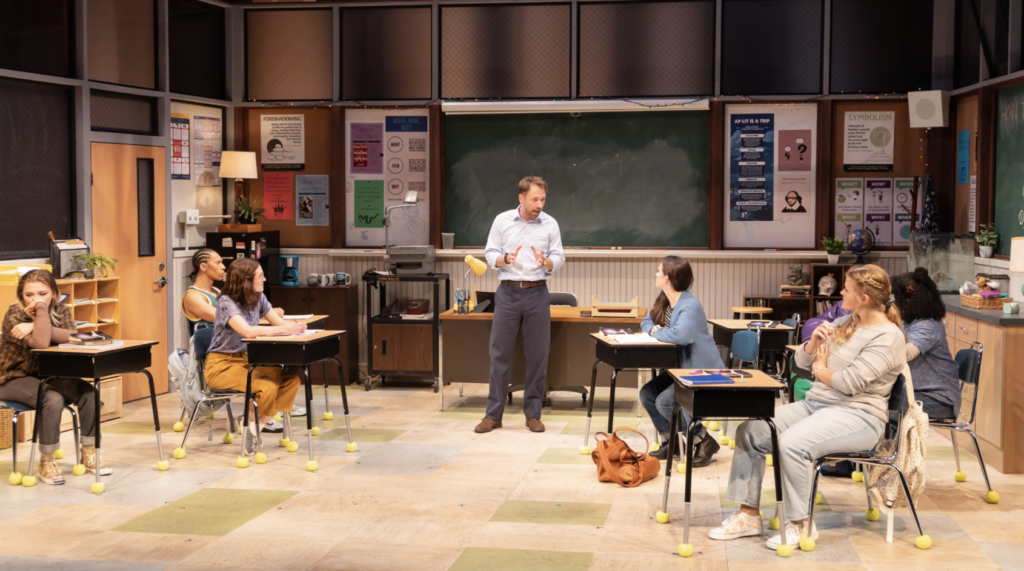
Photo by Don Ipock
Unicorn’s production, directed by Amanda Kibler, has some undeniable strengths—Poehling’s performance chief among them. However, it lacks that nuance, ultimately opting for an approach that pats the audience on the back for having eaten its vegetables instead of asking why its characters are serving up said vegetables the way they are.
Poehling’s performance, even when it’s mostly reaction and one-sided symbolic re-enactment, is raw and impressively real. She stammers, cries, and feels like an actual person trying to make sense of their experiences (it’s worth checking out the play for her work alone). She’s unevenly matched by Lindquist’s stagey, oddly stilted Luke, whose delivery sometimes breaks the flow of sentences in ways that threaten to change their meaning—but still lets Moscovitch’s descriptive, vulnerable writing shine through. The larger framing narrative and the stories it contains are intense, augmented effectively by lighting and sound that reflect Lauren’s levels of anxiety and rage as they ebb and flow.
It’s very easy to read (and perform) Red Like Fruit as a “lesson play,” the kind that makes college drama students feel edgy for staging it, but ultimately feels trite. The idea of a woman’s pain going ignored unless a man speaks up feels cliché at this point. Women especially don’t need to be reminded how true it is. That a woman who is clearly capable of speaking up for herself would feel a need for a man to tell her story for her is far worthier of interrogation. There’s a way for that to come across in the direction, but it isn’t here.
Unicorn’s production is worth seeing for the female lead and the strength of the writing, but you’d be forgiven for wishing it lived up to its potential a little more.