Bright Eyes’ Nate Walcott tours us through his dexterous career ahead of Saturday’s Truman show

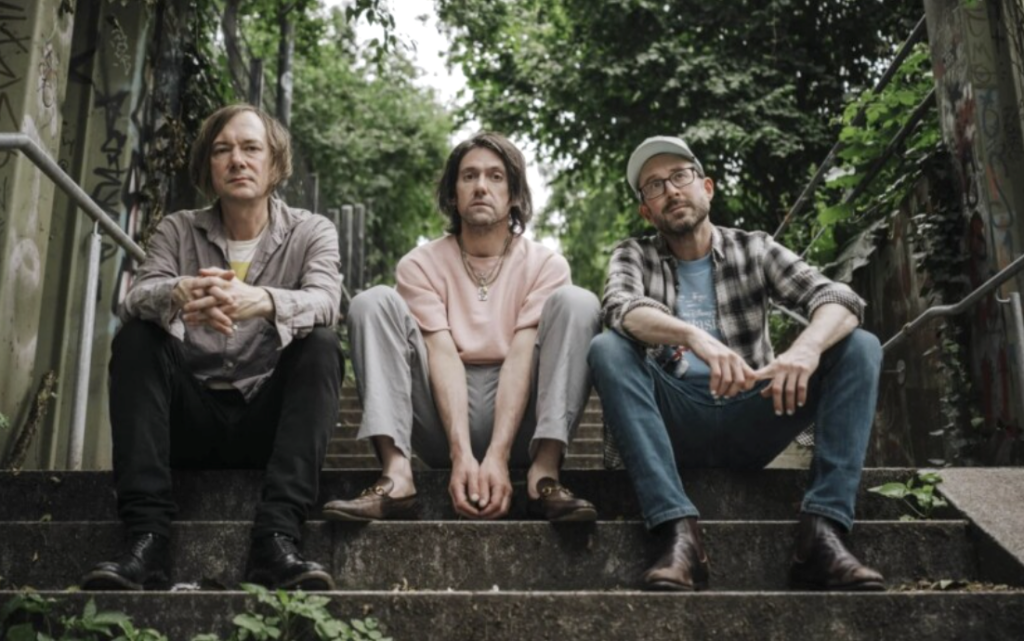
Bright Eyes. // photo by Mario Heller
Originally a solo project for musician Conor Oberst, indie rock band Bright Eyes has become a mainstay of heartfelt, confessional music, with a heaping helping of pointing out society’s flaws. The core trio of Oberst, Mike Mogis, and Nate Walcott has been making music together for well over two decades and is currently celebrating twenty years of their albums I’m Wide Awake, It’s Morning and Digital Ash in a Digital Urn.
We hopped on Zoom with Nate Walcott to talk all things Bright Eyes, the band’s longtime connections to the area, and Walcott’s robust career as an arranger.
The Pitch: You guys have played Lawrence so many times.
Nate Walcott: Oh, many times. In fact, when I was growing up in Lincoln, yeah, we’d end up coming up all the time.
What kind of shows would you come down for from Lincoln?
Geez. Let me see. I had met Mike [Mogis] and was recording with Lullaby [for the Working Class], and I had met Conor. It was right when Conor was getting going. This was a long time ago, like early ’90s, and while I was working on stuff with Mike, I also had a band called Kid Quarkstar that was a little bit more jazz/funk, R&B-influenced.
We would come and play maybe the Replay or the Bottleneck. I remember playing opening for Cibo Matto in like 1992 or 1993. That was a big one for us. That was huge.
I love the fact that Lullaby for the Working Class is your opener when you play Kansas City, because that’s a band you have played not only with, but in.
Yeah, Lullaby for the Working Class will be opening for us. That was one of my earliest big musical projects that I was involved with, I guess, in 10th grade, 11th grade. Mike called me out of the blue and on the landline; must’ve been 1992 or ’93 or something. He and Ted were working on the first Lullaby EP that led to the first full-length. I went over and recorded on that, and that was the first time I met Mike. And here we are, touring Bright Eyes and Lullaby together.
There’s a lot of crossover. There’s a lot of meaning to it for all of us, so it’s pretty cool. I think playing some of these cities, like Kansas City, which are so important to the band and to everybody in terms of easy access to playing shows outside of Lincoln and Omaha, I think that’s really cool, and we’re looking forward to it.
How’d you get into arranging? I feel like that’s been, in addition to your work in various bands, the bulk of your career. Your work on “Road to Joy” is legitimately one of my favorite things.
I think it goes back to when I was first getting going and to my first experiences with being in bands in Lincoln. In particular, that band I mentioned earlier, we would have horns, and I was the guy who ended up always making the charts.
That’s something I always was drawn to even before then, just growing up. I liked the physical interaction with notation and stuff like that. That just always really fascinated me, and I suppose that’s not specific to arranging. That can be composing as well, but I guess just the art of arranging and orchestration and figuring out what instruments do and when and how.
The bands that I was in in high school gave me a space to do that. And then I went to university in Chicago, and there were loads of places where I could get into that, and explore that more and apply it in real-life situations. I suppose when I started in Bright Eyes, it was just a combination of so many things. Bright Eyes was already going, as you probably know, when I got involved, and so, something that I could do in Bright Eyes was, and where I think I was of some use was–and we’re dealing with this every tour and all the time, even right now as we speak, as we’re getting organized for this tour.
Before I was involved in the band, there were a lot of instruments and a lot of stuff going on, and I was able to come in and help wrangle some of that and get it organized for live shows, things like that. Everybody would show up for rehearsals, and it would be pretty chaotic. Everybody’s just guessing at what they’re gonna do.
When I say everybody, I mean there’d be string players, and there’d maybe be somebody with a clarinet. I’m thinking specifically of the Lifted tour. I was able to help and be like, “I can write this all out and get it organized, and organize a little bit of the chaos.”
Of course, with Bright Eyes there’s a historical element of chaos, and that’s something that is a good thing, so I’m not trying to take that out completely, but Bright Eyes definitely gave me an opportunity to focus my interest in that world as well, ’cause then once I got more and more involved and became a member, I was able to really go deep in that and we were using legitimate orchestras on our records and stuff like that.
Anyways, all this was happening in the early to mid-aughts. Mike was producing a lot of records, and he saw what I was doing outside of the band in my own work. In the early ’00s, I had a band in Chicago that was just horns. There were six horns, drums, and bass. I made a little recording of that, and I remember showing it to Mike, just playing it for him, and he was into it.
This was around the time he started making records with bigger budgets, and he wanted strings, horns, and stuff. He saw what I was doing in Chicago, and that’s when he started asking me to help with his records. I’m talking about some of the Faint records where I did some strings for, and Cursive, and the people from out of town–everyone from Pete Yorn to I don’t even know. I’m blanking on who else.
But between Bright Eyes, Mike, my work outside of the band–it all started to pile up, and around 2005, that’s when I was really like, “This is something I really wanna do and take it seriously,” and I just started to invest more of my focus and resources and energy into that stuff. I really went after it a little more, and I started to really do some deep dives into studying the craft and art of orchestration and arranging. And here I am.
I don’t know. It’s still a process. I’m really lucky. Outside of the band, I get to work with people like Flea from the Red Hot Chili Peppers. I did some strings for his record that came out earlier this year. I’ve worked with people like Leon Bridges. I toured, and I recently arranged some songs for the Chicago Philharmonic to perform with Tortoise. And so I’ve really made that a focus, and it’s just something I love.
You’ve arranged so many albums that were formative in my early 20s. That string work on Wet from Birth by The Faint is a hallmark of that record. Rilo Kiley. Even now, in my 40s, things like Phoebe Bridgers’ Punisher and, yeah, that new Flea record are so good. You’ve collaborated and worked with so many people in the alternative rock world or however you wanna look at that, and that’s led to film work as well, which has let you work with some folks. How was it working with Mark Snow on The New Mutants? I feel like that’s both a blessing and a bad thing because that movie almost got buried.
Let me see. That’s actually a funny one.
That was a difficult project, and full disclosure, I met Mark Snow. I did not work with him. This is a little bit of industry insider talk. But no, this happens on projects, and I’m certainly not the first, and I definitely won’t be the last. But that project unfortunately went through some very difficult times, including–I don’t know how much of a factor this was, but Disney and Fox had an acquisition. Meanwhile, visions for this film were changing. It started as one thing. It was gonna be kinda like this YA thriller / coming-of-age teen X-Men movie.
The pitch was “Breakfast Club meets X-Men,” and the studio came in and wanted to change direction. There was a big change of the guard in the studio, and then also among the people working on the film. At some point, we left the project, and a lot of people left the project, and some other people came in. I had written some of the music. They re-shot a lot of it, recut it, and used a new editor. Some of my music remained, and then they brought in Mark to finish the new version. That’s why there are two composers on it.
I did meet Mark. It was a little awkward. These things happen, ’cause we had a big orchestra session at the Fox lot. There’s a 110-piece orchestra at, in the… it was magical. Incredible experience. I had this huge orchestra, and we were gonna record my music, but meanwhile I was spending time with Mark.
Very potentially awkward, but it wasn’t. It was just like, “Hey, we’re just here doing our jobs,” and it’s fine. But he was really cool, actually. That was a tricky, funny project but that was certainly an outlier. Since then, I’ve done a lot of composing that went much smoother, most recently Regretting You, which was a real treat to work with Josh [Boone] again on; that came out last year and did really well, and I’m really happy with the music on that.
Bright Eyes plays the Truman with Lullaby for the Working Class on Saturday, October 17. Details on that show here.