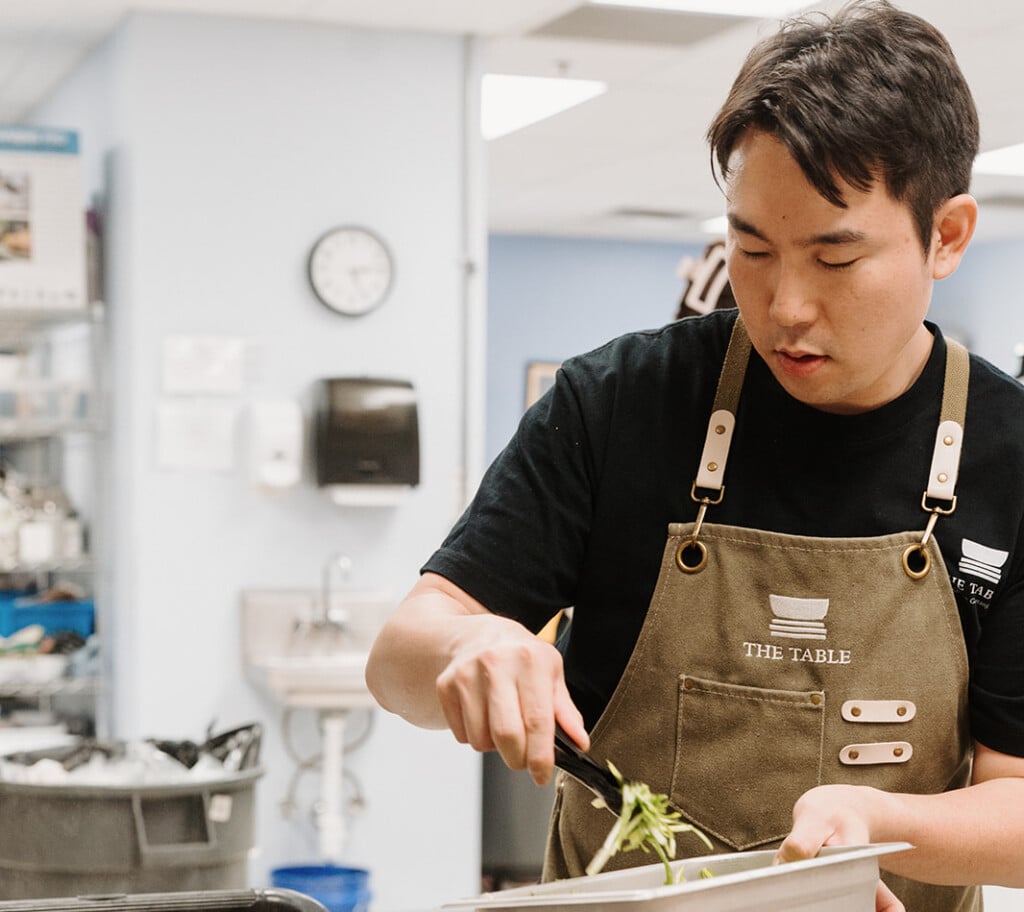
Mise en Place: Changhyun Kim makes an introduction to Korean nostalgia—from an Olathe church basement

Pastor and chef Changyun Kim garnishes bowls of gomtang // Courtesy of The Table
A neighborhood side-dish shop in Seongnam, South Korea and a church basement dinner pop-up in Olathe, Kansas—they couldn’t be more different.
But for chef and pastor Changhyun Kim, who runs The Table at Bonfire United Methodist Church—and before that, the aforementioned banchan spot—that isn’t exactly the case. At least, beyond the logistics of it all.
“I just know this food, and I love it,” Kim wrote after I’d first reached out.
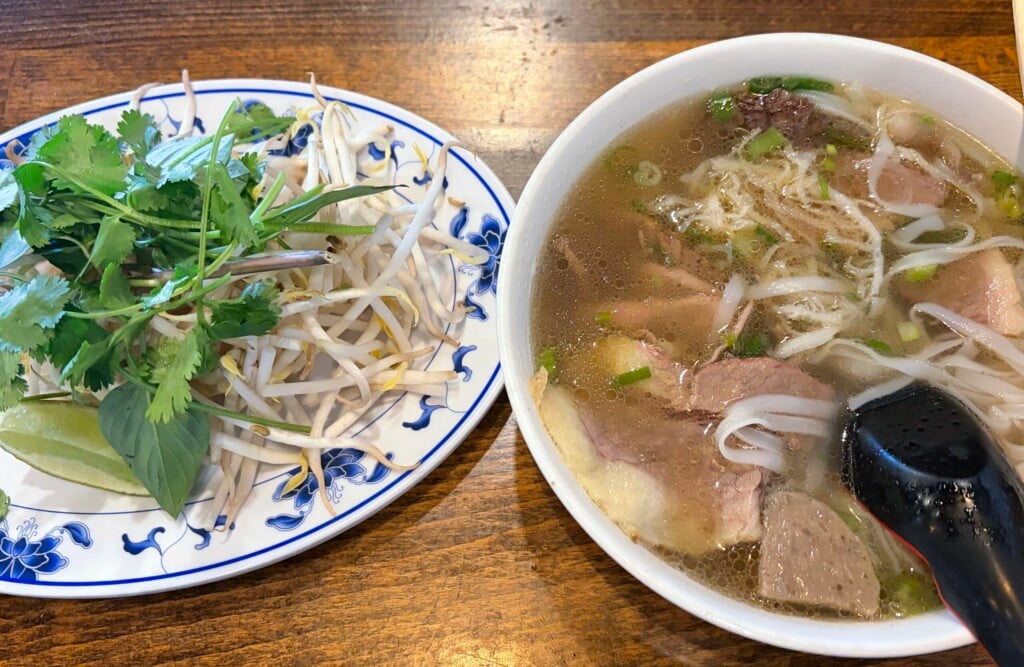
The signature dish at The Table is gomtang, a Korean rice soup in a clear beef broth, which has been simmered slowly with brisket and vegetables. It comes with a homemade trio of cabbage kimchi, radish kimchi, and onions and cucumbers marinated in a sweet soy sauce.

A bowl of gomtang // Courtesy of The Table
“It’s probably the hardest Korean dish to sell in America,” Kim continued. “It isn’t red, it isn’t spicy, and it doesn’t photograph well. But it’s the food Koreans reach for when someone is sick, or grieving, or finally home.”
That seems to be the through-line of Kim’s establishment: Love and understanding, in the form of soup. And at The Table, it’s offered with a welcome so simple and sincere that it feels far from the cliché one might expect of the premise. Most of this comes from the way that Kim holds the same conviction about people as he does food: you meet someone or something as they are, respect them, and let them stay themselves without asking to become familiar first—regardless of taste or religion.
He puts it this way: “Same belief, different table.”
The Pitch: Seongnam is pretty far away from Kansas City. What brought you to the metro, and why Olathe?
Changhyun Kim: I first came here in 2017 as an associate pastor in the immigrant church and seminary, so that’s why I first came here to Kansas City. And then my pastor journey: I came in 2017 to 2020, I served at the Korean Immigrant Church, and then I’m part of the United Methodist Church. We have an appointment system, a clergy appointment system like Catholics. I was appointed to Lecompton, Kansas, a very small white town between Topeka and Lawrence. I served there about three years, and later, about two years ago, we were planning on planting a church at the Bonfire United Methodist Church. That’s why I’m here. So there’s no specific reason for Kansas City, just my job offer.
And when did you become a minister? Was this process something you felt was connected with your relationship to food and cooking?

An array of homemade banchan // Courtesy of The Table
Long story short, when I was 20 or 21—all Korean men must go to mandatory military service—so before I went to the mandatory service, I was in a seminary when I was in Korea. I prayed for my calling: ‘What kind of pastor should I be?’ At that moment, I was inspired by God. The calling was to feed my sheep. So, after I got that calling sentence, I paused my seminary journey. I went to cooking class to learn Korean food. So, because God said feed my sheep, that means I have to cook and learn cooking.
Anyhow, those cooking experiences and my ministry journey connected really strongly with food, so I love food and feeding people. It’s been over 15 years now. I cooked in the Korean military; I cook almost every week for other friends. I was also Associate Chaplain at Baehwa Women’s University in Korea—that was my first career, and at the moment, I didn’t cook, but I had a restaurant touring group. We would visit new restaurants and eat together and build community at the time. And my first church in Kansas City, there are also Korean immigrant churches. There are so many people who miss their own home food, so I cook a lot, serve a lot, and yeah, this is how I am here.
Have you felt any interesting similarities or differences between running your place in Seongnam compared to The Table?
Of course. It’s totally different. When I was in Seongnam, our family restaurant wasn’t totally a restaurant. It’s a place for side dishes. We call that banchan, and we were selling it to go. But at the same time, we had a senior meal: $1 senior lunch every day for the community. But it was just my small family business. In Kansas City, The Table is very much focused on the restaurant itself. It looks like a restaurant, people come to dine in, and we have a small menu—not a whole lot of items.
What has been the most memorable conversation you’ve had with a guest at The Table?

Courtesy of The Table
I’ve had a lot, let me share a few stories. One family came from Lawrence, and they just said to me, “I appreciate this, because I really miss gukbap and this soup, but there’s no place that makes gukbap right in Kansas City. Now, we don’t have to go to Dallas.” I remember that appreciation.
Another customer, who’s become a church member now, asked me, “Who are you?”
“Oh, I’m a chef and pastor.”
And she asked for my Instagram and everything, and “Can I visit your church?” It was the very first question, so I said, “Of course you can.”
At the moment, our church is still not very big—about 20 people gather every Sunday. It’s a small church, but she became family within the very first week, and she’s a leader of Bonfire right now. So, I still remember these two conversations: appreciation for authentic Korean food, and then, “can I visit your church?”
The Table began as a living room dining club, then outgrew it. Was there a moment that led you to make that change?
At the very beginning, when we just started gathering as a church, we started in my living room. We had six planting members, including my family. We started to invite our coworkers, our friends, and I would cook and serve them every week for four to six months. We went through our network; there were no more friends we could invite.

Courtesy of The Table
‘How could we reach out to more people in this community?’ We can invite friends and coworkers but not strangers. That sounds weird—’come to my house, eat.’ So we became a restaurant and invited all people. I want to introduce people to Korean food, and if we have a chance, I want to introduce the love of Jesus and the church and, of course, community.
A lot of your story has been about sharing and giving to people without expecting anything in return. Do you have your own favorite dish that someone else makes for you?
Our church will have a retreat, and within our church members is a group of 50-year-old women. They wanted to make me homemade food, like traditional rice, soup, banchan, meat, something like that. That’s what I miss most right now. I don’t want a fancy, expensive caviar steak; I just miss my mom’s generation—50s, 60s food. My mom’s friends, I want their homemade food.
The Table is located at 11485 S Ridgeview Rd, Olathe, KS 66061. Check their Instagram for dining availability.