Missouri’s out-of-touch Republican politicians keep going to war against Missouri—including their own voters

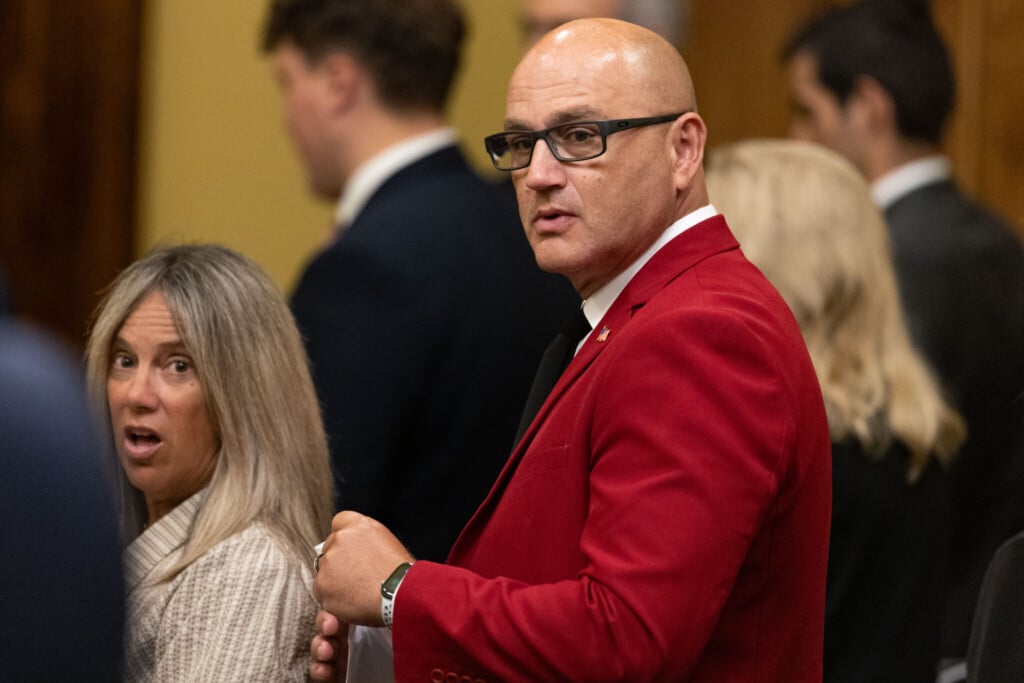
State Sen. Rick Brattin, a Republican from Harrisonville, and Secretary of State Denny Hoskins speak to reporters outside Hoskins’s office in the Missouri State Capitol. // Photo by Annelise Hanshaw/Missouri Independent
Michael McGrady Jr is a political columnist for The Kansas City Pitch.
Harvey Milk, the pioneering LGBTQ+ rights activist, once said that “Politics is theater.” In many ways, he was right—even in today’s political landscape. President Donald Trump is essentially a feature player on the stage, even though he appears to be headlining a drier, far more sophomoric adaptation of Mike Judge’s searing 2006 social satire Idiocracy. Even if people don’t care about a particular issue or an entire campaign’s policy platform, voters are politically socialized to see voting as a necessary civic duty. That said, this system also tells voters to fear hyperpartisan bogeymen, as seen in major elections since the president’s dramatic 2024 win.
Voters aren’t stupid. But there is much to deconstruct about the paradox of why voters see seemingly unqualified, radioactive folks as viable political candidates.
Case in point: the post-MAGA populism sweeping Democrats and Republicans at the national level. White supremacists, accused rapists, other bigots: all viable to serve in halls of power somehow. Voters across the United States are highly likely to support scandal-plagued candidates simply because they want to see the other political party fail.
The “lesser of two evils” takes hold in the psychology of the average voter, and many voters are of the growing class of political apathetics or so-called “low information voters.” The definition of a voter who is “low information” or “disengaged” is entirely subjective. Rather, I frame those who would be classified with those seemingly negative attributes as entirely “misinformed” and, eventually, “disenfranchised.” Regardless, this disengagement and apathy is quite commonplace.
There are competing theories among political scientists, sociologists, psychologists, and political consultants to explain these varying conditions. I cannot diagnose a single issue, but my observations clearly indicate that Missouri voters—indeed, all U.S. voters, regardless of their political ideology or party affiliation—face rampant political misrepresentation.
It is that political misrepresentation that continues to misinform and disenfranchise.
At the time of this writing, at least a week has passed since Missouri Republicans were served up two major losses during the August 4 primary election. Amendments 4 and 5, both constitutional amendments referred to the ballot for voter consideration by Missouri’s legislature, died in all of the state’s 114 counties. The closest success of either ballot initiative was in rural Shelby County, a county with a population of roughly 6,000, where 41.1 percent voted in favor of passing Amendment 4.
News outlets across the state are now questioning whether Jefferson City “politicos” actually represent the interests of their constituents—a debate popularized, in part, by the voters protecting abortion and reproductive rights in the state constitution in November 2024.
Rachel Maddow, a liberal news anchor and the host of MS NOW’s The Rachel Maddow Show, joked the night of August 4 that Missouri voters gave a “one-finger salute” to Jefferson City. In many ways, she is right. If adopted by voters that night, Amendment 4 would have amended the state constitution to require voter approval of citizen-initiated constitutional amendments in all eight congressional districts, rather than a statewide majority—a standard that has been in place since being adopted by voters during the 1908 general election. Amendment 4 was defeated by an 80 percent majority voting “no.” Similarly, Amendment 5—a measure that would establish a phase-out to reduce and eventually eliminate state individual income tax—was defeated with 83 percent of voters voting “no.” Republican Gov. Mike Kehoe has since blamed what he calls an “out-of-state” political class trying to turn the screws on Missouri and conservative governance.
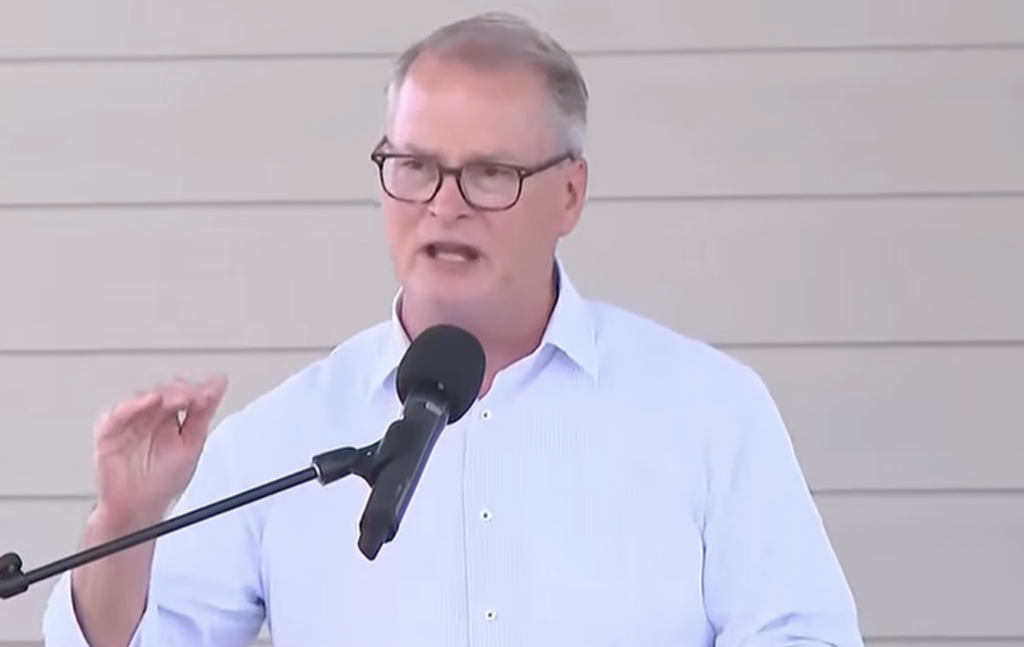
KCUR reported from an event in Rolla, Missouri, that Gov. Kehoe remains undeterred by the election results.
Gov. Kehoe explained to the crowd, “It is what it is. It turned out a lot worse than what we thought. But it doesn’t change the mission. … I always say follow the money. … Those special interests spent a lot of money because they have, quite frankly, great deals in the tax code right now.”
This couldn’t be more ironic coming from Kehoe.
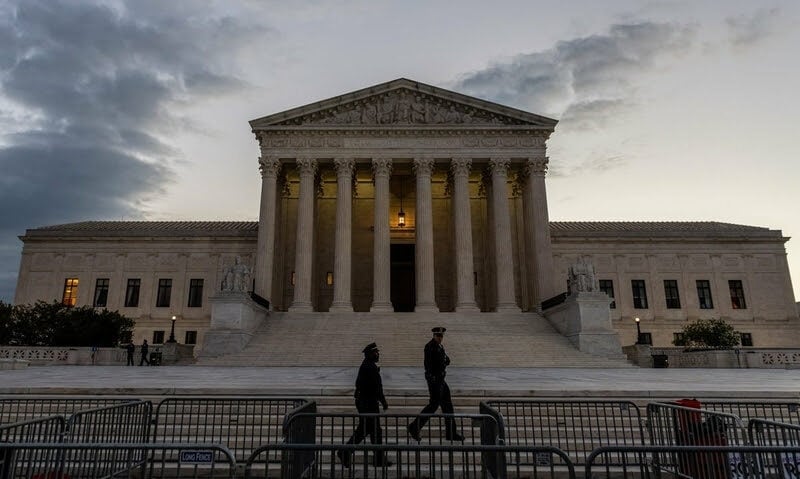
ProPublica reported at the end of June that his campaign to block “out-of-state special interests” through Amendment 4 accepted a large sum of funding from mysterious political action committees and advocacy nonprofits. One of these organizations is Missouri Promise Inc., an entity organized in Delaware that transmitted millions through the Missouri Promise PAC. Donors behind these types of organizations, known by both Republicans and Democrats as “dark money” groups, are kept private due to protections under the First Amendment, as further bolstered by the U.S. Supreme Court’s 2010 decision on anonymous political speech in the legal case of Citizens United v. Federal Election Commission.
The groups backing campaigns for and against both amendments were well funded with support from out-of-state interests across the political spectrum.
To wit: Gov. Kehoe’s marquee efforts to eliminate the state income tax saw over $20 million expended on both sides. A whopping $15.5 million was spent to adopt Amendment 5, all backed by other dark money groups and networks tied to Gov. Kehoe, his state and national allies, and the Republican Party establishment based in Washington, D.C.
Barely $5 million was spent opposing Amendment 5, with the overwhelming result killing the attempt to phase out the state individual income tax.
It is crucial to understand, too, that on particular issues like reducing state income taxes, a popular issue for conservatives and free market advocates, it isn’t necessarily popular or even unpopular with most voting groups. Rather, the impact of such policies could hurt the economy by increasing prices and reducing the cost of individual income tax, thereby benefiting only some high-income residents of a particular jurisdiction.
An analysis produced by the St. Louis-based Missouri Budget Project found that reducing or eliminating a state’s income tax in a bid to expand sales and consumption taxes will have very little positive impact on the statewide economy. And comparing Missouri to states without income tax regimes, like Florida and Texas, is like comparing “apples to oranges.”
“When comparing economic indicators, Missouri is already doing as well as these states,” reads the analysis. Furthermore, the analysis explains, “States without individual income tax rely more heavily than Missouri on regressive taxes, like sales and property taxes. These taxes create an upside-down tax structure, where low- and middle-income residents pay more than the wealthiest as a share of their income in state and local taxes.”
Kehoe and the GOP supermajority in the state legislature sold the Amendment 5 pipedream on very faulty data on overall economic indicators.
Both amendments, by all considerations, are whopping failures to say the least. I reference all of this because it speaks to the rising representation crisis and how out of touch the Republicans appear to be. This is additionally the case as it relates to the upcoming November election, where Jefferson City and conservative interests want to overturn abortion rights and to further eliminate the freedoms of trans adults, youth, their families, and allies by ousting them from public life.
Even with a slim statewide majority in 2024, Missouri voters chose to permanently establish the reproductive freedoms that have withstood court challenges and legislative attacks. Successes on the legal front have even expanded access to such medical care to the lone Planned Parenthood in Springfield, Missouri, such as access to the FDA-approved drugs mifepristone and misoprostol. I digress, nonetheless.
The vast majority of Republican lawmakers voted to place the amendments on the August and November ballots. That means even lawmakers who voted in favor of placing the amendments on the ballot saw Amendments 4 and 5 fail in legislative districts they believed would support them. Both amendments failed in all of Missouri’s counties, as noted, and in all legislative districts.
How is this an accurate representation of their constituents? It isn’t, and that is by design.
To help conclude, let me clarify a few things. I don’t hide my view that our state’s Republican-held government is amoral and incompetent. That amorality might, at times, prove useful, but it typically does not, because actions taken without due consideration of a policy’s intended and unintended consequences can prove harmful. Consider the concept of the “representation model.”
In political science, representation models are used to understand how a legislative body and its members accurately “represent” and carry out the interests and intentions of a particular constituency. There are three primary models of political representation: delegate, trustee, and politico. A “delegate” is someone who is elected to represent and convey the views of the constituents they represent to the legislative body. A “trustee” is elected to act on behalf of others, utilizing knowledge, experience, and intelligence from a particular field.
However, where a delegate and trustee differ is that constituents entrust their representatives to act as they view is appropriate. Then there is a hybrid of these two models, theorized as a “politico,” which I used at the beginning of the column. When Politicos are elected, these representatives answer to multiple constituency groups, including legislative districts and special interests of varying alignments. A series of competing models exists, including a “mandate” model that pairs with politico conduct.
Present-day political parties are the superior bodies that define ideological and policy goals for a class of elected officials running under party banners. Through mandate modeling, an order or instruction flows from a central body requiring representatives to toe the party line outlined in election campaigns. Therefore, supporting policies that seem extreme and potentially unpopular will likely remain the partisan mandate even when the success of such platforms is not secured.
This illustrates the crisis facing one-party rule in Missouri. Republicans under the leadership of figures like Kehoe and Trump fail to understand the unpopularity of their policies. Similar trends are occurring in left-wing politics, especially as a growing number of Democrats shift toward democratic socialism. Missouri voters have repeatedly demonstrated that political preferences cannot be reduced to the partisan talking points of a Republican supermajority.
The Republicans claim to represent the interests of the people, but Jefferson City continues to mistake a one-party government as genuinely ruling the state through democratic consent. Amendments 4 and 5 may prove less of an anomaly than a warning of what comes next for the Missouri GOP at all levels.
I doubt they’ll listen, though.