KC Voices: Fall of The Call is continuation of a sad trend. We have the power to reverse course

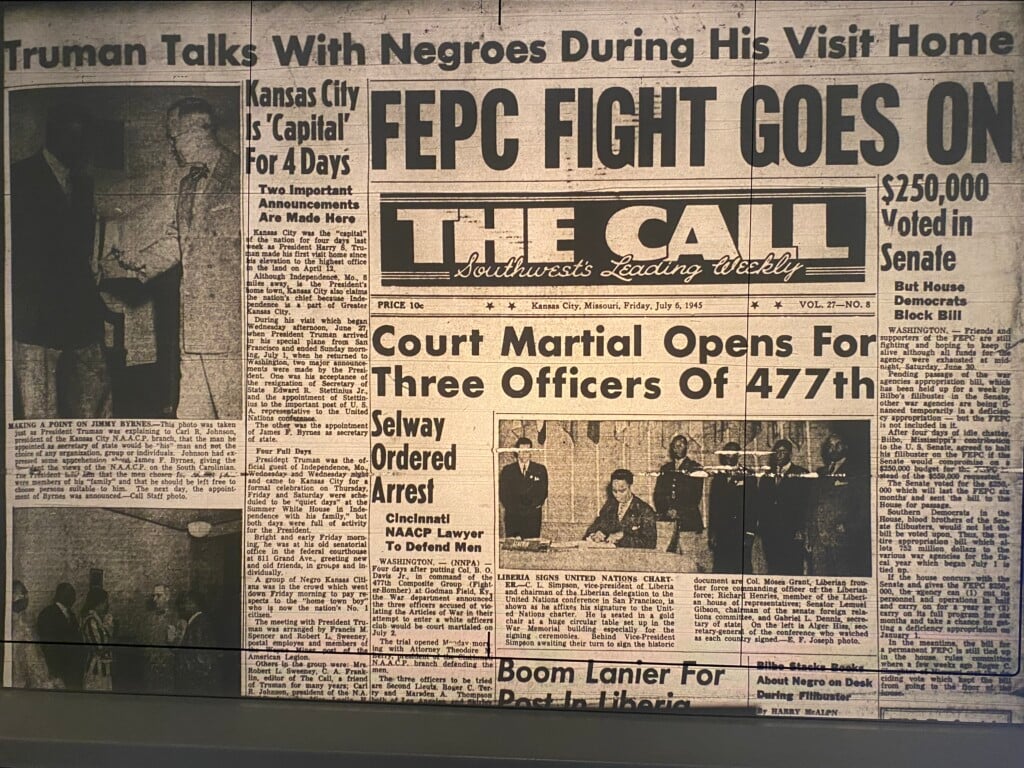
July 1945 issue of The Call. // KC Public Library
In the KC Voices column, we ask members of the KC community to submit stories about their thoughts and experiences in all walks of life. If you’ve got a story you’d like to share with our readers, please send it to brock@thepitchkc.com for consideration. Today, we’re hearing from Ryan Sipes—a Kansas Citian who works on preserving a free and open internet as one of the leaders at Mozilla. He’s proposing a common-sense solution to fund local journalism and keep the long-running THE CALL alive.

Illustration by Jack Raybuck
KC Voices local submissions
You may have seen the news that Kansas City’s historic black-owned weekly newspaper, The Call, didn’t go to press last week for the first time in all of its 107-year history. For many of us, the idea that a paper that has helped shape our history and told the stories of an entire community for generations might just disappear is genuinely heartbreaking. Especially given that The Call told the stories of residents of our city whose voices were historically diminished and silenced, it allowed those perspectives and histories to be shared and recorded for one another, in the moment, and for posterity.
Stories are what connect a community and make it not just a collection of individuals, but a group living and striving together in a common cause. Unfortunately, we live in a time when local storytelling is endangered. Large tech platforms, such as Facebook and Google, have supplanted information channels, like newspapers, that used to blend stories from outside the community with those from within.
We live in the aftermath of the near collapse of local journalism.
The Call is the latest victim in a national trend of newspaper closures since the early 2000s. And the problem isn’t just closures. As The Beacon called out in a 2023 piece about local journalism, even The Star, once one of the most influential newspapers in the nation with over 1000 employees, now employs around 70 people (as far as I can surmise).
This kind of decline raises the question: How many stories are we missing simply because there aren’t dedicated reporters out in the community to capture and share them?
As an example, at its peak, The Star had hundreds of reporters to cover a metro population of 1 million people. Now it’s much smaller and expected to cover the activities of 2.5 million people. How can it possibly keep up? Especially as the smaller papers, like The Call, are experiencing dwindling resources as well.
Don’t mistake my concern for some form of nostalgia. I’ve spent my career working in tech, developing open-source communication platforms like Mozilla’s Thunderbird email client, to connect people to each other. I’m not prone to believe that the way things were in the past was somehow innately better than the way it is today. But when it comes to local journalism, the facts are pretty stark.
Economists Pengjie Gao, Chang Lee, and Dermot Murphy at Notre Dame and the University of Illinois at Chicago published research about what happened to communities across the U.S. after a local newspaper closed. What they looked at was not what was lost in terms of cultural connection—but something economists are great at measuring: the effect it had on communities in terms of cash. They found that when a town lost its newspaper, its government borrowing costs rose in the years that followed. Not only that, but when the reporting stops, the governments quietly get less efficient–higher payrolls, more employees per resident, and more tax dollars spent per person.
Importantly, the researchers found that the Internet does not fill the gap. Borrowing costs rose just as much in high-internet communities as in low-internet ones. This is likely because social media and news aggregators online mostly pass along information–they don’t send someone to sit through a four-hour city council meeting and ask the hard questions.
The Call’s current state is a sad symptom of forces that endanger local news across the nation. But we can do something about it.
We can decide that funding journalism in our city and sharing and recording our stories are important. We can acknowledge our city’s newspapers and other journalistic outlets as the public good that they are. We all need to come to terms with the fact that funding them is the civic equivalent to eating your vegetables in that it’s something we just have to do if we want a healthy community.
There have been attempts to support local journalism across the country, efforts to directly fund newsrooms through philanthropic giving, and states like New York putting aside significant money for this purpose. But none of these have yet to prove themselves a clear model for how this should be done. And even if a blue state does provide grants and subsidies for news outlets, it’s unlikely that states like Missouri or Kansas will replicate this, given that it might earn the moniker of “socialism” for its audacity in using government to intervene where the market has fallen short.
I have a proposal for our city, an audacious one. Let’s provide a voucher for a subscription to a local news outlet for each household in the city. Like a library card, but for access to journalism in our community.
It solves two sides of the equation: it funds newsrooms and guarantees everyone has access to that reporting. Additionally, we would let residents choose which local news source they support, so we wouldn’t be picking winners and losers.
Funding for this “KC News Pass” could come from a mix of philanthropic and government sources. Depending on uptake of the benefit, we are looking at $6.5 million to $20 million, at $100/yr vouchers. The $6.5 million represents 30% use, and the latter $20 million represents 100% use of the vouchers. It’s important to bear in mind the research shows more reporting may save us money in the long run, and that’s not even considering the social benefits. And if we look at the roughly $1.7 billion city budget, a question arises: is there already money in it for this program?
In the case of The Call, how many more in our community would support this historic KC institution if they were provided with the means and encouragement to do so?
News Pass is an idea of how we might solve this problem, but regardless of how, a problem remains that we need to solve. We, both here in Kansas City and more broadly as a nation, must do something to protect our unique voices. Or it’s only a matter of time before a deafening silence falls over us – and then what record will there be of our lives? Who will tell our stories?