Art-rock icon Robyn Hitchcock examines art and our existence ahead of Lawrence show

Robyn Hitchcock. // Photo by Emma Swift
Robyn Hitchcock is one of those quiet legends who’s been influencing fans and fellow artists since indie rock was in its infancy.
That journey started in 1979 with his band The Soft Boys, and continued with a prolific solo career of psychedelic, Byrds and Beatles-tinged albums characterized by surrealistic imagery and a wide-ranging vocabulary. His influence on other artists, like his musical career, is also long and winding, including beloved bands from R.E.M. to The Pixies to The Decemberists.
Hitchcock is the guy responsible for college rock classics like “Heaven,” “My Wife and My Dead Wife” and “So You Think You’re in Love.” He collaborated with the director Jonathan Demme a number of times, on the 1998 concert documentary Storefront Hitchcock and later with small roles in Demme’s The Manchurian Candidate and Rachel Getting Married.
Suffice it to say, Hitchcock’s life is full of fascinating encounters, stories and big ideas. He’ll be sharing some of those in Lawrence on June 26 as part of the Free State Festival.
The evening starts in conversation with Lawrence Public Library director Brad Allen as part of the library’s ongoing 780 series, then continues with a show from Hitchcock and his band.
Ahead of the event, we spoke with Hitchcock about his forthcoming album The Confuser, his experiences on his current tour, and about art and legacy.
Abby Olcese, The Pitch: We’re excited to have you in Lawrence! When was the last time you were here?
Hitchcock: It was the early 1990s. I wasn’t there long enough to have fun, but I do remember a lot of folks came to the show.
You’ve mentioned that you’ve been doing more electric shows this tour than you have in a long time. Can we expect that from your show on the 26th?
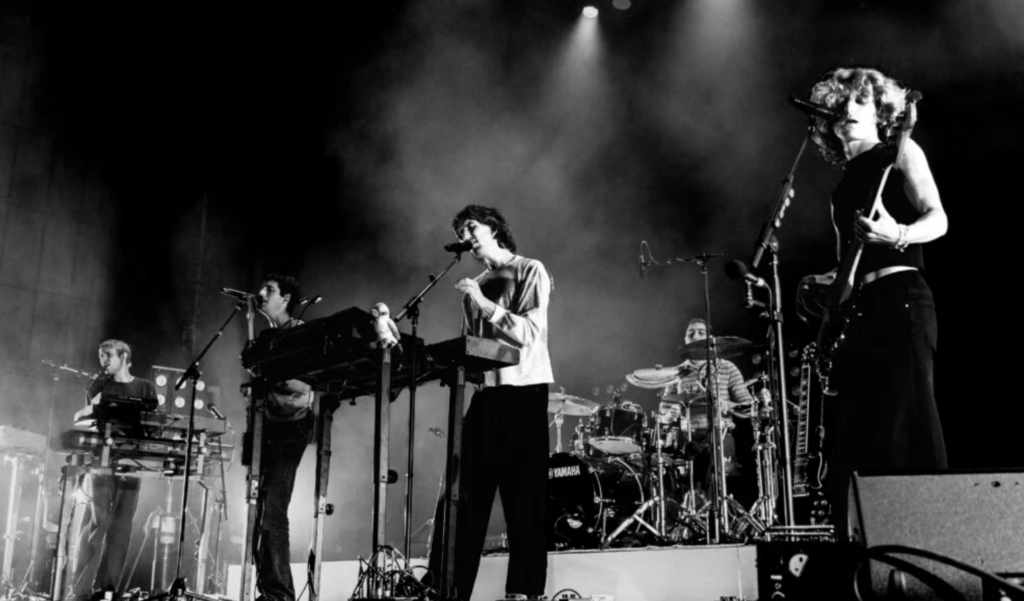
I’ll have the whole band. You can expect a screaming racket, me wailing away with a bunch of young Nashvillians, the same people who played on the record. Everybody seems to love it. I haven’t really toured with a band for decades, but I’ve done little bits of it. This is my most sustained electrical bombardment of anywhere since the early 90s.
It’s terrific partly because I’m thrilled that I can still do it. I’m thrilled that people like it and it’s a fabulous band, a slightly floating collection of individuals. It’s what I did when I first got to the States, way back in the Reagan administration. The world was young and there were ashtrays in every room. People communicated by payphone.
So, on that note, you’re a person who thinks deeply about culture, so you seem like the right person to ask this question to. You’ve said elsewhere that your new album, out in July, is concerned with “collapse” of the world, of America, and of ourselves. Having been a working artist through several eras of political and social difficulty, how do you feel about the argument that difficult times breed good art? Has that been true for you?
I think it’s difficult personal times as well as difficult political times. I’ve probably done my best work when I’ve been up against it, but that’s usually a personal thing, not to do with the political environment. I look at the world through an analytical eye rather than a compassionate one.
But all verbal niceties aside, what’s happening now totally sucks. I think America’s learning things about itself that have always been there. Trump and his people didn’t come out of nowhere. The forces that caused the Civil War didn’t go away when the Civil War ended. America has the best of things and the worst of things…it’s the place of the most ludicrous extremes. That also makes it the most exciting place to be, because you’re always up against it here.
Maybe it’s a positive thing, but maybe because of what Trump’s imposed on America, a lot of people are coming out. They know what they feel, and they show it. There’s a strong resistance that I think in the end will cast him aside. But until you get rid of the causes, you’ll never be free. America has all these mad assumptions that worked 300 years ago, but don’t work now But everything is so ingrained. These are all the things I think about, and I put them into my songs.

The new album is called “The Confuser,” which makes me think of the 2001 Nick Lowe album “The Convincer.” Is that connection intentional? What’s your relationship to his music?
Yeah, that’s deliberate! It’s my wife’s (singer-songwriter Emma Swift) nickname for me, because I find life confusing. He’s (Lowe) the convincer, and I’m the confuser. I naturally skew things and turn things upside down.
I love Nick Lowe. We sang “Lately I’ve Let Things Slide” at the show last night. I’m a big fan. He’s much more careful about his songs than I am. He works on them very hard. He pares them down and gets rid of any extraneous flubber. He does have a lot of fun with words, and we both teeter on the absurd. We’re kindly middle-class British gentlemen of a certain age. We sort of have similar backgrounds in a way. He’s more rose garden than I am, more traditional. I think of myself as his psychedelic little brother.
Okay, one more big question. Your work is often concerned with existence and creativity. On the new album, the song “I Am This Thing” considers death and legacy. So I’m thinking about that, and the fact that we’ve lost so many important artists lately — folks like David Hockney, Prince, David Bowie, David Lynch — people who weren’t just good artists but were singularly creative. I worry sometimes that my generation and others coming up may not be able to fill those holes. What do you think?
Well, everyone goes over the waterfall. Some people pop up at 21 and it seems like they’re a phenomenon already. For others, it takes a while to sink in, I suppose. I don’t know if you have the stature of David Hockney or even Lynch at 25 or 30. It’s the gravitas of people who’ve been around for a long time that resounds. Nick (Lowe) and I are both known in our own fields. I don’t know who’s come up, I imagine people like Stephen Malkmus will be revered, Beck maybe.
In terms of characters, they have to arrive at the right time as well. Morrissey is rather self-sabotaging but he’s one of those characters, even if he’s semi-canceled. There will be a Morrissey-shaped hole when he’s gone, same with Johnny Marr. Unless you’re a dead legend like Nick Drake or Jimi Hendrix, someone who detonates early and leaves a permanent mark on the culture, otherwise to have the status you talk about, you need to be consistent for a 50-year career, like Hockney was, like Nick is, like I hope I am. That’s the most one can aspire to, really.
My wife Emma has been a huge influence in terms of how I do things over the last few years. Manages herself and me and runs our boutique label, and steered me towards this particular band. I’m very grateful to her for giving me another shot at being a rock and roller. It’s very strange to be one, but as I often say, it’s an old folks’ game. I’ll always be 11 years younger than McCartney, and he shows no sign of going away. Nobody’s holding up a skull and going, “Pack it in, Hitchcock.” Until they actually go over the cliff, there’s no incentive for me to think I’m doing the same.