Georgia Davies, bassist of The Last Dinner Party, on literary influences and Arctic Monkeys homage ahead of Midland gig

Photo: Rachell Smith // Courtesy of The Last Dinner Party
Rumors of The Last Dinner Party as an industry plant took off after their first album release in 2024, Prelude to Ecstasy. The band’s curated image, along with their incredible talent, was so succinct that people were in disbelief that it was organic.
But their growth was years in the making.
Founding trio Georgia Davies, Abigail Morris, and Lizzie Mayland met in 2018 during their first year at university in London. Davies and Morris were studying English Literature and Mayland was studying art history. Their combined talents converged into The Last Dinner Party with hard-hitting lyrics analyzing femininity, queerness, and religion. The band began playing together in pubs as far back as 2021 after meeting the final two band members, Emily Roberts and Aurora Nishevci. They released their second album, From The Pyre, last year.
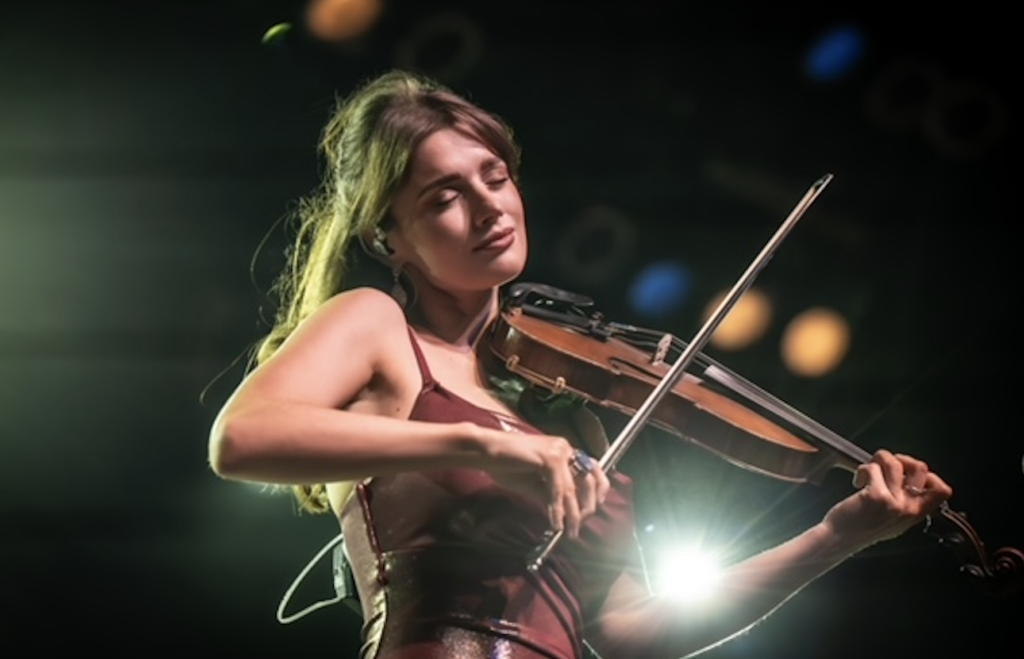
Bassist Georgia Davies cites inspiration to learn the bass after seeing Tia Carrere play Cassandra Wong in Wayne’s World. I spoke with Davies ahead of The Last Dinner Party’s upcoming show in Kansas City, a bookshelf overflowing with books reaching to the ceiling behind her. You can catch her on bass and get tickets to see the phenomenal femme band playing April 1 at The Midland.
The Pitch: What music — songs or artists — are you currently listening to during your tour?
I’m really loving this British artist called Fat Dog. They’ve been around for a few years. It’s just really high energy — electronic meets acoustic drums and they’re just really weird and really good for going out on a run or getting hyped up for a show.
Running — or, I love going swimming. Going outside venues is super important to get more in touch with the real world. It’s good to be in a new city and go for a little wander-around and find out what that city’s about and what the people like to do.
Can you speak to the influence of Virginia Woolf’s writing for the Last Dinner Party as a whole, and also the new album?
It was more pertinent to the first record, because that was when we were studying at university and making up the concept of the band. And everything we were reading — Liz, Abby, and I were reading — a lot of Victorian literature, Edwardian literature. She’s a literary figure who challenged the norms of gender as well as sociopolitical status, of sexuality. I think that the way she challenged those norms as a way of processing her own struggles is really inspiring. Particularly the book Orlando was very inspiring to us, in the way that we conceptualized the aesthetic for the band as a whole. I wouldn’t say she came into the second record as much.
Are there any more English literary influences that continue on in this record?
It’s more of the romantic poets who talked about nature, like Wordsworth and Coleridge and Byron and those guys, but not specifically anything. I think this album is much more to the point and blunt, less shrouded in literary references. It’s more precise.
Outside your musical influences and meeting your current band members, what formative life moment influences your musicianship today?
Moving to London is massive. I grew up in Australia and always wanted to live in the UK and live in London particularly. I saw it as this world where bands and alternative people and music and everything could flourish. When I moved here when I was eighteen, it was so influential and there were so many people — artists and writers and musicians — just doing stuff all the time. Every night of the week there was something cool that I could to with my friends and see. Just being in a spacial location where there’s a lot of creativity is extremely inspiring.
How did it feel to tour your home country Australia?
It was amazing — it was very emotional. Because it’s so far away it’s somewhere that I never thought we would go. It’s very hard for international artists to break through to an Australian audience just because Australians are very particular about bolstering their own homegrown music. It was really amazing to see big groups of people who knew the words to our songs, and be able to play to my grandparents who never get to see us, and the rest of my extended family and my friends from high school. It was very cool.
How do you associate with both the religious and queer themes of The Last Dinner Party’s work?
It’s interesting for me because I identify as queer, definitely, but I also didn’t grow up religious at all. I was completely outside of religion in my family and I think a lot of Australians are nonreligious. So to be in a band with people for whom religion and Catholicism particularly was an extremely influential part of their life is really interesting: to talk to people for whom that is true and to see how my relationship to my queerness differs from someone who was raised Catholic’s relationship with their queerness. I never really gave it a second thought but for people who were raised in the church, their queerness came to them so much more difficult and through so many more challenges. It’s really amazing being in a group of people with different lived experiences and different relationships to queerness and to religion because it means that we are just constantly learning a lot from each other.
What was your favorite bassline to write on the recent album?
On the second record, it’s probably “Count the Ways.” I think it’s the most recognizable. The songs started as a piano ballad and we didn’t really know what to do with it. And we were sort of, like, ‘but what if it sounded like the Arctic Monkeys?’ So I wrote that baseline as a sort of homage. But it’s my favorite. It’s just fun.
I did notice in that one the way that you counter Abigail’s vocals: as she steps up you step down. As the foundational backing instrument of the band, what elements of integration are you considering during a live performance?
I’m ultimately just trying to keep time [laughs]. When we first started playing gigs, I was really really nervous and didn’t know a lot about playing live music and stagecraft and all of these things so all I did was try and keep in time and try to keep up with the drums. Now that I’m a more comfortable musician, I really enjoy engaging with people in the crowd. Especially because I’m not singing for most of the time, I feel like I can find little pockets of people who are either crying or having a great time with their friends and making sure those people feel seen by us and know that we can see them. We know that they’re there feeling moved by the experience and having a good time.
How do you provide that engagement?
I love when you lock eyes with just one person and they’re like, ‘can she see me?’ and I’m like ‘yeah I can actually see you.’ They’ll sometimes tap their friend and be like, ‘she’s looking.’ Or sometimes when people have signs I’ll be like [thumbs up, gestures towards the screen in acknowledgement] ‘yeah, great, I can see that.’
What would you say to a young girl looking up to you as a bass player?
I would say that playing the bass is really cool and it’s definitely for girls. I think a lot of girls try to talk them into playing just piano or even just guitar or something that is more like a feminine instrument. Bass guitar, because it’s such a massive sound and because it supports the whole band, it’s an essential ingredient to making the band sound good. It’s a really powerful thing for a girl, for a woman, to hold that responsibility in her hands, so she should.