Kansas City data centers and AI flip the script on job security
Construction trades are riding the biggest building boom in decades, in part due to data center projects. But the artificial intelligence that the facilities power could upend the job market for everyone else.

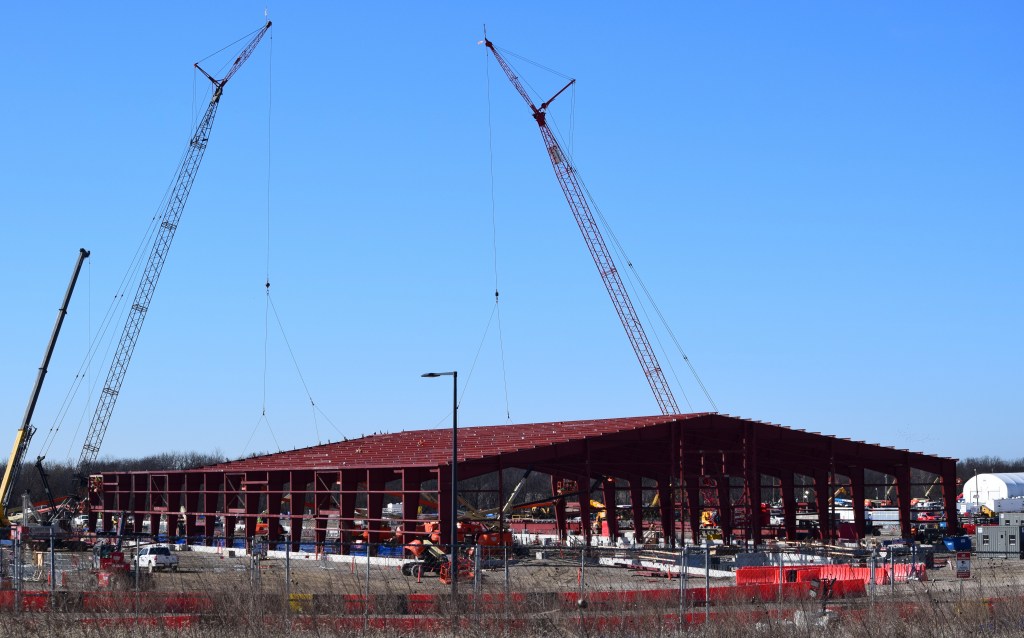
Construction crews work on Google’s data center campus near Worlds of Fun, one of several data center projects proposed or underway in the Kansas City area. (Thomas White/The Beacon)
Andrew Jonas has spent the past three years building data centers in Kansas City’s Northland as a union plumber.
At a recent public hearing he lauded the construction jobs those projects have provided. Even so, he spoke against a 90% tax abatement for a multibillion-dollar project in his hometown of Independence.
“They’re popping up like crazy everywhere,” Jonas said. “Do I love them? No. Not at all. But they’ve got money and they make for damn good jobs.”
Takeaways
- Kansas City’s data center construction boom is a bright spot in an otherwise flat local job market, driving a 9.3% increase in construction employment last year.
- The pipeline of projects matters more to union trades than any single project — current demand is doubling apprenticeship classes and promising the trades long-term stability.
- The AI being powered by data centers poses far more risk to white-collar and graduate-degree holders than to the blue-collar workers building them.
As his testimony suggests, the data center boom is as consequential as it is controversial. Residents have been vocal about potential positives stemming from billions of dollars in investment and concerns about tax breaks and potential impacts on utility bills.
Underlying the public debate about large-scale data centers — and the impact of the AI they support — is the biggest story in the labor market set to unfold over the next decade.
The current construction boom, largely brought on by data centers, is real and measurable.
What comes after the building phase, though, is less certain. After the massive initial investment, there will be a steep drop to a smaller permanent workforce at data center sites.
Moreover, once the cranes leave and the machines are switched on, a new AI-powered or at least AI-assisted job market will rise. It is expected to be a job market where someone with a skilled trade certification has more job security than the average office worker, even if they have an advanced degree.
A bright spot in a cooling jobs market
The data center gold rush is happening as the national labor picture darkens.
For the full year of 2025, the economy nationwide added just 181,000 jobs total — the slowest pace outside of a recession on record, according to Kansas City Federal Reserve President Jeff Schmid.
In February alone the economy lost 92,000 jobs. The federal government has shed 330,000 jobs since October 2024. Health care — which had been carrying the job market — posted a rare decline of 28,000 jobs in February, driven mostly by a large strike.
Locally, the numbers paint a similar picture with one glaring exception. Overall Kansas City area jobs numbers remained flat, losing about 3,600 jobs in 2025.
However, construction saw a 9.3% jobs increase last year locally, the biggest increase of any sector by far.
Data centers are a major reason why. At least 50 data centers are either proposed, under construction or running in the Kansas City area. Collectively they represent tens of billions of dollars in combined investment.
The building boom
Ralph Oropeza has been in the building trades for 35 years. As business manager of the Greater Kansas City Building and Construction Trades Council, he’s watched construction cycles come and go.
This one, he said, doesn’t compare.
“It’s like the ‘90s on steroids,” Oropeza said. “Those jobs were in the millions (of dollars). Now we’re talking about jobs in the billions.”
The investment pipeline backs him up. Here are just a few of the most notable:
- Meta’s $1 billion Northland data center campus drew an average of 1,500 skilled trade workers at its peak and is now operational with room to grow.
- Google’s first KC-area campus, also a billion-dollar project, is still under construction near Worlds of Fun and reportedly draws 1,000 construction workers.
- The Nebius Independence campus, a $6.6 billion “AI factory” with up to $150.6 billion in investment, is expected to employ 1,200 people during construction if it clears a legal challenge and a potential citywide referendum vote.
- Google also has a second data center campus known as “Project Mica” that represents $10 billion in investment and is actively under construction near Smithville.
- And the De Soto City Council approved plans for a $3.1 billion data center near the Panasonic battery plant from California-based Beale Infrastructure.
Several other proposed large-scale data center projects are in various stages of planning, including potentially three in Wyandotte County and the proposed $100 billion Project Kestrel campus near KCI.
Bo Moreno, business manager of International Brotherhood of Electrical Workers Local 124, said he walked into contract negotiations a few years ago with $30 billion in projected regional work over the next decade. Two years later, that number hit $80 billion. Now he says a single project can carry a price tag of $100 billion.
“This is something that we’ve never seen before,” Moreno said. “It’s akin to the industrial revolution.”
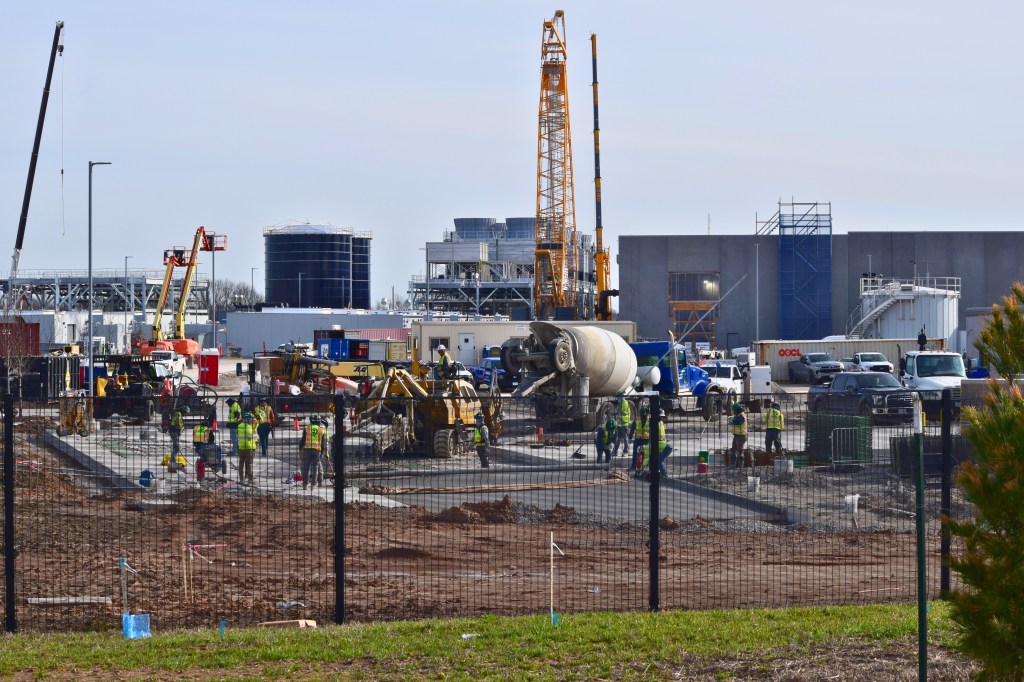
Every day trades workers — electricians, laborers, pipefitters and more — show up to data center construction sites across Kansas City. Many pull overtime on six-day weeks that can push annual pay well north of $100,000.
Damon Miles, secretary-treasurer of Laborers Local 264, said hundreds of his union’s workers have reported daily to the Meta and Google sites doing tasks like pouring concrete, building scaffolding and doing site work.
“Those are jobs with pensions, jobs with health insurance,” said Miles, adding that projects like this are “starting points that give people an opportunity.”
The demand has reshaped the apprenticeship pipeline.
Moreno said IBEW Local 124’s first-year apprentice class has grown from 90 in 2021 to roughly 220 expected in this year’s class to push total apprentice membership to just under 900. Miles said his laborers have also doubled their apprentice head count.
Oropeza said that unions aren’t filling all of the jobs on the data center projects in the area, but that they are getting “the lion’s share of the work.” He says developers reach out to the unions because of their high standards and their ability to staff large-scale projects.
When a contractor lands a data center project they have hundreds of jobs to fill, so that often means putting out a call into the local hiring hall. The hall dispatches journeymen — fully trained, licensed tradespeople who began as apprentices — to the site. If the project is bigger than what the local workforce can staff, the international unions send skilled travelers from other parts of the country.
At peak demand, Moreno said IBEW Local 124 had 1,200 travelers working in Kansas City on top of his full local membership of about 3,700. He emphasized that local members are at full employment and that leadership positions on the data center jobsites they staff are held by local residents.
Data centers face a persistent criticism that these projects only really produce temporary construction jobs before giving way to relatively few permanent jobs.
Every labor leader interviewed by The Beacon had the same answer — all construction is temporary. For them it isn’t that a single project lasts — it’s that the pipeline of projects creates careers and gives the trades stability to bring on more apprentices who become workers who are employable for decades after the data center is humming.
“I’ve been working in the field for 35 years, and I’ve always had a temporary job,” Oropeza said. “It’s the best damn temporary job I’ve ever had.”
What happens when the building stops?
Chris Kuehl has seen this movie before.
Kuehl is an economist and co-founder of Armada Corporate Intelligence, a firm that advises companies and trade associations across the country. He understands why the trades are thrilled about data centers.
But he also sees around the corner.
“It’s like most technologies,” Kuehl said. “The startup phase is always the best part, because that’s when you’re getting all the building and all the investment. But once it’s completed, it settles into another pattern.”
The head-count employment numbers bear that out.
Meta’s Northland facility drew 1,500 workers during construction. Now operational, it supports about 100 permanent jobs. Nebius’ proposed Independence campus would employ roughly 1,200 during building and about 130 once it’s running.
Those permanent jobs aren’t bad jobs either. Data center technician roles at Google in Kansas City have advertised salaries starting at $67,000 a year, and the positions typically require trade certifications or associate degrees rather than four-year degrees. Electrical engineers, server operations managers and controls specialists earn even more.
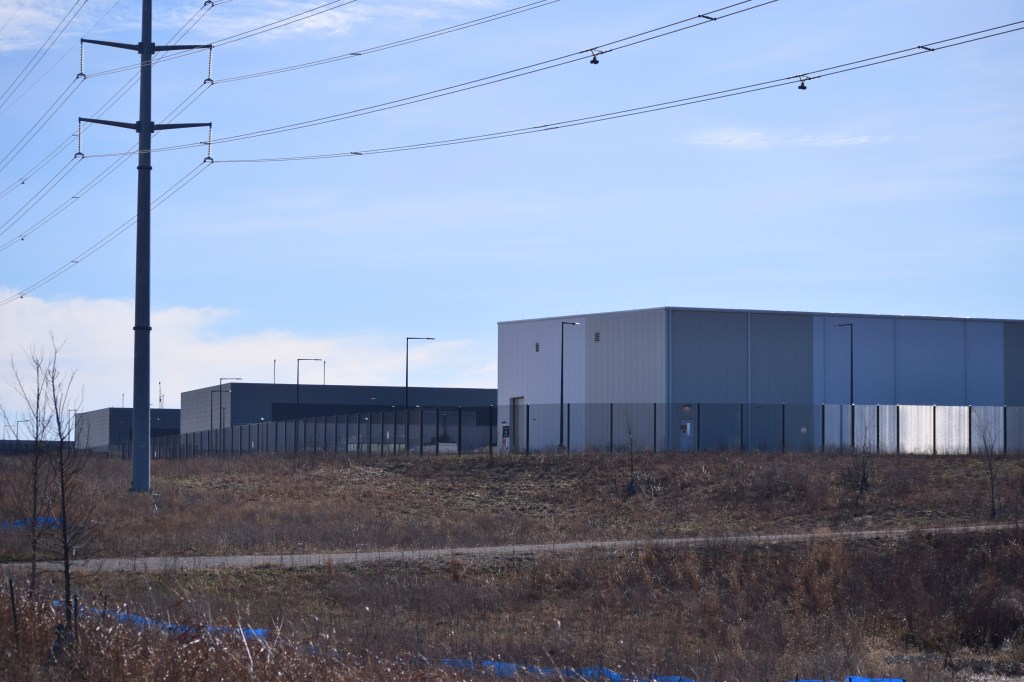
But the permanent workforce around data centers is roughly one-tenth of the construction crew.
Data centers do require ongoing servicing. Moreno noted that by the time builders finish a third structure on a data center campus, electricians are often back in the first one replacing parts that have already gone obsolete. Cooling systems and HVAC need constant upgrades. Oropeza pointed to the service arms of union shops whose entire business is maintaining the systems the construction crews installed.
“They’re kind of the gift that keeps giving when it comes to jobs,” Moreno said.
Still, Kuehl cautioned against expecting data centers to generate the same economic gravity that other large investments produce.
When Volkswagen built a plant in Chattanooga, Tennessee, several German suppliers moved in nearby within a year.
Data centers are unlikely to produce the same clustering of associated businesses. After all, their product moves through fiber lines, not freight.
“You don’t have to be next to a data center to use that data center,” Kuehl said. “You can be anywhere.”
What could follow, he said, is growth in the electrical contracting, utility and energy sectors. Every data center revolves around water and power — generating it, transmitting it, managing it. The push for new energy sources to feed these facilities, whether solar, nuclear or something else, creates its own chain of specialized work. But it’s a narrower pipeline than the construction boom.
‘The revenge of the trades’
If the building phase is the high point, the long-term labor story is more complicated. The central irony in the data center boom is that the trade workers building these facilities may be among the most secure workers in the AI era.
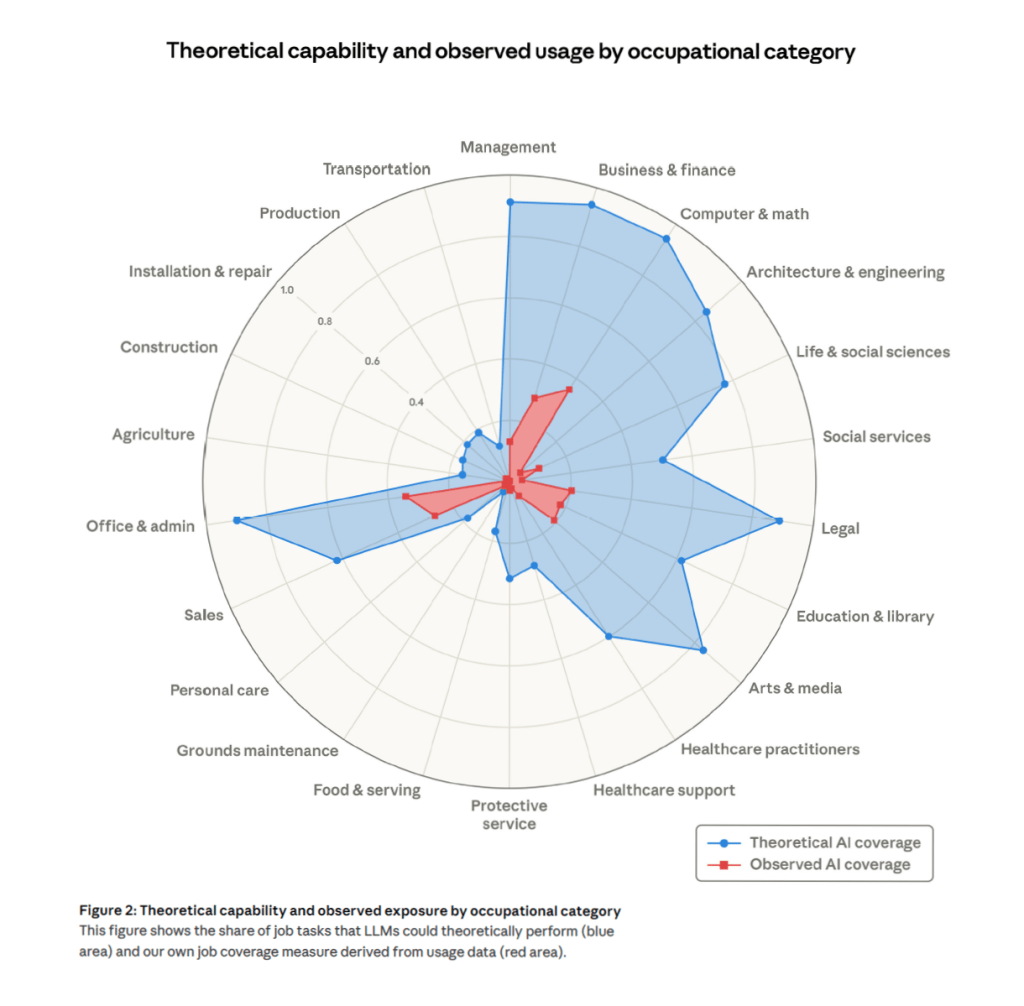
The technology inside those data centers is already reshaping the broader workforce. Anthropic — the maker of the AI chatbot Claude — recently published a report measuring AI’s real-world impact on jobs across roughly 800 occupations. The analysis tracked which professional tasks are being automated or augmented in practice weighed against what AI has the power to do.
The gap between what AI is theoretically capable of and how it’s currently used is wide. AI could theoretically speed up 94% of the tasks in occupations focused on computers and math, but it’s only being used for 33% of those tasks. Office and administrative work has a theoretical AI exposure to 90% of job tasks, but the actual usage is far lower, for now.
Researchers found that the workers most at risk earn 47% more on average than the least exposed. People with graduate degrees are nearly four times as common in the most AI-exposed occupations compared to occupations with the least AI exposure.
The study also predictably found that physical work is outside of the scope of AI, meaning that blue-collar jobs have little to no AI-exposure risk. Meanwhile, workers in the most exposed professions are more likely to be older, female, more educated and higher-paid.
Kuehl said AI is already displacing jobs in data-centric fields like accounting, banking, credit management and engineering.
Locally, the Kansas City area’s roughly 180,000 professional and business services workers sit squarely in the crosshairs. They shed 6,700 jobs over 2025, in a 3.6% decline.
Companies are in what KC Fed’s Schmid described as a “low-hire, low-fire” position — not cutting staff but not bringing new people on, waiting to see what AI can handle.
For young graduates, that wait-and-see is devastating. Kuehl said this has been the worst year for college hiring in two decades.
The result is something like a role reversal. For decades, blue-collar work in fields like manufacturing was automated while white-collar work grew. Now the trades are surging while AI chews into knowledge work.
“It’s kind of the revenge of the trades,” Kuehl said. “Once upon a time, you looked at the kids that went into trade school as, ‘Oh, those are the losers that can’t cut it in college.’ Now you’ve got a bunch of college grads borrowing money from the people who went to trade schools.”
The unions are seeing it firsthand. Oropeza said some applicants are showing up with four-year degrees, looking for a career change because their previous jobs aren’t paying what they need. He saw the shift coming early. When he became business manager, he told the building trades they needed to change how they are perceived and be more inclusive.
“As AI takes over, there’s going to be a workforce available for us to recruit,” he said, noting that he wants to change how people view their industry by being more accommodating to women, minorities and others.
Moreno confirmed the shift. He said the quantity and quality of IBEW applicants have gone through the roof. People with master’s degrees are taking their aptitude tests and interviewing for apprenticeships. He went to college himself before becoming an electrician and says he’s never looked back.
“It really is the American Dream people want,” Moreno said. “That path to the middle class.”
‘Creative destruction’
At least for now, the data center boom is a net positive for Kansas City’s construction workforce. The money is real. The careers are real.
The harder truth is that these billions are also building the infrastructure for a technology whose impact on the labor market has barely started.
What happens next depends on how quickly AI implementation and utilization ramp up. If it happens fast it could be a reaping of white-collar jobs. If AI implementation comes slow enough for workers and employers to adapt, then job duties could shift and the day-to-day nature of knowledge work would look different but would face minimal friction.
The range of outcomes for office workers is wide. On one end, AI could ultimately take the form of an efficiency tool akin to email. On the other extreme it could look like a jobless dystopia where leaders are forced to figure out how to make the economy work with only a fraction of the population employed.
Kuehl views the situation closer to the boom around the internet. There’s initial excitement around the capabilities, but its practical use isn’t to its full potential. He believes that data centers and AI will have some winners and some losers but not a disastrous effect.
Some early winners include the companies peddling AI.
Nebius, the company behind the “AI factory” in Independence, announced on March 16 that it has struck a $27 billion deal to host some of Meta’s AI cloud capacity and training. The same day, Reuters reported that Meta plans to lay off 20% or more of its workforce. Both company’s stock prices rose alongside the news.
“It’s always been one of the hallmarks of capitalism: creative destruction,” Kuehl said. “If one industry is destroyed, another one comes to replace it.”
This article first appeared on Beacon: Kansas City and is republished here under a Creative Commons Attribution-NoDerivatives 4.0 International License.