Kansas election committee uncloaks main goal: Shoving more hardcore Republicans into office

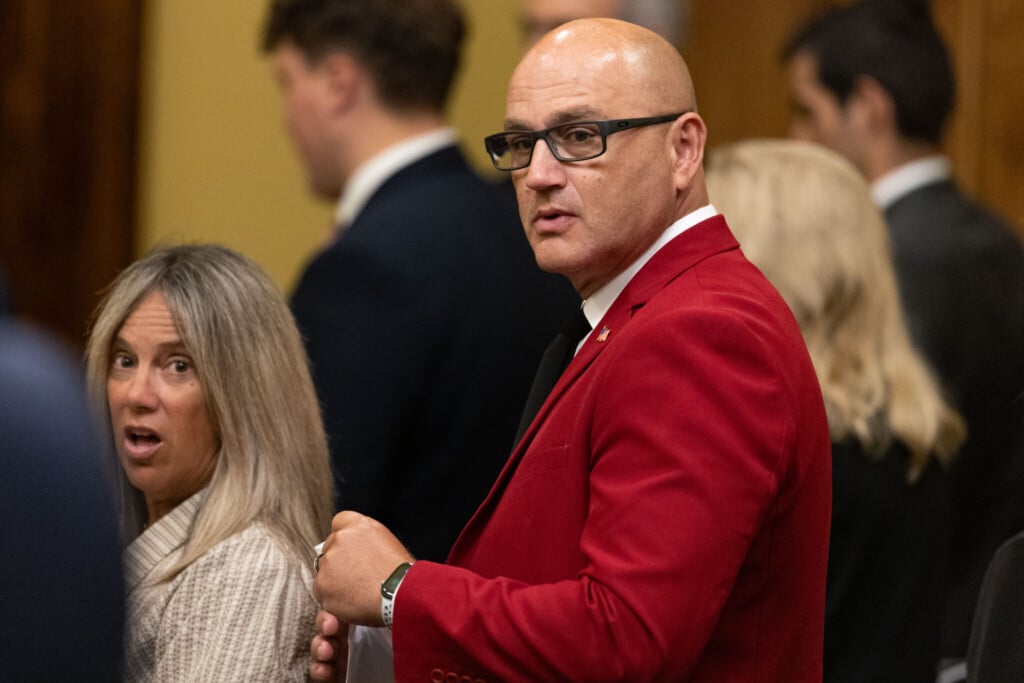
Rep. Pat Proctor speaks with colleagues on Jan. 12, 2026, at the Kansas Statehouse in Topeka. (Photo by Sherman Smith/Kansas Reflector)
When it comes to the Kansas Legislature, sometimes you have to use a wide-angle lens to catch what’s actually going on.
Hearings in the House Elections Committee this week began clearing the way for bills meant for one purpose: expanding Republican power. Committee chairman Pat Proctor, R-Leavenworth, may claim he wants to expand voter participation, but his record of tightening voter requirements makes one raise an eyebrow.
No, the combined effect of these bills would be to cement rightwing Republican control — not just of Kansas state government, but of city and county government as well.
How might that work? Let’s examine two bills of the many floating around committee.
House Bill 2452 would move local elections to even-numbered years. This means that elections for school board and city council would take place at the same time as elections for president, governor, and state senators and representatives.
What would be the effect of such a move? Well, Secretary of State Scott Schwab’s office had some choice words for the proposal. (He’s running as a Republican candidate for governor, in case you didn’t know.) His deputy Clay Barker laid it all out during a hearing held Tuesday.
“The bill would impose significant administrative challenges on county election officers in several respects,” Barker wrote in his submitted testimony. “The more complex the election administration, the greater the risk of administrative errors.”
He went further: “Voter fatigue could become an issue. Voter fatigue occurs when ballots have many offices, races, or ballot measures. Voters become overwhelmed and disengaged, leading to lower participation and less informed choices. Research has shown that noticeable voter fatigue begins after 5–7 voter decisions; severe drop-off occurs with 10–15 voter decisions.”
That suggests that a long ballot could lead to voters either neglecting downballot races or voting based on party alone.
Let’s pause for a moment to marvel. That testimony doesn’t come from a Democrat or liberal. It comes from a conservative Republican’s office.
That appeared to agitate Proctor, who asked Barker: “Secretary of State’s Office has no position on the value of increasing voter turnout for an election?”
Again, let’s pause to marvel. This is the Proctor, whose signature accomplishment was eliminating a three-day grace period for the state to receive mail ballots. That law cleared the way for officials to invalidate legal votes because of mail problems. He has also told audiences that in his perfect world there would be no early voting and that women stole the 2022 abortion referendum by voting.
As late-night infomercial salesmen say, that’s not all, folks!
Another piece of legislation Proctor has introduced this session, House Bill 2494, would allow candidates in nonpartisan races to list their party affiliation on ballots. In heavily Republican Kansas, that hands a massive advantage to Republican candidates. Previously, they might have to campaign and tell voters what they actually believed. If the bill becomes law, they can just wink and nod.
Local boards and commissions have implemented nonpartisan elections because solid candidates transcend ideology politics. A school board member or city commissioner looks after the school district or city. National or state politics don’t enter into it. Or at least they shouldn’t.
Nonpartisan elections encourage voters to focus on the individuals involved and not the letter or word next to their names.
HB 2494 would change all that.
Now, lets put two and two together. How would that bill interact with the even-year election one? What does Proctor mean to accomplish in Kansas?
Every even-numbered year, Kansans will go to the polls and receive lengthy, complicated ballots. As they move down the ballot from the highest-ranking races, they will be confronted by unfamiliar offices and unfamiliar names. If they haven’t researched or been involved in their communities, those listed could just as well be imaginary.
But wait! There’s a helpful notation of Republican after several of those strange names. The voter breathes a sigh of relief, fills in the ovals next to those names and goes along his or her merry way.
The upshot is a an even more partisan government at all levels.
Either of these proposals, on their own and not promoted by Proctor, possess defensible qualities. We should make it easier for more people to participate in elections. That makes sense. Likewise, I’m not sure that forcing people to hide their party affiliation in local races makes as much of a difference as advocates might think. From my experience in municipal politics, many people involved in these races know candidates’ ideology.
The situation gives pause because of the way the bills interact and the fact that Proctor — known for misleading rhetoric — wants them. He’s running for secretary of state, and it certainly appears as though he wants to burnish his resume in advance of primary and general elections.
I reached out to Proctor for comment, asking if he was trying to elect more Republicans and promote his campaign through his committee chairmanship.
He responded: “You are a partisan hack and the Kansas Reflector is a left-wing propaganda rag.”
Proctor also posted a tweet Thursday about chairing the elections committee, declaring that “I am focused on restoring confidence in our elections by increasing transparency. And sometimes, transparency means simply listening to people’s concerns and engaging in a conversation.”
You might read that as meaning he just wants to chat about these bills and see what others think. Count me skeptical. Given his tart dismissal of my questions, Proctor sounds like a man who has made up his mind.
It’s worth seeing these proposals in the context of broader Kansas and national politics.
In August, voters will decide whether to allow state Supreme Court justices to be selected via a popular vote. This would clear the way for the court approve a statewide abortion ban and draconian cuts to school funding. Likewise, Senate and House leaders tried mightily to redistrict U.S. House seats, ousting Democratic Rep. Sharice Davids.
The trend lines can glimpsed from close up or far away. Kansas leaders want people to vote, but only if they can be sure that they’ll vote for Republicans.
In a state that hasn’t always done that, it sure looks like GOP leaders are putting their fingers on the scale.
Clay Wirestone is Kansas Reflector opinion editor. Through its opinion section, Kansas Reflector works to amplify the voices of people who are affected by public policies or excluded from public debate. Find information, including how to submit your own commentary, here.
Kansas Reflector is part of States Newsroom, a nonprofit news network supported by grants and a coalition of donors as a 501c(3) public charity. Kansas Reflector maintains editorial independence. Contact Editor Sherman Smith for questions: info@kansasreflector.com.